Sonoma County is feeling the direct effects of Climate change causing fires and water shortages. Felicia Smith of Healdsburg City talks through the solutions

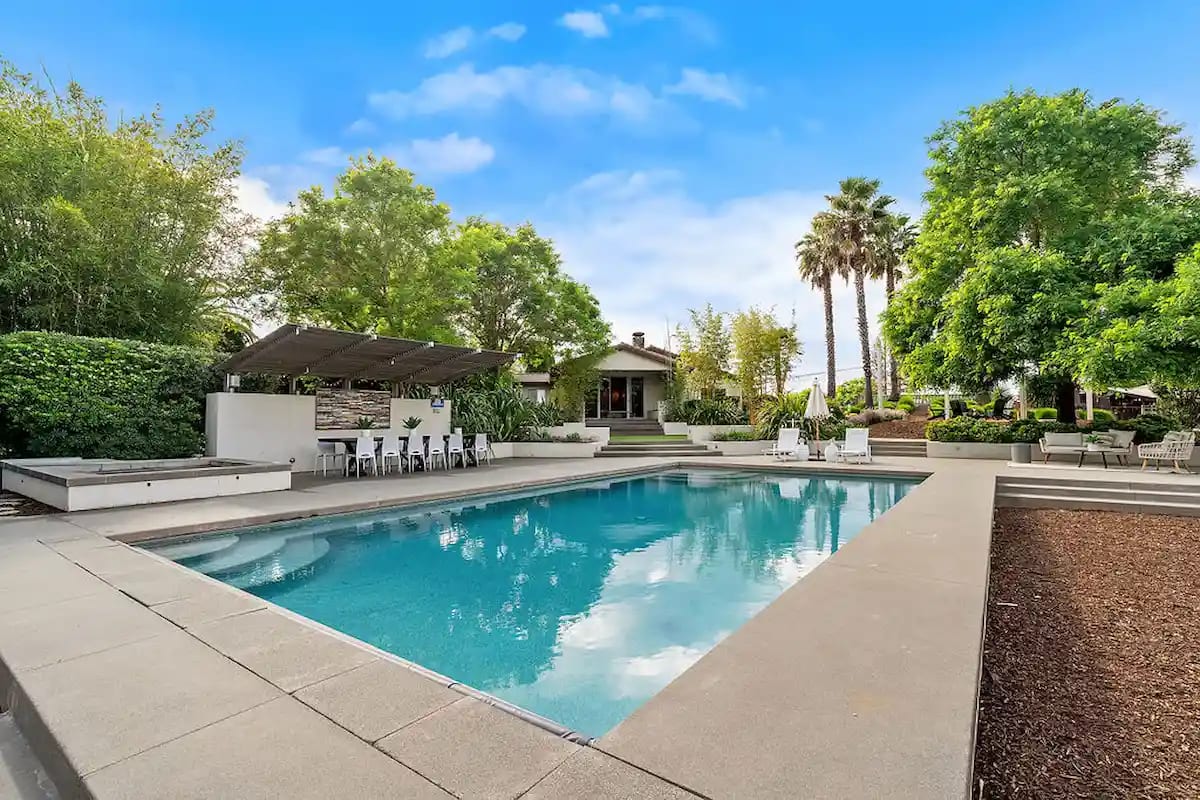
If you bought a Sonoma County vacation rental for $1.25 million and spent another $175,000 on a pool and outdoor upgrade, a cost segregation study could put roughly $300,000 to $450,000 of that into year-one tax write-offs. At a 37% federal bracket, that is somewhere between $95,000 and $135,000 of immediate tax savings on a single property, and the One Big Beautiful Bill Act made the math even better for any property placed in service on or after January 19, 2025.
This is the strategy that more of our Bay Area buyers are quietly running on Sonoma County wine country properties than at any point in the last decade. It is in the tax code, it is legal, and the timing in 2026 is unusually good. We asked Geraldine Serrano of Specialty Tax Group, a cost segregation firm we work with regularly, to walk through the technical pieces. The local angle, the property selection, and the catch at the end are ours.
Quick disclaimer before we get into it. We are real estate brokers, not CPAs. Nothing here is tax advice. Every situation is different, and you should run any of this past a real-estate-savvy CPA before you act on it. That is why we have partnered with Geraldine Serrano of Specialty Tax Group to help numerous clients take advantage of these benefits and advise them on how to optimize their investment strategies, as outlined below.
When you buy a residential rental property, the IRS lets you depreciate the building over 27.5 years. That is the default schedule. Slow, even, boring: a small deduction every year.
A cost segregation study takes that same property and breaks it into its component parts. The cabinetry. The flooring. The light fixtures. The appliances. The driveway, the landscaping, the pool equipment, the window treatments. Each component gets reclassified into a shorter depreciation life: 5, 7, or 15 years instead of 27.5.
Here is Geraldine on why that matters in 2026:
"Under the One Big Beautiful Bill Act, 100% bonus depreciation is back for any qualifying property placed in service on or after January 19, 2025. That means anything reclassified into a 5, 7, or 15-year bucket can be written off entirely in year one. Not spread out, not phased down, all of it. For owners who qualify under the short-term rental rules, this is the most powerful first-year deduction available in the tax code right now."
For most Sonoma County vacation rentals we sell, an engineering-based cost segregation study moves 20% to 40% of the basis into those accelerated buckets.
Three reasons this strategy lands harder here than in most markets.
First, the price points work. Cost segregation studies have a fixed cost, typically $4,000 to $10,000, so they only pay off above a certain basis. Most of the eligible vacation rental properties we sell in Healdsburg, Glen Ellen, Forestville, and along the Russian River fall in the $800,000 to $2 million range, which is squarely in the zone where cost seg returns multiples on its fee.
Second, wine country buyers tend to renovate. A $175,000 pool and outdoor upgrade is not unusual on a Healdsburg property. New decking, outdoor kitchens, fire features, landscape lighting, pergolas: all of it has shorter depreciation lives than the structure and is exactly what cost seg studies are built to capture.
Third, the average short-term rental in Sonoma County generates around $66,000 in gross annual revenue, with top performers in Healdsburg and along the Russian River clearing six figures. The cash flow story stands on its own before you even layer in the tax benefits.
Here is what the math looks like on a 3 bed / 2.5 bath Healdsburg property purchased for $1.25 million, with $175,000 spent on a pool and outdoor upgrade.
Geraldine's team estimates a study like this would identify roughly $300,000 to $450,000 in components eligible for 100% bonus depreciation in year one. At a 37% federal bracket (which is where most of the Bay Area W-2 earners running this strategy actually sit), that is $95,000 to $135,000 in immediate federal tax savings. California state savings sit on top of that.
Two pieces have to be in place for the strategy to actually offset W-2 income, not just passive rental income. Geraldine on the rule that makes this work:
"Short-term rental owners get a major tax advantage that traditional landlords don't. If the average guest stay is seven days or less, and you can show material participation, usually the 100-hour test, the IRS does not classify the property as a passive rental activity. It is classified as a non-passive trade or business, which means the losses can offset W-2 and other ordinary income, not just other rental income."
The 100-hour test is the most common one Sonoma County owner-operators use. You spend more than 100 hours a year on the property, and nobody else (not your cleaner, not your handyman, not your property manager) spends more time than you do. If you are running your own bookings, doing your own dynamic pricing, coordinating cleaners, and handling guest communication, you are almost certainly already there.
A rough rule of thumb from the studies we have seen run on local properties.
Under $500,000 basis, the study fee usually eats most of the benefit. Skip it.
Between $500,000 and $750,000, it depends on the property type and how much was spent on improvements. A property with significant outdoor work, a pool, and high-end finishes is more likely to pencil. A plain ranch is less likely to.
Above $750,000, cost segregation almost always pays for itself many times over. Above $1 million, in Geraldine's words, "you are leaving real money on the table by not running one."
The other thing to look for is an engineering-based study, not a software-only product. The IRS pays close attention to how components are classified, and an engineering report from a credentialed firm holds up under audit in a way that a $500 online tool does not.
The cost segregation strategy only works if the property is a legal short-term rental. Sonoma County's rules differ depending on whether the property sits inside city limits or in the unincorporated county, and the cities each run their own permitting regimes. Some capped, some restricted by zone, some effectively closed in certain neighborhoods.
The unincorporated parts of the county are where most of the real opportunities live for STR investors, and the short-term rental rules in Sonoma County determine which addresses qualify for a permit at all. Buying the wrong property is the single most expensive mistake in this strategy. None of the tax math works if the address cannot legally operate as a vacation rental.
The other catch that is probably talked about even less is some of the nuances of how the property is purchased in the first place. It really does matter what type of loan you take out to finance the property. If you take out the wrong loan then the whole plan can come crashing down. A local lender in Sonoma County, CJ Kerls, has a great blog talking about the details of choosing the right loan product
If you want to see what is currently for sale that already qualifies, we keep a running list of eligible vacation rental properties updated daily. And the full breakdown of the regulatory side is in our vacation rental permit and license guide.
Sonoma County vacation rentals plus a cost segregation study plus the short-term rental material participation rule equals one of the most powerful first-year tax strategies available to Bay Area W-2 earners in 2026. The numbers only work if the property is legally permitted as a vacation rental, the basis is large enough to justify the study fee, and you can show material participation. When all three line up, six-figure year-one deductions are the norm, not the exception.
Geraldine Serrano leads cost segregation studies at Specialty Tax Group, an engineering-based cost segregation firm working with real estate investors nationwide. Her team has run studies on hundreds of short-term rental properties, including a number of the Sonoma County listings we have closed for clients. If you want an introduction, send us a note and we will make it.
If you are sitting on a six-figure tax bill and wondering whether a Sonoma County vacation rental could change the math next April, send us a note. We are having this conversation about ten times a week right now, and we would rather have it with you than with someone who is about to write the wrong tax check.
What you need to know about Sonoma County Vacation Rentals
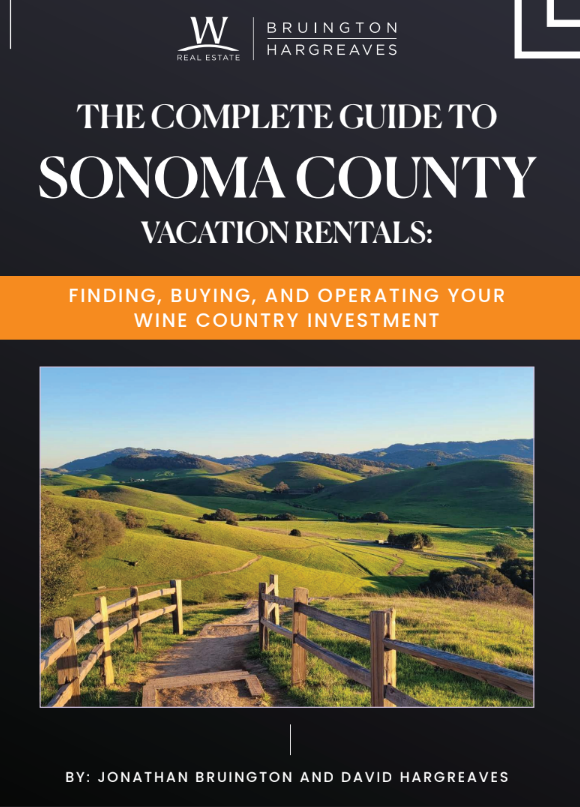
Picture yourself sitting on a sun-drenched deck overlooking rolling vineyards, a glass of local wine in hand, knowing that not only are you enjoying your own piece of wine country paradise, but your investment is working for you even when you're not there. This isn't just a dream – it's a reality for savvy investors who have discovered the unique opportunity that Sonoma County vacation rentals present.
The allure of Sonoma County is undeniable. From the world-class wineries of Healdsburg to the towering redwoods along the Russian River, from the historic charm of Sonoma Plaza to the artistic enclave of Sebastopol, this region captures the hearts of visitors from around the world. It's this magnetic appeal that makes Sonoma County not just a beautiful place to own property, but a compelling investment opportunity.
Once you sign up we will arrange to chat or you can schedule a call direct.
We provide the service for free but you will need to be onboarded as a client and sign our terms of working.
If you don’t buy a home,you don’t pay.. If you a buy a home we will get paid to represent you.
There are so many pitfalls to buying an eligible property that many people have fallen into. You can avoid these mistakes and buying a lemon by working with the leading vacation rental realtors in Sonoma county.
Sign in with your email address
Enter your email address