
The Big Picture: More Choices, More Time, More Leverage
Let's start with what changed over the past year. Inventory surged 31.5%, meaning buyers now have 1,285 homes to choose from compared to 977 a year ago. You'd think this flood of new options would tank prices, but here's where it gets interesting: overall sales actually increased 4.1%, and the median price dipped just 1.9% to $785,000.
What does this tell us? Well-priced homes are still selling. The difference is that buyers now have the upper hand they haven't enjoyed in years. Homes are taking 62 days to sell (up from 50 days), and sellers are accepting offers averaging 94.3% of their original asking price—down from 96.7% last year. Translation: the market is rewarding patience and punishing overpricing.
The months of inventory metric—which tells us how long it would take to sell all available homes at the current sales pace—jumped from 2.5 to 3.2 months. While this represents a significant 26.3% increase in buyer leverage, we're still in what's technically considered a balanced market (anything under 6 months typically favors sellers). The absorption rate, which measures what percentage of available inventory sells each month, fell from 39.6% to 31.3%. A year ago, nearly 40% of available homes were selling every month; now it's less than a third. This shift means buyers can take their time, be selective, and negotiate from a position of strength.
The Tale of Two Markets: Under vs. Over $2 Million
Here's where your investment strategy needs to get specific, because what's happening below $2 million looks nothing like what's happening above it.
The Sub-$2M Market: Resilience and Opportunity
Despite inventory climbing 30.8% in this segment, median prices actually increased 1.9% to $764,000. Let that sink in for a moment. More supply typically means lower prices, but not here. Why? Because this segment is driven by people who need places to live—primary residence buyers, move-up buyers, and investors seeking rental income. These aren't discretionary purchases; they're driven by life needs and solid fundamentals.
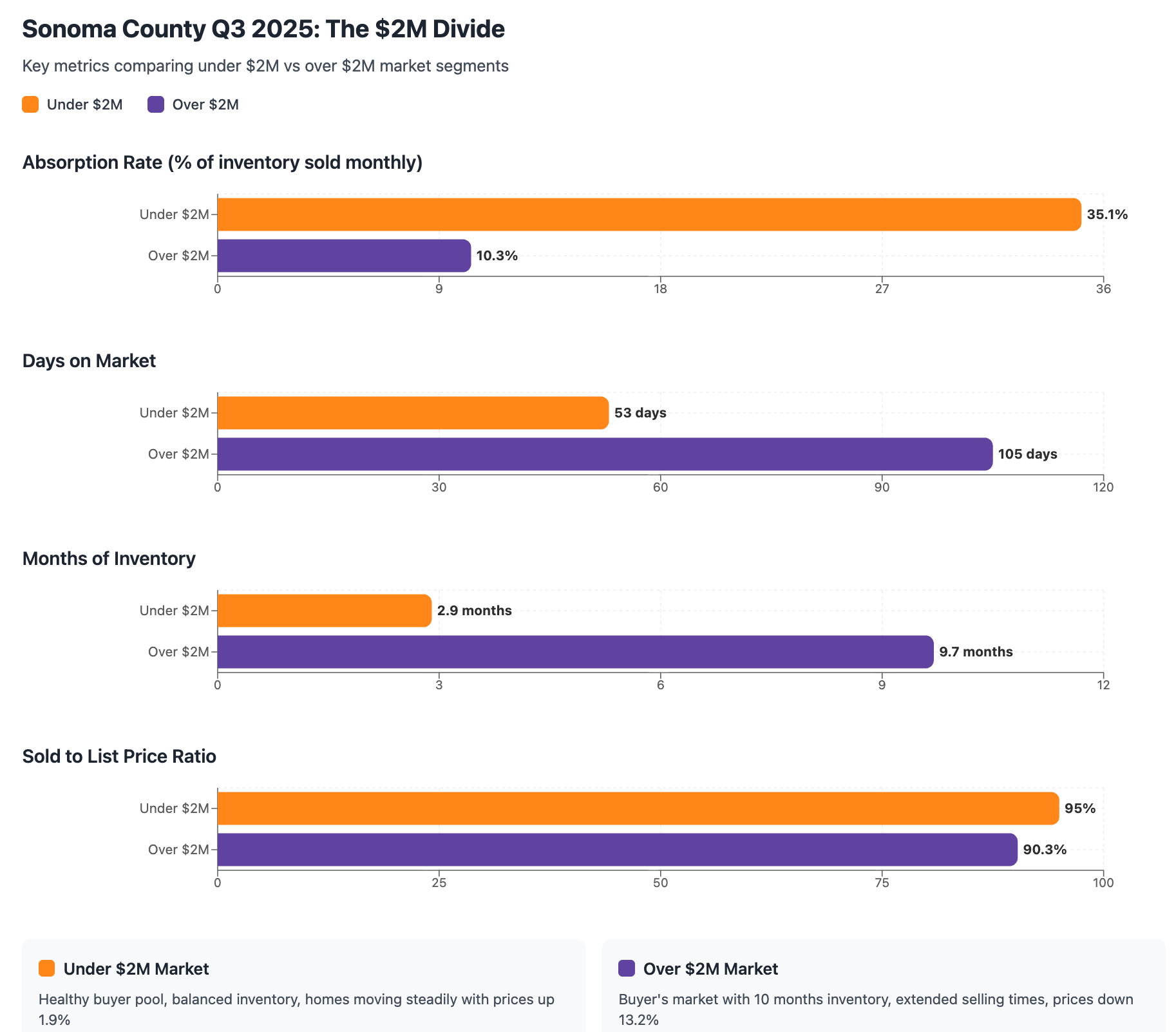
Yes, homes are taking longer to sell (53 days versus 44 days), and yes, the market is absorbing inventory more slowly (35.1% monthly versus 44.9%). But one-third of available homes are still selling each month, and sellers are getting 95% of their asking price. With 2.9 months of inventory, this segment remains relatively healthy—still closer to a seller's market than a buyer's market by historical standards.
What's particularly noteworthy is that new listings actually declined 6.5% in this segment, from 1,185 to 1,108. This tells us that potential sellers with properties under $2M are being cautious, perhaps waiting for better conditions or simply choosing to stay put. This supply constraint is exactly why prices are holding—and even rising slightly—despite the overall inventory increase. The homes that are available? They're the ones sellers genuinely need or want to sell, and buyers who've been waiting are stepping up to purchase them.
For buyers seeking that wine country lifestyle while building equity, this segment offers the best of both worlds: negotiating power without the fear of falling prices. You're not fighting through bidding wars like we saw in 2021-2022, but you're also not seeing the price declines that might make you worry about losing equity.
The Luxury Market: A Buyer's Paradise
If you've been dreaming of that estate property but hesitated at the price tags, pay attention. The over-$2M market is experiencing a profound shift that represents the strongest buyer opportunity in years.
Inventory exploded 67.3% to nearly 10 months of supply—that's 257 homes available compared to 188 a year ago. Sales dropped 18.3%, meaning only 79 luxury homes sold in Q3 2025 versus 97 in Q3 2024. Median prices fell 13.2% to $2.55 million. And here's the kicker: luxury homes are taking 105 days to sell, and sellers are accepting just 90.3% of their original asking price—meaning a $3 million listing is selling for around $2.7 million.
Only one in ten luxury homes is selling each month (10.3% absorption rate), down from nearly one in five a year ago (17.2%). This isn't a correction; it's a fundamental recalibration of the high-end market.
Unlike the sub-$2M segment where new listings declined, the luxury market saw new listings increase 18.5% from 146 to 173. This suggests that luxury sellers are either motivated by life changes that require them to sell, or they're taking advantage of gains accumulated over the past several years to cash out while they still can. Either way, this influx of new luxury inventory combined with declining sales creates the nearly 10-month supply that's giving buyers unprecedented leverage.
The 41.9% increase in days on market—from 74 to 105 days—tells another important story. Luxury properties aren't just sitting longer; they're requiring significant price adjustments to attract buyers. When you combine the 105-day marketing period with the fact that homes are selling for 90.3% of original asking price, you're looking at a market where pricing strategy can make or break a sale.
What's Driving This Divide?
The divergence comes down to buyer motivation. The sub-$2M market serves people making lifestyle decisions backed by economic necessity—downsizing to free up capital, relocating for family, securing a second home they can also rent out. These buyers have been waiting on the sidelines, building equity in their current homes, saving for Sonoma County's lifestyle appeal.
The luxury market, however, caters to purely discretionary purchases. When economic uncertainty rises, when interest rates fluctuate, when stock portfolios feel shaky, these are the first purchases that get postponed. And right now, luxury buyers can afford to be extraordinarily selective.
There's also a demographic component at play. Many Bay Area professionals who've been eyeing Sonoma County for years are now in their peak earning years with substantial equity from Bay Area home appreciation. They're ready to make the move, but they're looking in the $1-2M range where they can secure a beautiful property without overextending. The luxury buyer—often second-home purchasers or retirees with very specific requirements—is a smaller, more selective pool.
The Market Tempo: Why Speed Matters
One of the most revealing aspects of Q3 2025 is what the changing pace tells us about market psychology. A year ago, with homes selling in 50 days overall (44 days under $2M, 74 days over $2M), there was still a sense of urgency. Buyers felt they needed to act quickly or risk losing out.
Today, with the overall market averaging 62 days—and luxury homes averaging 105 days—that urgency has evaporated. Buyers are taking time to evaluate multiple properties, negotiate inspection repairs, and sometimes even walk away to look at other options. This is a dramatic psychological shift from the competitive markets of recent years.
For sellers, this means the "weekend open house with multiple offers" scenario is largely gone, replaced by a more measured process where properties need to be priced correctly, staged beautifully, and marketed strategically to attract today's more discerning buyers.
What This Means for Your Investment Strategy
If You're Buying Under $2M:
You're entering a balanced market with genuine negotiating power. Inventory has increased enough to give you choices, but demand remains strong enough to support prices. Focus on properties that need minimal work—turnkey remains king. Be prepared to move decisively when you find the right property, but know you're buying into a segment with demonstrated price resilience.
The lifestyle benefit here is real and immediate. You're not just making an investment; you're securing a home in one of California's most desirable regions while prices are holding steady and you have room to negotiate. For those balancing portfolio diversification with quality of life, this segment delivers both.
The data shows you'll likely spend about 53 days from listing to close, and you should expect to pay around 95% of the asking price for a well-priced property. This gives you a clear framework for budgeting both time and money. And with 2.9 months of inventory, you have enough selection to be choosy without so much inventory that you'll be paralyzed by options.
If You're Buying Luxury:
This is your moment. With 9.7 months of inventory, you have unprecedented selection and leverage. Sellers are motivated, and the data shows they're accepting offers nearly 10% below asking price. Take your time, be selective, and don't be afraid to negotiate. The property that needs extensive renovation? Pass. The turnkey estate with sustainable features and modern amenities? That's where you'll find both lifestyle value and investment potential.
Plan for a longer timeline—the average 105 days to close means you should start your search well before you need to be in your new home. But use this time wisely. Visit properties multiple times, in different seasons if possible. Get to know the neighborhoods, understand the local infrastructure, and really evaluate whether the property serves both your lifestyle goals and your investment objectives.
For those relocating from expensive Bay Area markets or seeking that perfect wine country retreat, the luxury segment is offering opportunities not seen in over a decade. A $2.55 million median price represents significant value when you consider what that same investment would buy you in Marin, San Francisco, or Silicon Valley. And if sustainability matters to you—and it should—now is the time to find properties with solar, water conservation systems, and energy-efficient design without paying the premium these features commanded two years ago.
The 10.3% absorption rate also tells you something important: you're competing with far fewer buyers. In a market where only one in ten luxury homes sells each month, being a serious, qualified buyer with realistic expectations makes you a desirable customer for sellers who need to move their property.
If You're Selling:
Pricing accuracy isn't just important—it's everything. The market is punishing "testing the waters" strategies. If you're selling below $2M, you're operating in a healthier market, but you still need to price within 5% of true market value to sell in a reasonable timeframe. The 1.6 percentage point decline in sold-to-original list price ratio (from 96.5% to 95.0%) means the market is less forgiving of optimistic pricing than it was a year ago.
If you're selling luxury property, accept that you're in a buyer's market. Price aggressively from day one, ensure your home is truly turnkey, and be prepared for a 3-4 month marketing period. The good news? Buyers with serious intent are still out there—they're just doing their homework and expecting value. The nearly 10-point gap between original asking price and final sale price (90.3%) tells you that overpricing doesn't just delay your sale—it can stigmatize your property as other buyers see it sit on the market and assume something is wrong with it.
For those considering downsizing to realize your real estate wealth, the sub-$2M market offers a receptive buyer pool. The key is pricing your larger home correctly to attract those serious buyers while targeting your next property in a segment that's showing price stability. Many of our clients who've successfully downsized in 2025 did so by pricing their luxury property competitively from day one, allowing them to move quickly into their next chapter while the sub-$2M market still offers good selection.
The inverse relationship between the two market segments actually creates opportunity for strategic sellers. If you're moving from a luxury property to something under $2M, you're moving from a buyer's market into a more balanced market. Price your luxury home to sell (accepting the current market realities), and you'll have cash in hand to compete effectively in the sub-$2M segment where you might still face some competition for the best properties.
Reading the Supply Signals
One of the most telling aspects of Q3 2025 is the divergence in new listing activity. Overall, new listings declined 3.9%, but this masks dramatically different behavior by price segment.
In the sub-$2M market, new listings fell 6.5%, suggesting that potential sellers are holding tight. These are often people who refinanced at low rates during the pandemic and see no compelling reason to sell—they're comfortable where they are. This supply constraint is exactly why prices are holding in this segment despite increased inventory overall.
In contrast, luxury new listings rose 18.5%. This influx suggests that luxury sellers either have compelling reasons to sell (life changes, downsizing, portfolio reallocation) or they're reading the market signals and choosing to sell while they still can before conditions potentially worsen. This creates the inventory glut that's now defining the luxury market.
For buyers, understanding these supply dynamics is crucial. The sub-$2M market's reluctant sellers mean that when a great property hits the market, it's likely to attract attention quickly. The luxury market's motivated sellers mean you have more room to negotiate and more time to decide.
The Community Connection
One element that doesn't show up in the data but matters enormously: Sonoma County's community appeal remains stronger than ever. The region continues to attract buyers who value sustainability, local agriculture, and authentic community engagement. Whether it's the farmers markets, the wine industry's shift toward organic practices, or the tight-knit neighborhoods that define towns like Healdsburg, Sebastopol, and Sonoma, this isn't just about buying property—it's about buying into a lifestyle and a community that aligns with your values.
For many of our buyers, particularly those relocating from urban Bay Area markets, the ability to know your neighbors, participate in local events, and feel connected to a community is worth as much as the financial investment. This intangible value doesn't fluctuate with interest rates or economic cycles—it's a constant that supports long-term property values regardless of short-term market conditions.
The eco-conscious buyer will find particular value in Sonoma County's commitment to sustainability. From water conservation initiatives to the proliferation of solar installations, from organic farming practices to community-supported agriculture programs, the region walks the walk when it comes to environmental stewardship. As climate concerns continue to influence real estate decisions nationwide, Sonoma County's proactive approach to sustainability makes it an increasingly attractive investment.
Looking Forward
The divergent performance between market segments isn't likely to change dramatically in the near term. The sub-$2M market will continue to be supported by fundamental demand and limited supply, while the luxury market will need time to work through its current inventory levels.
Several factors could influence how quickly the luxury market stabilizes. If interest rates continue their downward trajectory, some discretionary buyers may return to the market. If stock markets remain strong, luxury buyers may feel more confident deploying capital into real estate. And if Bay Area property values continue to appreciate, more buyers will have the equity needed to make Sonoma County luxury purchases.
For investors and lifestyle buyers alike, understanding which segment you're operating in is crucial. The $2M threshold isn't just a number—it's a market dividing line that determines your negotiating power, price stability, and time to transaction.
The absorption rate differential tells the story most clearly: you're three times more likely to sell a sub-$2M property in any given month (35.1%) than a luxury property (10.3%). This isn't a subtle difference—it's a chasm that defines entirely different market experiences.
The Bottom Line
If you've been building equity in your Bay Area home, contemplating that wine country lifestyle, or looking to diversify your portfolio with real estate that you can actually enjoy, Sonoma County is offering clearer opportunities now than it has in years. The key is knowing which market you're playing in and adjusting your strategy accordingly.
For sub-$2M buyers: you have negotiating room and selection, but you're buying into a segment showing price resilience. This is ideal for those seeking a primary residence or a second home with potential rental income to offset ownership costs.
For luxury buyers: you're operating in the best buyer's market in a decade. Take your time, be selective, and don't be afraid to negotiate. The lifestyle investment you've been dreaming about is more attainable now than it's been in years.
For sellers across both segments: pricing realism is your greatest asset. The market is functioning—1,207 homes sold in Q3 2025 compared to 1,160 in Q3 2024—but it's functioning on buyers' terms. Price right, present well, and be patient.
Whether you're seeking the steady fundamentals of the sub-$2M market or the negotiating leverage of the luxury segment, the data is telling us one thing clearly: well-informed buyers and realistically-priced sellers are still making deals. The market hasn't stopped—it's just become more discerning. And for those willing to do their homework and understand the nuances of which market they're operating in, Q3 2025 has created opportunities that reward preparation, patience, and strategic thinking.