
The best vacation rental market in Sonoma County for income against purchase price is still the Russian River corridor around Guerneville, and in 2026 it is not a close call. Wine country markets like Sonoma and Healdsburg earn far more per home in absolute dollars, but once you price in what an eligible property actually costs, the Russian River delivers the strongest gross yield in the county. Below is what the latest 2026 data shows, along with the caveats that matter before you read too much into any median price.
The Data Behind This
The performance numbers in this piece come from AirDNA, the industry standard platform for short term rental analytics, pulled together into detailed Q2 2026 market reports by our friends at Vinifera. Vinifera is a boutique vacation rental management company that has been running hospitality operations in Sonoma County since well before Airbnb existed, and they are genuine data nerds about this market. Credit to both. AirDNA supplies the raw occupancy, nightly rate, and revenue data, and Vinifera turns it into something you can actually make decisions with. We then layer on our own tracking of which properties are legally eligible to be operated as a whole house vacation rental, because the highest earning market on paper is rarely the best return once you factor in the price of an eligible home. For more data visit Vinifera
What Each Market Earns
Here is the median annual vacation rental income across all active listings in each market, based on the latest 2026 data:
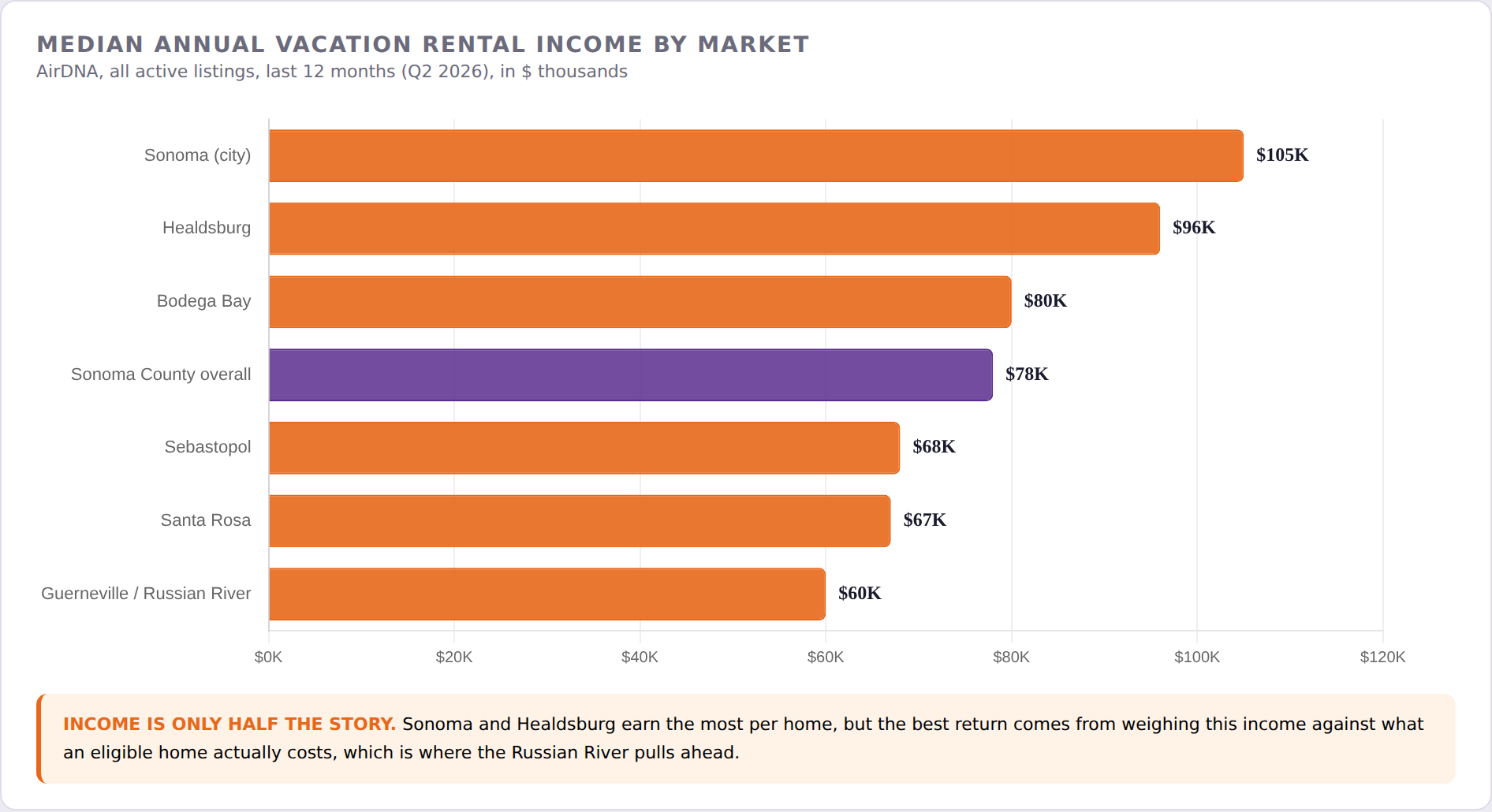
On income alone, Sonoma and Healdsburg lead comfortably. But income is only half of the equation. What you really want to know is how much income you get for every dollar you put into the purchase.
Income against price, the number that actually matters
To compare markets fairly, I look at gross yield: the annual rental income divided by the purchase price. A higher percentage means more income per dollar invested. This is where it gets interesting, because the ranking flips completely once you use realistic prices for eligible homes.
Guerneville and the Russian River: roughly 8 to 10 percent. Eligible homes here typically run $600,000 to $800,000, and a median income near $60,000 produces the best ratio in the county.
Bodega Bay and the coast: roughly 6 percent. Eligible homes around $1.4 million against $80,000 of income.
Sonoma, the city: roughly 4 to 7 percent. Strong income near $105,000, but eligible homes commonly cost $1.5 million to $3 million.
Healdsburg: roughly 3 to 6 percent. High income near $96,000, offset by eligible homes that also run $1.5 million to $3 million.
Sebastopol: roughly 4 to 6 percent, with the northwest corridor toward Occidental and Graton as the prime area.
Santa Rosa: roughly 3 to 5 percent, and it depends heavily on the exact pocket.
The pattern is clear. The Russian River is not the highest earner, but it is the most efficient. You are buying income at a much lower multiple of price than anywhere else in the county.
The caveats that matter most
This is where you have to be careful with median prices, because a raw median can badly mislead you on a vacation rental purchase.
The published median sale price for a town includes homes inside the city limits. But new whole house vacation rentals are not allowed inside the city limits of Sonoma, Healdsburg, Santa Rosa, or Windsor. Every eligible property sits outside those city limits, and those homes tend to be larger, more rural, and more expensive than the town median. So the median understates what you will actually pay for an eligible home in the premium markets.
A few specifics worth knowing. In Healdsburg and Sonoma, the town median might read around $1 million to $1.26 million, but a genuine vacation rental property is far more likely to cost between $1.5 million and $3 million. Do not budget off the town median in these two markets.
In the Russian River, the median is much closer to reality. Most eligible homes fall in the $600,000 to $800,000 range, which is roughly what you would actually pay, and that is a big part of why the yield holds up.
On the coast around Bodega Bay, the median near $1.4 million is a fair reflection of eligible pricing.
In Santa Rosa, there is no single number that works, because it depends entirely on the pocket. The areas that perform as vacation rentals are Bennett Valley (roughly $1 million to $2 million), north east Santa Rosa around Riebli Valley, Larkfield, and Mark West Springs (roughly $1.5 million to $2.5 million), and west Santa Rosa toward Sebastopol (roughly $1.2 million to $2 million). The citywide median of around $742,000 sits well below any of these, so it is not a useful guide for a vacation rental buyer.
The Sonoma County overall median is not a meaningful number for this purpose at all. It blends city and rural, eligible and ineligible, and every price tier into one figure that describes no actual buying decision. Use the market income to judge earning power, but always price the specific eligible home, not the town median.
What the top performers actually earn
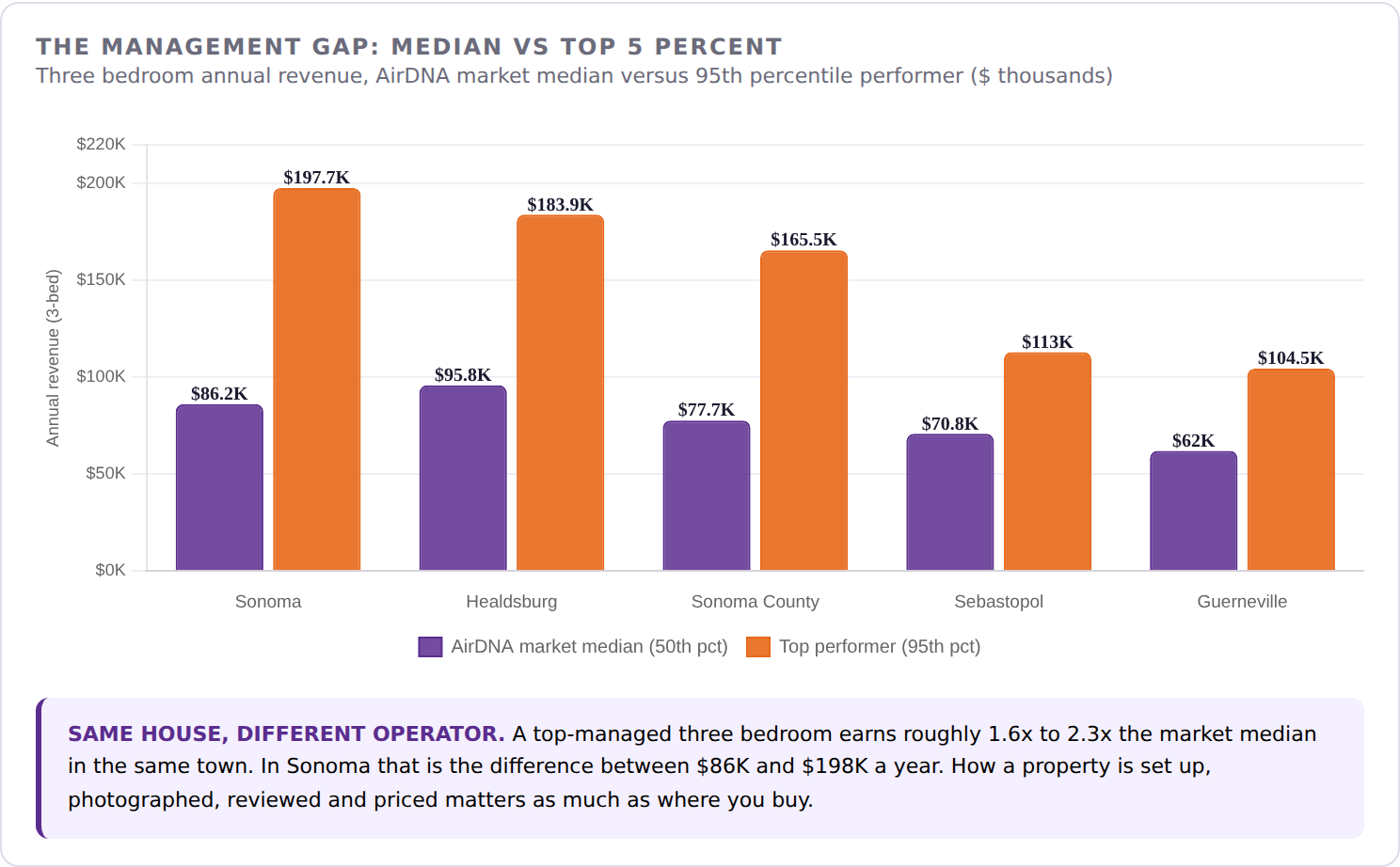
The market medians tell you what a typical listing does. The AirDNA data also shows what the best run properties earn, and the gap is large. A well managed home at the top of its market often earns more than twice what a median property does. Since a three bedroom is the most common home a buyer will find and purchase in these markets, I have led with three bedroom examples and added four bedroom figures alongside. These are real top performers from the AirDNA data, described without addresses.
In Sonoma, the strongest three bedroom vacation rentals earn between $220,000 and $247,000 a year, running 55 to 58 percent occupancy at nightly rates of $1,200 to $1,430, almost always with a pool and a hot tub. The best four bedrooms clear $200,000 to $210,000 at nightly rates north of $1,600.
In Healdsburg, the top three bedroom performer earns close to $299,000 at an exceptional 81 percent occupancy with a pool and hot tub, and other strong three bedrooms land in the $190,000 to $210,000 range. On the four bedroom side, one standout luxury home earns $464,000 at nightly rates around $3,545, though that is an outlier. More typical high performers earn $175,000 to $214,000.
In Santa Rosa, where results depend on the pocket, the best three bedrooms earn $103,000 to $125,000 at 60 to 69 percent occupancy, and a pool clearly helps. The best four bedroom performer is remarkable: about $308,000 a year at 88 percent occupancy, with strong four bedrooms behind it at $248,000 to $266,000. That is the north east Santa Rosa upside I keep pointing clients toward.
Two things to hold in mind. These are the top of the market, not the average, so treat them as the ceiling rather than the expectation. And they are what happens when the property is set up and managed well, which is exactly where a good management partner earns their fee.
How bedroom count changes the math
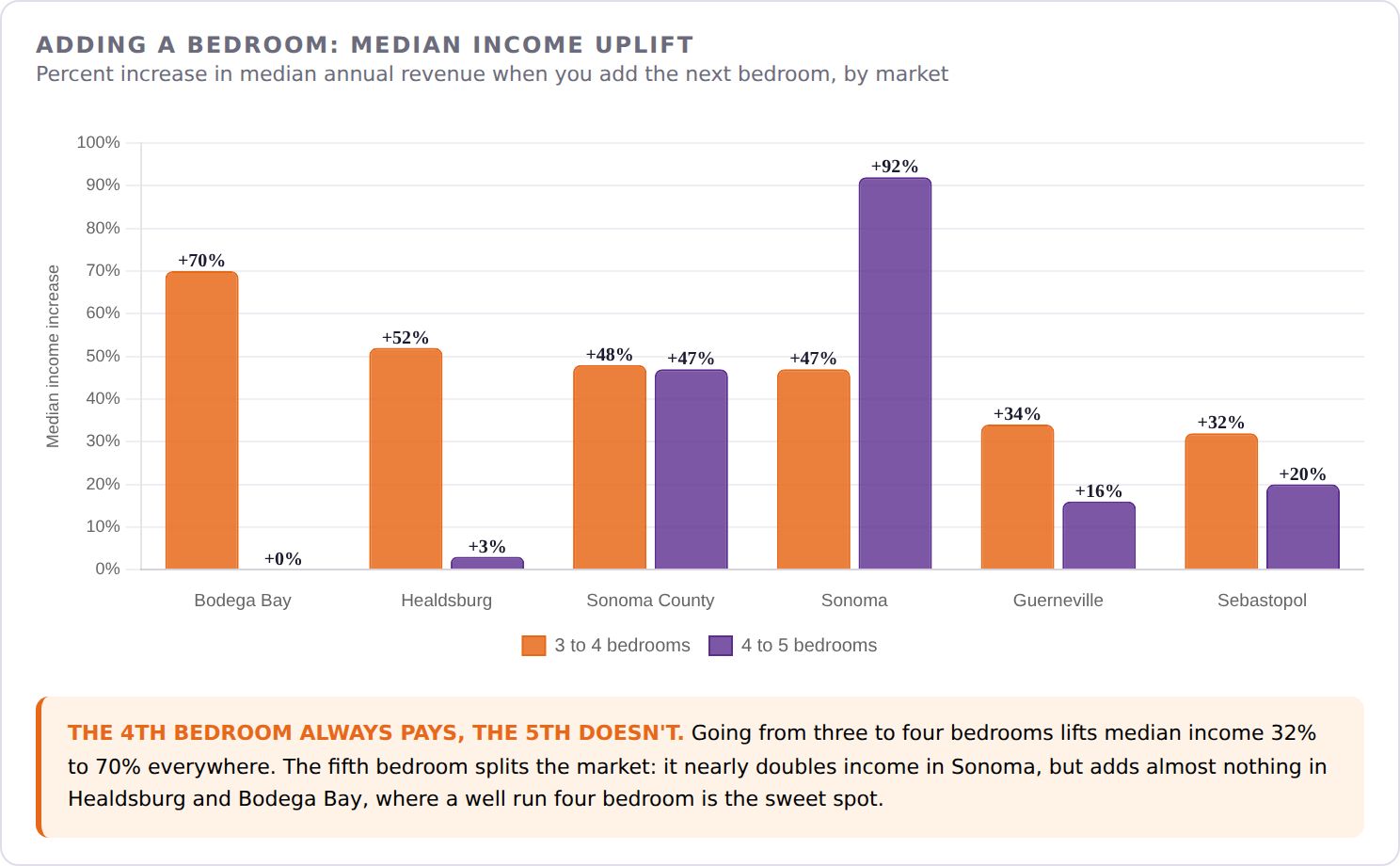
One of the most common questions I get is whether to stretch for an extra bedroom. The data gives a clearer answer than most people expect, and it is different in every market.
The move from three to four bedrooms pays off almost everywhere. Median income jumps meaningfully when you add the fourth bedroom: about 47 percent in Sonoma (from $86,000 to $127,000), 52 percent in Healdsburg (from $96,000 to $146,000), and as much as 70 percent in Bodega Bay (from $75,000 to $127,000). If you can buy or permit a four bedroom instead of a three, it is usually worth it.
The fifth bedroom is where markets split, and this is the insight that saves people money. In Sonoma, going from four to five bedrooms nearly doubles median income (from $127,000 to $244,000), because the city draws large groups and luxury travelers who will pay for space. But in Healdsburg, the jump from four to five is only about 3 percent (from $146,000 to $150,000), and in Bodega Bay it is essentially flat. In those markets, a well run four bedroom is the sweet spot. Paying for a fifth bedroom you cannot monetize is money you will not get back.
There is a hard limit on all of this that catches buyers out. Your bedroom count for permit purposes is capped by the septic system. If a home is marketed as a four bedroom but only has a three bedroom septic permit, you can only get a three bedroom vacation rental permit, and you will only earn like a three bedroom. Understanding the septic system on a rural property is one of the first things we check during escrow, because it directly controls your income ceiling.
One market the data misses: Kenwood and Glen Ellen
If you asked me for a fifth market to add to this list, it would be Kenwood and Glen Ellen. The reason they are not ranked alongside the others is a data gap, not a performance problem. Vinifera does not publish a standalone report for them, and Kenwood is small enough that it does not even register as its own market on AirDNA. That thin sample is exactly why they get overlooked, and part of why there is opportunity.
When you pull Glen Ellen directly from AirDNA, the numbers are strong. Across all 165 active listings, the typical home earns around $110,000 a year at 52 percent occupancy and an average nightly rate of $683. Break it down by the sizes most buyers actually shop for and it gets more interesting. The typical three bedroom earns about $109,000, but the best run three bedrooms earn far more, with top performers pulling $184,000 to $221,000 a year, one of them at 92 percent occupancy. Step up to four bedrooms and the typical home earns about $170,000, while the best performers reach $274,000 to $338,000.
Kenwood sits right next door and shares the same visitor base: guests heading to the Sonoma Valley wineries with easy access back to San Francisco. It is too small to appear as its own market in the data, but the read across from Glen Ellen is fair. Both benefit from being genuinely rural, so more of what comes on the market is actually eligible.
The trade off is price. These are premium markets, and eligible homes are not cheap. But for a buyer focused on income and willing to spend, the Glen Ellen and Kenwood corridor deserves a serious look, even if the tidy market level data does not exist to rank it.
How many eligible homes actually come up for sale
Income and yield only matter if you can find a home you are allowed to operate. Here inventory is genuinely tight, which is the whole reason we track it. In 2025, 714 vacation rental eligible properties either sold or went under contract across 27 Sonoma County communities. That is only about 9 percent of all residential sales in the county, which tells you how selective this market has become since the 2023 ordinance.
Here is roughly how those eligible sales spread across the key markets in 2025:
- Sebastopol and its northwest corridor: 157 eligible sales, the highest raw count in the county.
- Santa Rosa: 147 eligible sales, the deepest pool in a single city, though quality varies enormously by pocket.
- The Russian River corridor including Guerneville, Forestville, Monte Rio, Camp Meeker, and Cazadero: 90 eligible sales, and the best source of sub $1 million options.
- Healdsburg, Kenwood, and Glen Ellen combined: 73 eligible sales.
- Sonoma, the city: 62 eligible sales, heavily weighted above $2 million.
- Petaluma: 49 eligible sales.
- Occidental: 24 eligible sales, with limited rental competition in the area.
- Bodega Bay: 16 eligible sales, helped by the coastal classification that avoids the cap zone restrictions.
The takeaway is that volume and value do not line up. Santa Rosa and Sebastopol offer the most choice, the Russian River offers the best value, and Sonoma and the Glen Ellen area offer the highest income but the thinnest, priciest inventory.
A reminder on eligibility
None of these numbers matter if the property cannot be permitted, so two rules are worth repeating.
First, a vacation rental permit does not transfer when a home is sold. Even if the current owner is running a successful, fully booked vacation rental, that permit does not come with the house. The new owner has to apply for a brand new permit and meet all of the current criteria. An active rental today is not a guarantee that you can operate it tomorrow.
Second, not every home qualifies. Since the August 2023 ordinance reshaped Sonoma County's vacation rental rules, a property has to pass a series of eligibility checks covering zoning, cap zones, exclusion zones, city limits, HOA restrictions, multi unit status, and attached JADUs before a new buyer can be permitted. Some active vacation rentals would not qualify for a new permit at all under today's rules. We run every property through those checks before it goes on our list, so you are only looking at homes a buyer can actually operate.
If you want to talk through which market and price point fits your goals, you can request access to our client website, where we list every vacation-rental-eligible home we are tracking once you are set up, or email me directly at david@bruingtonhargreaves.com.
About the Author
David Hargreaves is the co-founder of BruingtonHargreaves, one of Sonoma County's top-ranked real estate teams and part of W Real Estate. Originally from the UK and an Oxford University graduate, David built and ran a digital marketing agency serving Google, Facebook, and other major brands before becoming one of Sonoma County's top agents within three years of entering real estate.
Today he and business partner Jonathan Bruington have sold more than $250 million in Sonoma County homes over the past three years, earning recognition as a RealTrends No. 2 team in the county and the No. 1 team in Healdsburg. David specialises in helping Bay Area buyers and sellers with luxury properties and vacation rentals across Healdsburg, Windsor, Santa Rosa, and the Russian River communities.
He lives in Sonoma County with his wife Nancy and is happiest cycling the back roads, exploring local wineries, or behind a camera. Have a question about buying, selling, or building in Wine Country? Book a free call.