The Russian River is Sonoma County's best-value vacation rental market in 2026. Our index ranks seven markets by price against rental income, with occupancy, nightly rates, seasonality and three-year trends.

We often get asked if you can still buy a property in Sonoma County in 2026 and operate it as a vacation rental. The answers is a definite, Yes, you can still operate a whole-house vacation rental in Sonoma County in 2026, but almost only in the unincorporated county and only on the right parcel. The home has to be a detached single-family house in an eligible zone (RR, AR, LEA, DA or RRD inland, or anywhere in the coastal zone). It also has to sit outside an exclusion zone and outside a full cap zone, and it needs a zoning permit, a TOT certificate and an annual license. Every city except Petaluma and Sebastopol is effectively closed to new whole-house rentals. A permit never transfers when a home sells, so every buyer starts from scratch under today's rules.
There is no moratorium in 2026. The last one ran from May 10, 2022 to May 9, 2023, and applications have been open since.
This guide covers every rule that decides whether a property qualifies, how the rules have changed since 2016, and what to check before you buy. We run every property that comes on the market through these checks, and we put the ones that qualify on a private website for our clients.
In the unincorporated county you need four things to operate legally, in this order: a certified property manager, a zoning permit, a TOT certificate and an annual license. They apply inland and on the coast alike.
|
What |
What it does |
Cost from July 1, 2026 |
How often |
|---|---|---|---|
|
Certified property manager |
An individual who has passed the county exam and answers complaints within 1 hour by day, 30 minutes at night |
$153 certification |
Once per manager |
|
Transient Vacation Rental (TVR) zoning permit |
Confirms the parcel is eligible and sets the bedroom count and occupancy |
About $980 ($915 permit + $52 CEQA exemption + 1.3% technology surcharge) |
Once per owner; expires on sale |
|
Transient Occupancy Tax (TOT) certificate |
Lets you collect and pay the 12% TOT |
One-page form, usually about a week |
Once |
|
Vacation rental license |
Authorizes operation and enforces the operating standards |
About $712 ($458 license + $245 neighbor noticing + 1.3%) |
Every year; renewal costs the same as the first year |
Fees change every July 1. For FY 2025-26 the permit was about $916 and the license about $666. Source: Permit Sonoma fee schedule 2026-2027.
The rules themselves live in two places in the county code: Sec. 26-28-160 (where a vacation rental is allowed) and Chapter 4, Article VIII (the license and operating standards). The county's own overview is on Permit Sonoma's vacation rental page.
The key terms, in plain English:
A property qualifies only if it passes every step below. Most failures happen at steps 1, 3 and 6. You can check steps 3, 5 and 6 yourself on the county's vacation rental map viewer: enter the address or APN to see the zoning, any cap or exclusion zone, and every active permit nearby. The general county zoning lookup shows the base zoning too.
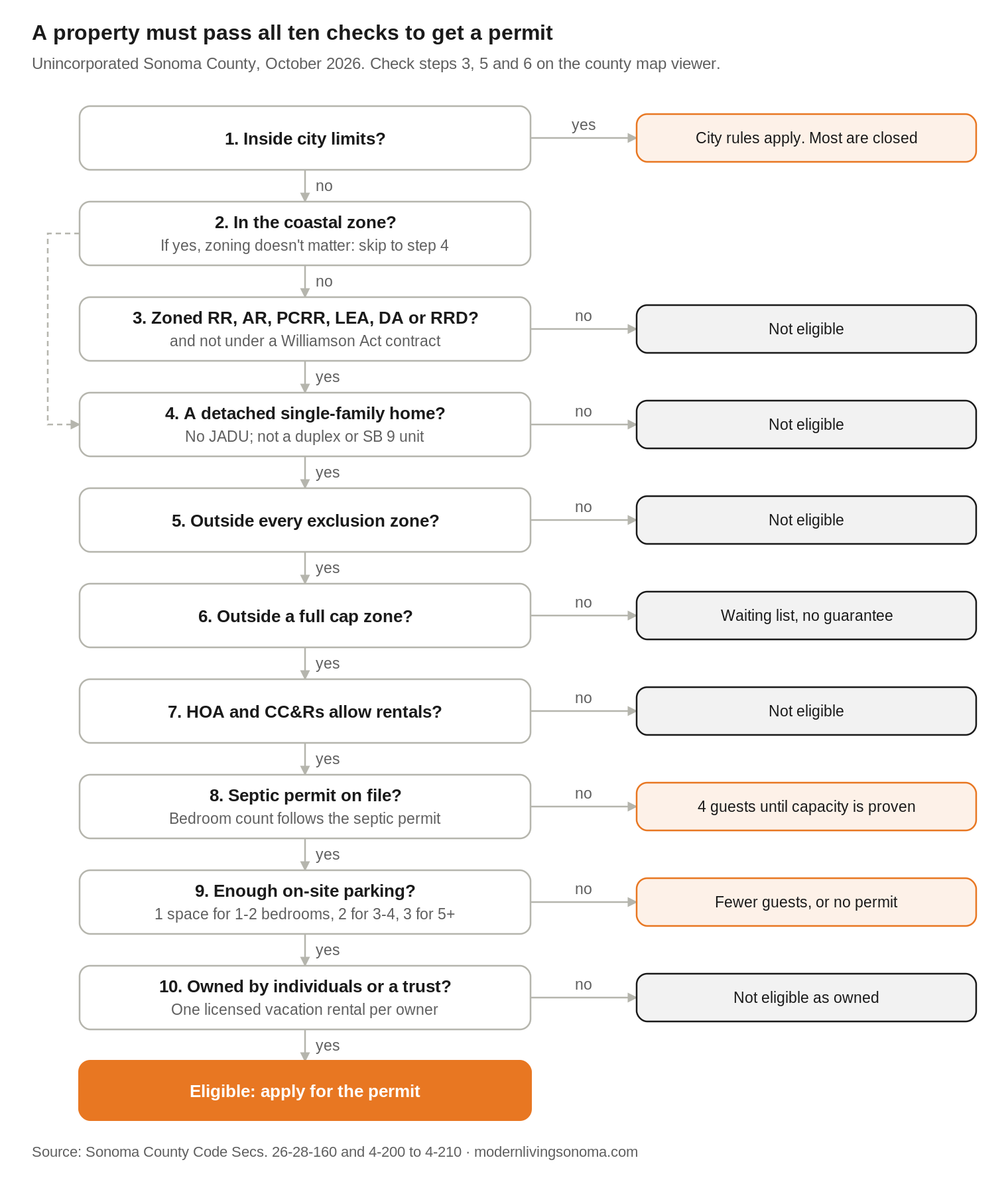
If a property passes all ten, it can get a permit. The remaining risk is a rule change before you apply, so it pays to apply soon after closing.
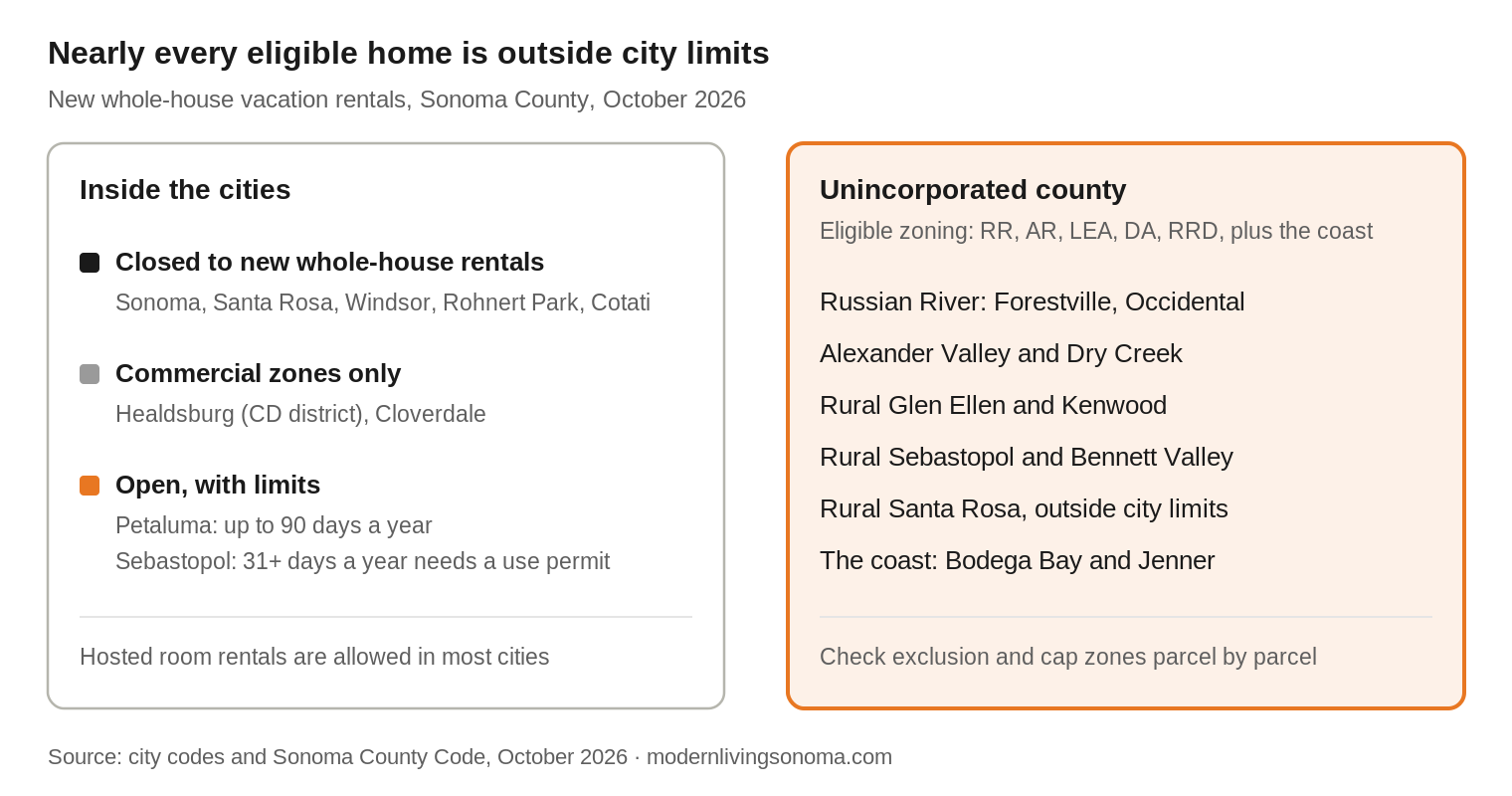
Nine cities run their own rules, and only Petaluma and Sebastopol still issue new whole-house permits on ordinary homes. That's why nearly all eligible homes sit in the unincorporated county: the Russian River corridor, Alexander Valley, Dry Creek, Glen Ellen, the coast and the rural pockets just outside the cities.
|
City |
New whole-house (non-hosted) rentals |
Hosted rentals |
Source |
|---|---|---|---|
|
Healdsburg |
Only in the CD commercial district, with a conditional use permit. Not allowed in any residential or mixed-use zone. |
Not a defined use in the city code; check with the city |
|
|
Sonoma (city) |
No. Only rentals licensed before November 3, 1999 continue. A bed and breakfast inn in a historic home, with a use permit, is the only route. |
No hosted category |
|
|
Windsor |
No in residential zones; existing ones had to close in July 2025. Allowed only in some commercial and Town Center zones. |
Yes, citywide, including renting your own home whole for up to 60 nights a year |
|
|
Santa Rosa |
No. Non-hosted permits are capped at 182 and the city accepts no new applications. A 1,000-foot separation rule also applies. |
Yes, citywide, no cap |
|
|
Sebastopol |
Yes. Up to 30 days a year needs an administrative permit; 31 days or more needs a conditional use permit. |
Yes, administrative permit, no day limit, up to 2 bedrooms |
|
|
Petaluma |
Yes, up to 90 days a year, with a manager within 45 miles |
Yes, no day limit, up to 2 bedrooms |
|
|
Cloverdale |
Only in commercial zones, with a conditional use permit |
Yes, in all residential zones |
|
|
Rohnert Park |
No |
Hosted only (per the county's 2021 summary; confirm with the city) |
|
|
Cotati |
No |
No; bed and breakfasts only in some zones |
City permits don't survive a sale either. Santa Rosa voids a permit on sale, and Windsor's license "does not run with the land."
The city closures pushed demand just outside city limits, which is why the county later capped areas such as Chiquita Road and Norton Road near Healdsburg and Palmer Avenue south of Sonoma. In Healdsburg the line between city and county is often a single street, so the best opportunities are usually just across it.
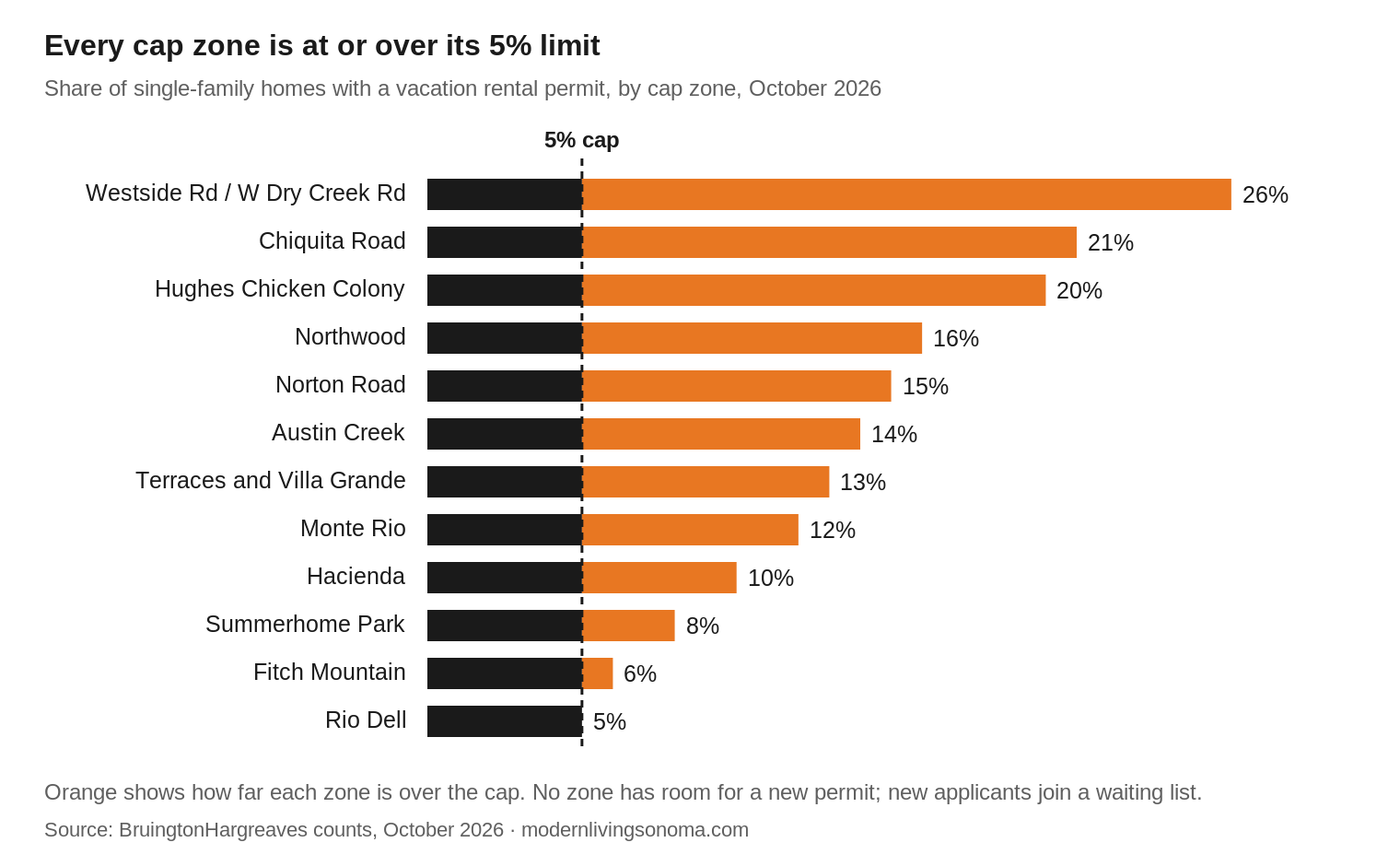
There are 12 cap zones and more than 25 exclusion areas, and all 12 are now at or over their 5% limit, so no cap zone has room for a new permit. Every cap zone has the same 5% cap, whatever its current density; the figures below show how far over the cap each zone is, not a different limit. We track every zone ourselves. Exclusion and cap rules aren't retroactive: a home that already had a permit keeps it until it sells. Concentrations move as homes sell, so check the county map viewer for any specific parcel.
|
Cap zone |
Where |
Status |
Our count, October 2026 |
County figure, April 2024 |
|---|---|---|---|---|
|
Westside Road / West Dry Creek Road |
20 parcels near Healdsburg, added July 16, 2024 |
Over cap, waiting list |
26% |
Not yet a cap zone |
|
Chiquita Road |
West of Highway 101, near Healdsburg |
Over cap, waiting list |
21% |
17% |
|
Hughes Chicken Colony |
Southwest of Highway 12 and Ramal Road, Sonoma Valley |
Over cap, waiting list |
20% |
17% |
|
Northwood |
Russian River, near Monte Rio |
Over cap, waiting list |
16% |
15% |
|
Norton Road |
North of Dry Creek Road, near Healdsburg |
Over cap, waiting list |
15% |
15% |
|
Austin Creek |
Between Highway 116 and Cazadero |
Over cap, waiting list |
14% |
14% |
|
Terraces and Villa Grande |
Downriver from Monte Rio |
Over cap, waiting list |
13% |
13% |
|
Monte Rio |
Russian River |
Over cap, waiting list |
12% |
13% |
|
Hacienda |
Forestville |
Over cap, waiting list |
10% |
8% |
|
Summerhome Park |
Forestville |
Over cap, waiting list |
8% |
8% |
|
Fitch Mountain |
Between the Russian River and Healdsburg's eastern city limit |
Over cap, waiting list |
6% |
8% |
|
Rio Dell |
Forestville |
At cap, waiting list |
5% |
4% |
Source: Board of Supervisors status report, April 30, 2024; Westside Road from the July 2024 CEQA notice.
In a cap zone, new applicants join a waiting list with no guarantee of a permit. A zone at 15% has to lose two-thirds of its rentals before a new one is allowed, and that only happens as permitted homes sell and lose their permits. Buying in a cap zone in the hope a slot opens up is closer to gambling than investing. Buying next to one can work well, because the cap limits your competition.
The original exclusion zone (the X combining district) was adopted in 2016. It covers:
Glen Ellen and Kenwood are not off limits. The exclusion zones cover the residential pockets in and around each village, but the rural parcels around them on agricultural and resource zoning can still qualify. Those parcels include some of the highest-earning vacation rentals in the county: Glen Ellen has the county's highest median vacation rental income, and 27 eligible homes sold in Glen Ellen and 18 in Kenwood in 2025. The trick is knowing exactly where each exclusion boundary runs, parcel by parcel.
Fitch Mountain was in the original exclusion zone; in 2023 it became a 5% cap zone instead.
Added April 24, 2023:
Added July 16, 2024: the Carriger Road area in Sonoma and the Trinity Oaks subdivision in Glen Ellen, 388 parcels in all (Ord. 6494).
Hosted rentals are still allowed inside exclusion zones. Neighborhoods can also petition the county to add themselves to the exclusion zone, so a quiet area today isn't guaranteed to stay open.
Most of these rules don't affect whether you can buy, but they decide how much you can earn and how easily you can lose the license. They come from the license ordinance, Chapter 4, Article VIII of the county code.
Occupancy and bedrooms:
Noise, light and safety:
The property manager:
Posting, advertising and neighbors:
Tax:
Ownership:
Enforcement:
A vacation rental permit ends the day a home changes hands. The county code says a permit "automatically expires upon sale or transfer of the parcel," and the new owner has to apply from scratch under the rules in force that day (Sec. 26-28-160). Santa Rosa and Windsor work the same way. So "the sellers run it as an Airbnb" tells you nothing about whether you can.
This matters most for homes that were grandfathered in. A rental permitted before R1 was banned in 2022, or before its neighborhood became an exclusion or cap zone, keeps operating only until it sells. The buyer can't get a new permit, so the income goes with the seller. Coastal rentals operating before October 26, 2023 are the same: they're exempt from the permit only until the property transfers.
The one exception is a commercial bed and breakfast license. Unlike a vacation rental permit, it transfers with the property when it sells, which makes a licensed B&B one of the few ways to buy a short-term rental business that keeps operating.
What buyers should check before removing contingencies:
Don't rely on the listing description or the listing agent. One of our clients nearly bought a home in Santa Rosa city limits that the listing agent said would make an excellent vacation rental; it could never have been permitted.
For sellers, eligibility is a selling point worth documenting. Show buyers the zoning, the septic permit, the parking and, if you've been operating, your income and occupancy records. An eligible home draws both vacation rental investors and second-home buyers who want to offset costs, which widens the pool and supports the price. If your permit is grandfathered and a buyer can't get a new one, price for that rather than for the income.
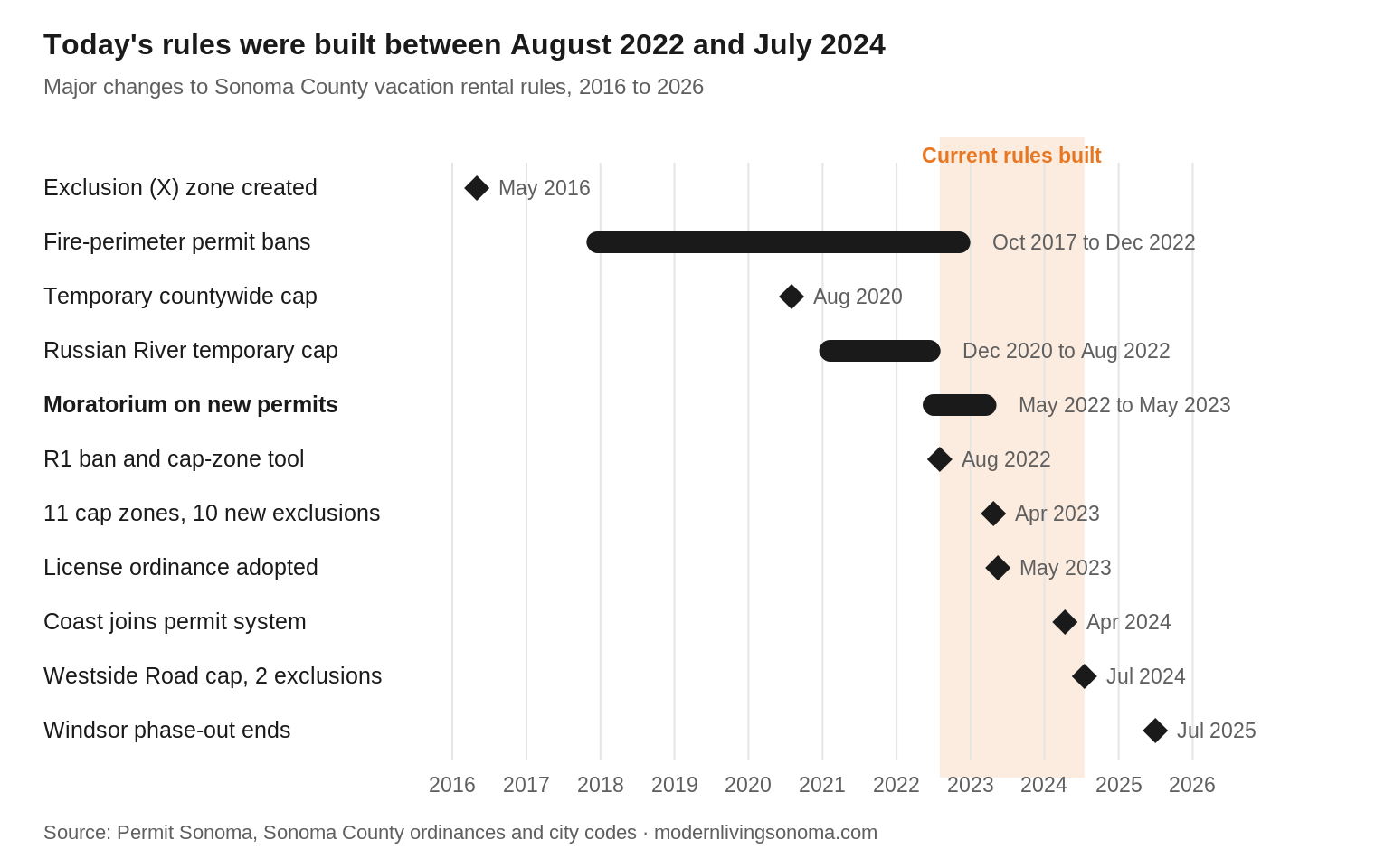
The current system was built between August 2022 and July 2024, and nothing major has changed since. If you read an older article (including some of ours) that mentions a moratorium, a 30-mile manager rule, 10% caps or R1 eligibility, this is where those rules went.
|
Date |
What changed |
|---|---|
|
July 1, 2026 |
New county fees: permit about $980, license about $712 a year |
|
July 2025 |
Windsor's existing non-hosted rentals in residential zones had to close |
|
April 11, 2025 |
Deadline for grandfathered coastal rentals to get a license |
|
July 16, 2024 |
Westside Road/West Dry Creek Road near Healdsburg becomes a 5% cap zone; Carriger Road (Sonoma) and Trinity Oaks (Glen Ellen) become exclusion zones |
|
June 15, 2024 |
Deadline for existing inland rentals to get a license |
|
April 11, 2024 |
Coastal Commission certifies the county's coastal vacation rental rules, bringing the coast into the permit and license system |
|
September 26, 2023 |
County adopts its coastal vacation rental ordinance |
|
July 25, 2023 |
Santa Rosa caps non-hosted permits at 182 and stops taking new applications |
|
June 2023 |
Windsor bans non-hosted rentals in residential zones, with a two-year phase-out |
|
Mid-June 2023 |
License ordinance takes effect; new licensees must be individuals, one license per owner |
|
May 16, 2023 |
County adopts the vacation rental license ordinance |
|
May 9, 2023 |
Moratorium ends; applications reopen under the new rules |
|
April 24, 2023 |
County adopts 11 cap zones at 5% and 10 new exclusion zones; Fitch Mountain switches from exclusion to cap |
|
December 2022 |
The last fire-perimeter bans on new permits (2019 Kincade, 2020 LNU and Glass fires) expire |
|
August 2, 2022 |
County bans new permits in R1, creates the cap-zone tool, moves quiet hours to 9pm, ends "sleeping areas" and sets the license framework. It also agrees to process applications it had frozen from mid-March to May 10 |
|
May 10, 2022 |
County stops accepting applications: a 45-day moratorium, extended in June to May 9, 2023. About 200 applications were pending, 90 of them in District 5 |
|
March 2022 |
County delays its decision. Its 2021 count was 2,459 vacation rentals, 1.8% of housing stock, and a county study found no link between vacation rentals and house prices |
|
December 4, 2021 |
Santa Rosa requires permits and introduces its 1,000-foot rule |
|
December 15, 2020 |
Temporary cap on the lower Russian River (over 1,000 parcels) and a small Sonoma Valley area, to August 6, 2022 |
|
August 2020 |
County imposes a temporary countywide cap of about 1,943 permits |
|
January 2019 |
LIA parcels can host rentals; LIA whole-house rentals then operating could seek a use permit to continue |
|
December 2017 |
City of Sonoma removes vacation rentals as a conditional use |
|
October 24, 2017 |
Urgency ban on new permits inside the 2017 fire perimeters, later extended to the 2019 and 2020 fires |
|
May 2016 |
County creates the vacation rental exclusion (X) zone across parts of Sonoma Valley, Glen Ellen, Kenwood and Fitch Mountain |
Sources: Permit Sonoma regulations history, August 2022 press release, April 2023 press release, plus our own coverage at the time.
No. The county's moratorium ran from May 10, 2022 to May 9, 2023. Applications have been open since, subject to the zoning, cap and exclusion rules.
No. The permit expires automatically on sale, and you apply for a new one under the rules in force at the time. A home that operates today may not qualify for you. The one exception is a commercial bed and breakfast license, which does transfer with the property.
Not as a whole-house rental on an ordinary home. Healdsburg allows them only in its CD commercial district, Santa Rosa accepts no new non-hosted applications, and the City of Sonoma and Windsor's residential zones are closed. Santa Rosa and Windsor do allow hosted rentals, and just outside each city there are eligible county parcels.
Mostly in the unincorporated county on RR, AR, LEA, DA or RRD zoning: parts of the Russian River corridor such as Forestville and Occidental, Alexander Valley, Dry Creek, rural Glen Ellen and Kenwood outside the exclusion zones, rural Sebastopol, Bennett Valley and rural Santa Rosa, and the coast. See our guide to buying a vacation rental in Sonoma County.
From July 1, 2026 the zoning permit is about $980 and the license about $712 a year, plus $153 to certify a property manager. In our experience the permit takes 30 to 45 days with a complete application, and the TOT certificate about a week; the license comes after both.
No. An ADU or JADU can never be the vacation rental, and a home with a permitted JADU can't be licensed at all. A legal guest house can be part of the main home's rental. An ADU can be rented for more than 30 days, which isn't a vacation rental.
No vacation rental permit is needed, because a vacation rental is defined as a stay of 30 days or less. Normal landlord rules apply instead.
A vacation rental is the whole home. A hosted rental is one bedroom rented while you live there. Hosted rentals need a simpler permit (about $226) and are allowed in R1 zones and exclusion zones where whole-house rentals aren't.
Not a new one. New licensees must be individuals or a trust acting through its trustee, and each owner can hold an interest in only one licensed vacation rental. Rentals operating before mid-June 2023 are exempt.
Two per permitted bedroom plus two, up to 12. Septic capacity and parking can lower that, and with no septic record or no on-site parking the limit is four.
Yes, since the Coastal Commission certified the county's rules on April 11, 2024. Coastal zoning isn't restricted, but septic, parking and bedroom rules apply. Rentals operating legally between October 2018 and October 2023 need only a license until they sell.
You join a waiting list. With every cap zone at or over 5%, a slot may not open for years, so treat a cap zone home as ineligible unless the county map shows room under the cap.
Yes. Every vacation rental needs a county-certified individual who can respond to complaints within an hour by day and 30 minutes at night. It can be you, if you pass the exam and can meet the response times.
We check every property that comes on the market against these rules. Sign up for access to our private list of eligible vacation rentals, or book a free call to talk through a specific property.
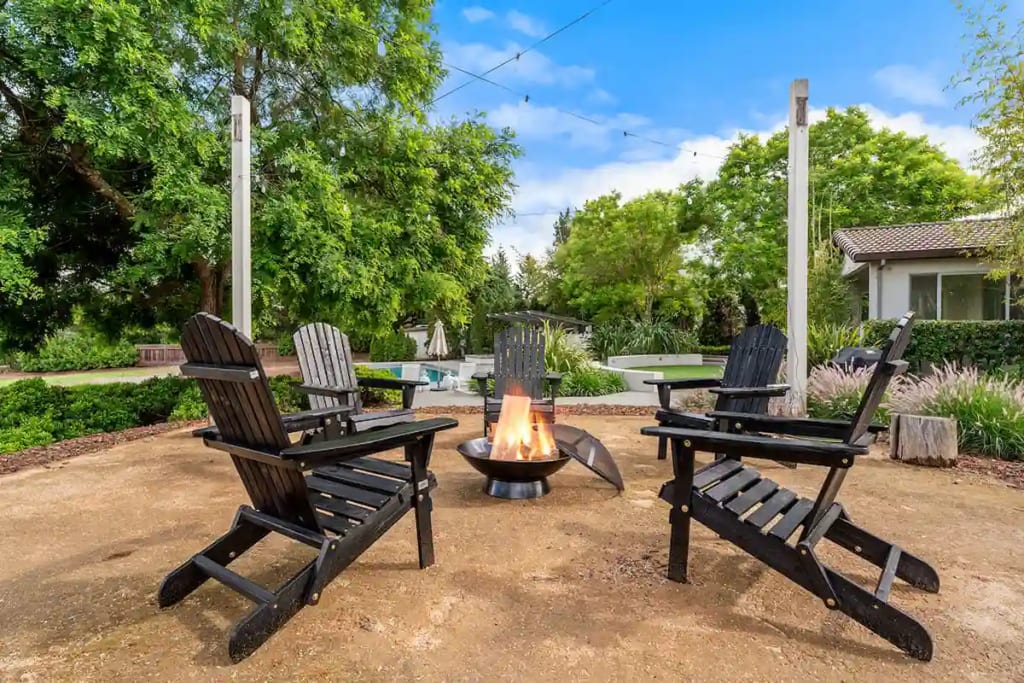
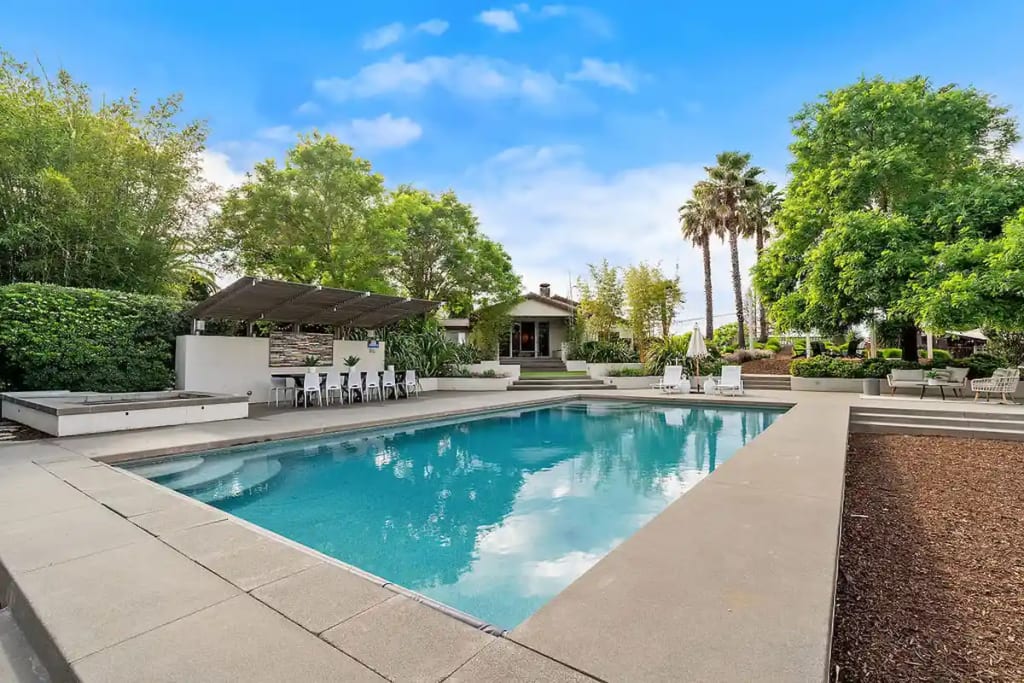
Picture yourself sitting on a sun-drenched deck overlooking rolling vineyards, a glass of local wine in hand, knowing that not only are you enjoying your own piece of wine country paradise, but your investment is working for you even when you're not there. This isn't just a dream – it's a reality for savvy investors who have discovered the unique opportunity that Sonoma County vacation rentals present.
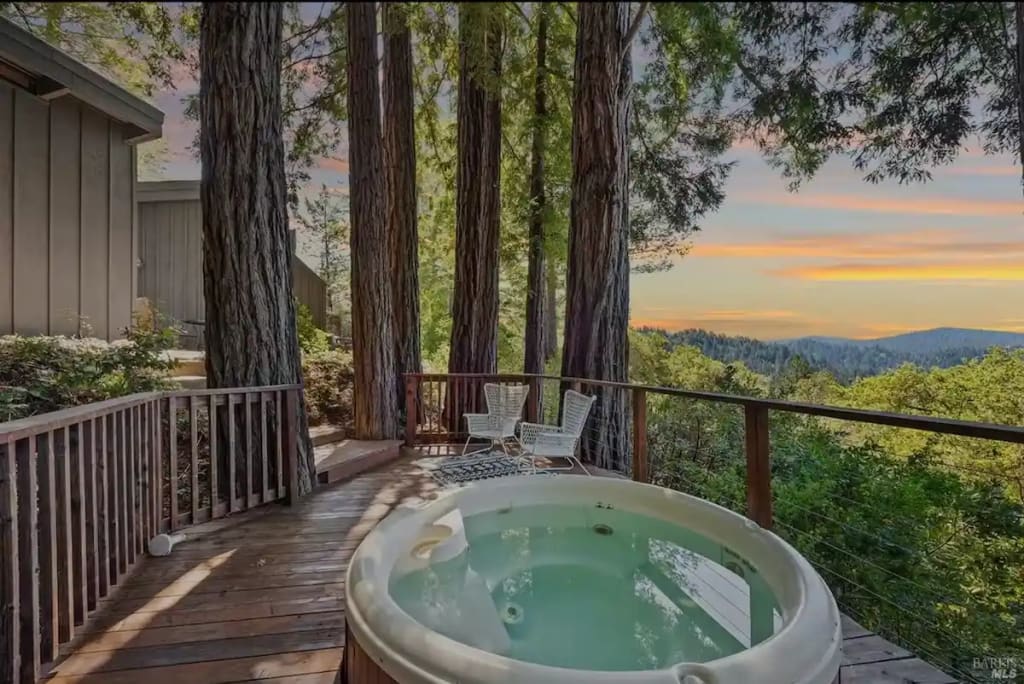
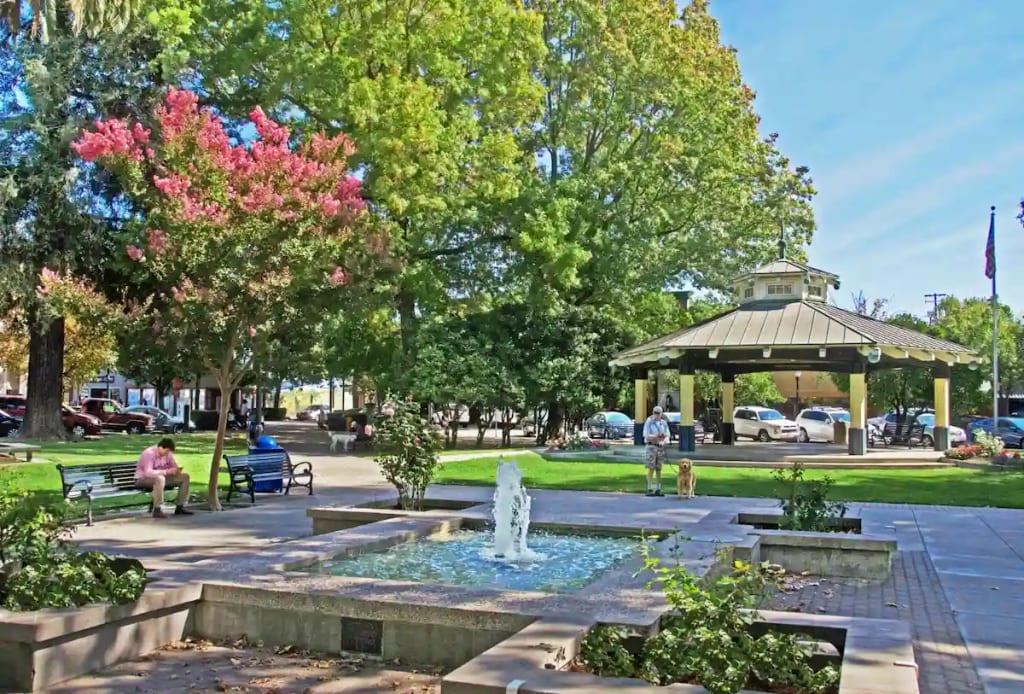
The allure of Sonoma County is undeniable. From the world-class wineries of Healdsburg to the towering redwoods along the Russian River, from the historic charm of Sonoma Plaza to the artistic enclave of Sebastopol, this region captures the hearts of visitors from around the world. It's this magnetic appeal that makes Sonoma County not just a beautiful place to own property, but a compelling investment opportunity.
Sign in with your email address
Enter your email address