

When you sell a vacation rental, you can owe federal capital gains tax, depreciation recapture, a 3.8% investment tax and California income tax, all on the same sale. A 1031 exchange into another investment property defers every one of them. If you used bonus depreciation to write off a big slice of the home when you bought it, the recapture is larger than most owners expect, which makes the exchange worth even more.
Quick disclaimer: we are real estate brokers, not CPAs. This is general information, not tax advice, so run your own numbers with a CPA before you list.
What you owe on a taxable sale
If you simply sell and keep the cash, these are the taxes in play, using 2026 federal figures:
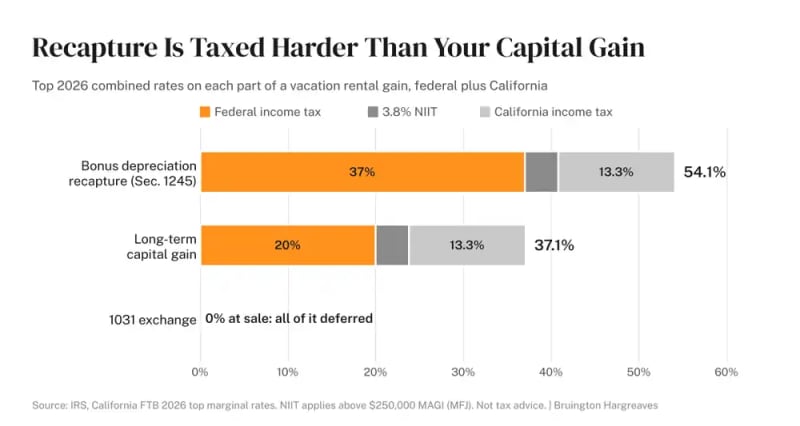
- Federal long-term capital gains: 0%, 15% or 20% on your gain above your cost basis, if you've owned the home more than a year. For married couples filing jointly, the 20% rate starts at $613,700 of taxable income.
- Section 1245 recapture: your ordinary income rate, up to 37%, on depreciation taken on 5, 7 and 15-year components. This is the part bonus depreciation creates.
- Net investment income tax: 3.8% on top, if your modified AGI is above $250,000 (married filing jointly).
- California income tax: the whole gain, recapture included, is taxed as ordinary income, at up to 13.3%.
California also requires escrow to withhold 3 1/3% of the sale price at the point of sale to be paid towards your California tax liability, unless an exemption applies, such as a qualifying 1031 exchange.
How bonus depreciation works on the way in
When you buy a rental, the IRS normally lets you depreciate the building over 27.5 years. A cost segregation study breaks the property into its parts, such as cabinetry, flooring, fixtures, appliances, landscaping and pool equipment, and moves them into 5, 7 and 15-year classes.
The One Big Beautiful Bill Act restored 100% bonus depreciation for qualifying property acquired after January 19, 2025. Everything moved into those shorter classes can be written off in year one. For most Sonoma County vacation rentals we sell, a study moves 20% to 40% of the basis into those buckets.
The short-term rental rules are what make this so powerful. If the average guest stay is 7 days or less and you materially participate, usually by passing the 100-hour test, along with other criteria, you can claim the classification as a real estate professional. As a real estate professional, the rental income isn't treated as passive. The losses can then offset your W-2 income.
In our cost segregation guide, a $1.25 million Healdsburg rental with a $175,000 pool and outdoor upgrade writes off $300,000 to $450,000 in year one. At a 37% federal bracket, that's about $111,000 to $166,000 in federal tax savings. California doesn't follow federal bonus depreciation, so the state return won't see the same write-off.
The catch: recapture when you sell
Bonus depreciation moves the tax. It doesn't erase it. When you sell in a taxable sale, the depreciation taken on those 5, 7 and 15-year components comes back as Section 1245 recapture, taxed at ordinary rates rather than long term capital gains rates.
You still had the use of that money for years. But an owner who wrote off $400,000 in year one and sells three years later can face a recapture bill close to the tax they saved. That's why the 1031 exchange matters so much to vacation rental owners.
How a 1031 exchange works
Under Section 1031, when you exchange real property held for business or investment for other like-kind real property, you generally don't recognize the gain. Like-kind is broad: almost any U.S. investment real estate qualifies, so you can exchange a vacation rental for another vacation rental, a rental house or a commercial building. Property outside the U.S. doesn't qualify.
The rules are strict:
- A qualified intermediary holds the sale proceeds. If the money reaches you, the exchange fails.
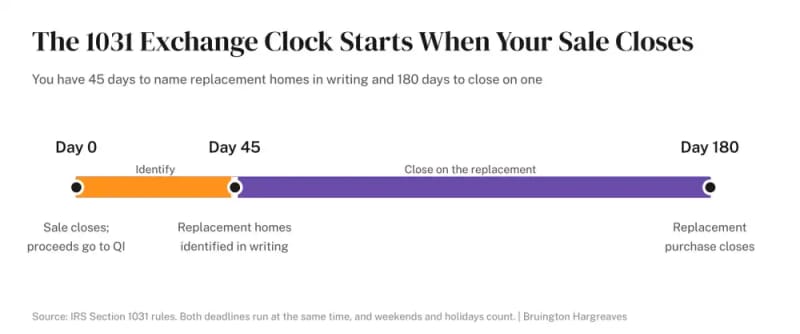
- You have 45 days from closing to identify replacement properties in writing, and 180 days to close on one.
- To defer all the tax, buy at the same or a higher price and replace the debt you paid off. Any cash or other property you take out is taxed.
- Personal use is limited. The IRS safe harbor for vacation homes (Rev. Proc. 2008-16) asks for 24 months of ownership, at least 14 days rented at a fair rent in each 12-month period, and personal use of no more than 14 days or 10% of the rented days, whichever is greater. It applies to the home you sell and the one you buy.
- If you did a cost segregation study, the components can still trigger recapture inside an exchange, depending on what you buy. Your CPA should model this before you list.
- You report the exchange on IRS Form 8824.
The 45-day problem in Sonoma County
Forty-five days is tight anywhere. In Sonoma County it's tighter, because only about 9% of the homes that sold in 2025 could be permitted as a vacation rental by the new owner. Permits don't transfer when a home sells, so most of the listings an exchange buyer sees are homes they could never rent short-term.
That's why our clients get access to a dedicated eligible vacation rental website. Every home on the market that passes our eligibility checks appears there within 24 hours of listing, so you can see the whole inventory at any time. Exchange buyers use it months before they sell, so their 45-day list is ready the day escrow opens.
Case study: from Santa Barbara to Kenwood
Our clients live in Bend, Oregon, and owned a vacation rental in Santa Barbara. When the rules there changed, they decided to sell and exchange into Sonoma County. With family in the Bay Area, they wanted a home they could enjoy themselves that would also earn strong income.
- We worked with them for 8 months to choose the area and shortlist homes. When an offer came in on their Santa Barbara home, the replacement was already identified, so they could secure it within the exchange deadlines.
- They bought an existing, high-performing vacation rental in Kenwood for $3.3 million: 5 bedrooms, 6 bathrooms and a pool.
- They worked with our permit specialist and our preferred vacation rental management partner.
- We worked closely with the seller and the management company to transfer existing bookings at the close of escrow, so the income didn't stop.
"We worked with David and his team to purchase a vacation rental property in Kenwood. David helped us zero in on the best areas in Sonoma county and after touring a fair number of houses, ultimately helped us find exactly what we were looking for. He and his team continued to be a great resource throughout the inspections and final negotiations. We highly recommend David Hargreaves."
Exchanging out of California
If you sell a California rental and buy outside the state, California still has a claim on the deferred gain. You file form FTB 3840 every year until the gain is taxed, and California taxes it when you eventually sell the replacement in a taxable sale.

Other ways owners reduce the bill
- Installment sale: spread the gain over the years you're paid, though recapture is generally taxed in the year of sale.
- Hold for life: heirs usually inherit at a stepped-up basis, which can wipe out the deferred gain.
- Move in: turning a rental into your home rarely avoids the tax. Rental years after 2008 reduce the homeowner exemption, depreciation is still recaptured, and a home bought through a 1031 has to be owned for 5 years first.
Before you list
- Get your cost basis and depreciation schedule from your CPA, including any cost segregation study.
- Decide whether you're selling or exchanging before you sign a listing agreement.
- Line up a qualified intermediary before escrow closes.
- If you're exchanging into Sonoma County, start watching eligible inventory now, and get financing lined up. Our guide to buying a vacation rental in Sonoma County covers the rest. You can also get in touch and ask to get access to our private client website that lists every eligible vacation rental in the county.
Planning a 1031 exchange into or out of a Sonoma County vacation rental? Email me directly at david@bruingtonhargreaves.com.
About the Author
David Hargreaves is the co-founder of BruingtonHargreaves, one of Sonoma County's top-ranked real estate teams and part of W Real Estate. Originally from the UK and an Oxford University graduate, David built and ran a digital marketing agency serving Google, Facebook, and other major brands before becoming one of Sonoma County's top agents within three years of entering real estate.
Today he and business partner Jonathan Bruington have sold more than $230 million in Sonoma County homes over the past three years, earning recognition as a RealTrends No. 2 team in the county and the No. 1 team in Healdsburg. David specialises in helping Bay Area buyers and sellers with luxury properties and vacation rentals across Healdsburg, Windsor, Santa Rosa, and the Russian River communities.
He lives in Sonoma County with his wife Nancy and is happiest cycling the back roads, exploring local wineries, or behind a camera. Have a question about buying, selling, or building in Wine Country? Book a free call.