
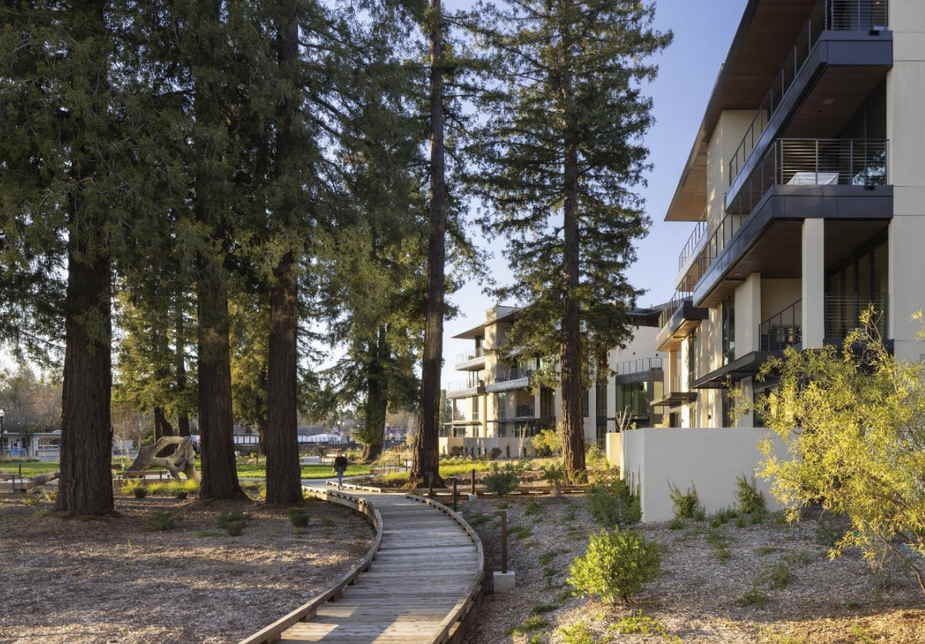
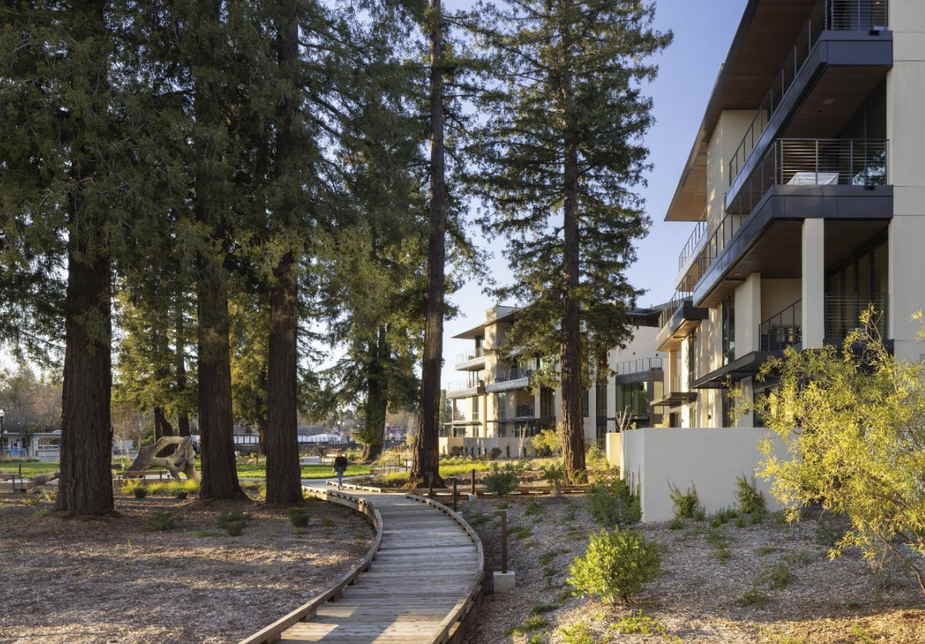
Yes, a Mill District penthouse in Healdsburg just set a Sonoma County record: $7.8 million, or $2,448 a square foot, the highest price ever paid for a condo in the county. That is the number everyone is repeating. The more useful story sits underneath it. At Mill District, several units have seen real price erosion, and some of the earliest buyers are now struggling to resell, one of them asking less than they paid. The important part is that this is a Mill District pattern, not a Healdsburg one, and it is close to what you would expect from a new resort-style development.
How far identical units diverge
Start with how differently the same floor plan has traded. These are not different homes. They are the same plans, repeated floor to floor, and the closed prices are all over the map.
The studios have sold from $728,500 to $900,000, a 24 percent range. The larger 800 square foot studio is the sharpest example at the low end: two identical units, one closed at $975,000 and the other at $1,600,000, $625,000 apart for the same plan. The one-bedroom-plus-den tells the same story: two units on the same 1,368 square foot layout, one at $1,825,000 and one at $2,595,000, a $770,000 gap. The larger one-bedroom-plus-den ran from $2,300,000 to $2,995,000, and the seven two-bedroom flats that have closed span $3,074,000 to $3,582,606.
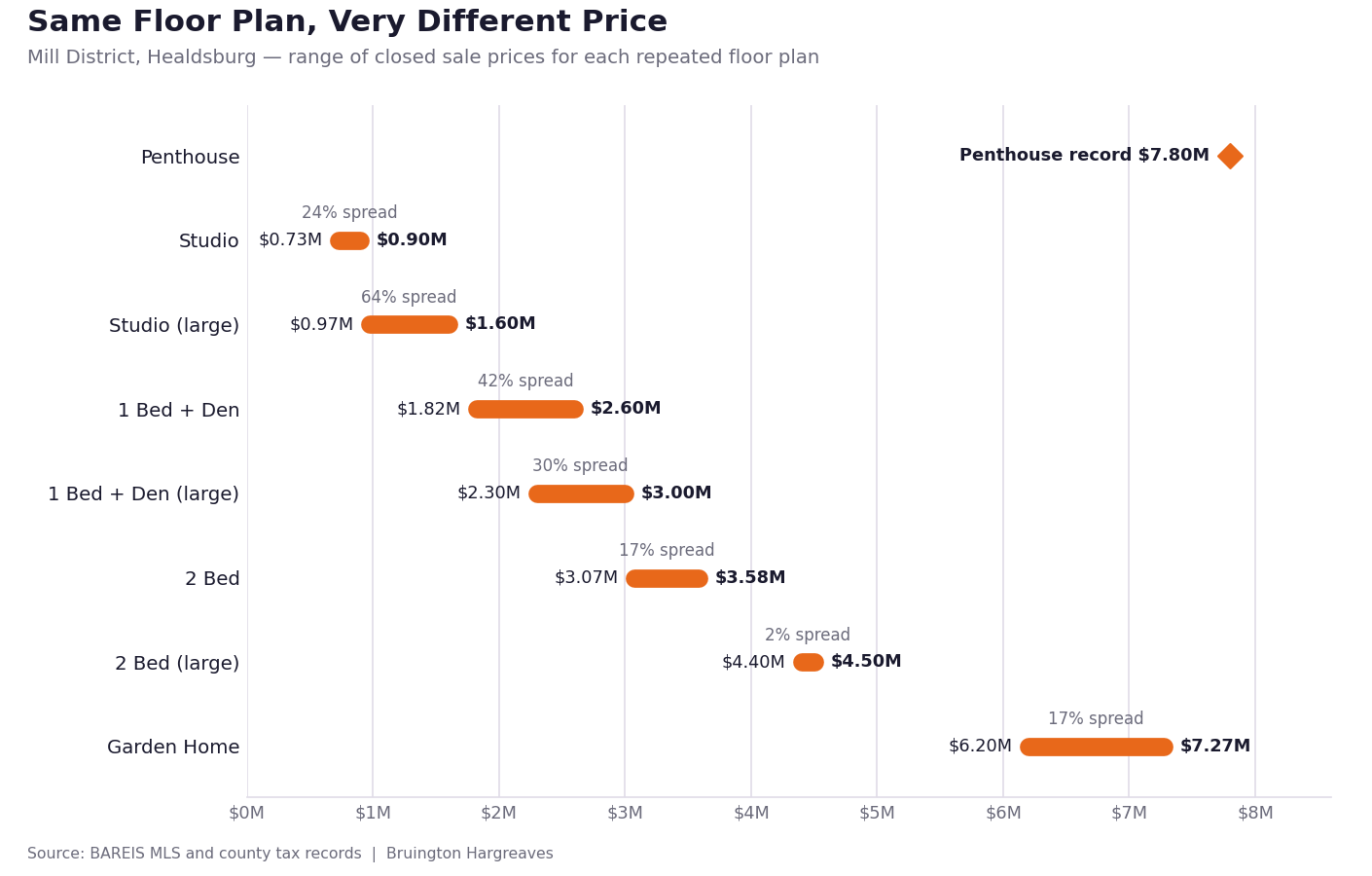
Only the biggest plans held a tight line. The three larger two-bedroom homes all landed between $4,400,000 and $4,500,000, a spread of just 2 percent, and the three-bedroom garden homes that resold went for $6,200,000, $6,275,000, and $7,272,000. Put it together and every closed sale at Mill District falls between about $1,219 and $2,448 a square foot. The building's cheapest foot and its most expensive foot are almost double apart, and the widest percentage gaps sit on the smallest, least expensive homes. These figures come from BAREIS MLS and county tax records, so the per-foot numbers are only as precise as the square footage those tax records hold.
The erosion is real
Now the softening. Start with the record itself. That penthouse first listed at $8.6 million and sat for roughly a year before it was pulled, relisted this May at $7.8 million, and sold all cash. A remarkable price, and still an $800,000 cut from where it began. When the single strongest unit in the building needs an eight-figure sale to come down by seven figures, it tells you how far early asking prices had run ahead of the market.
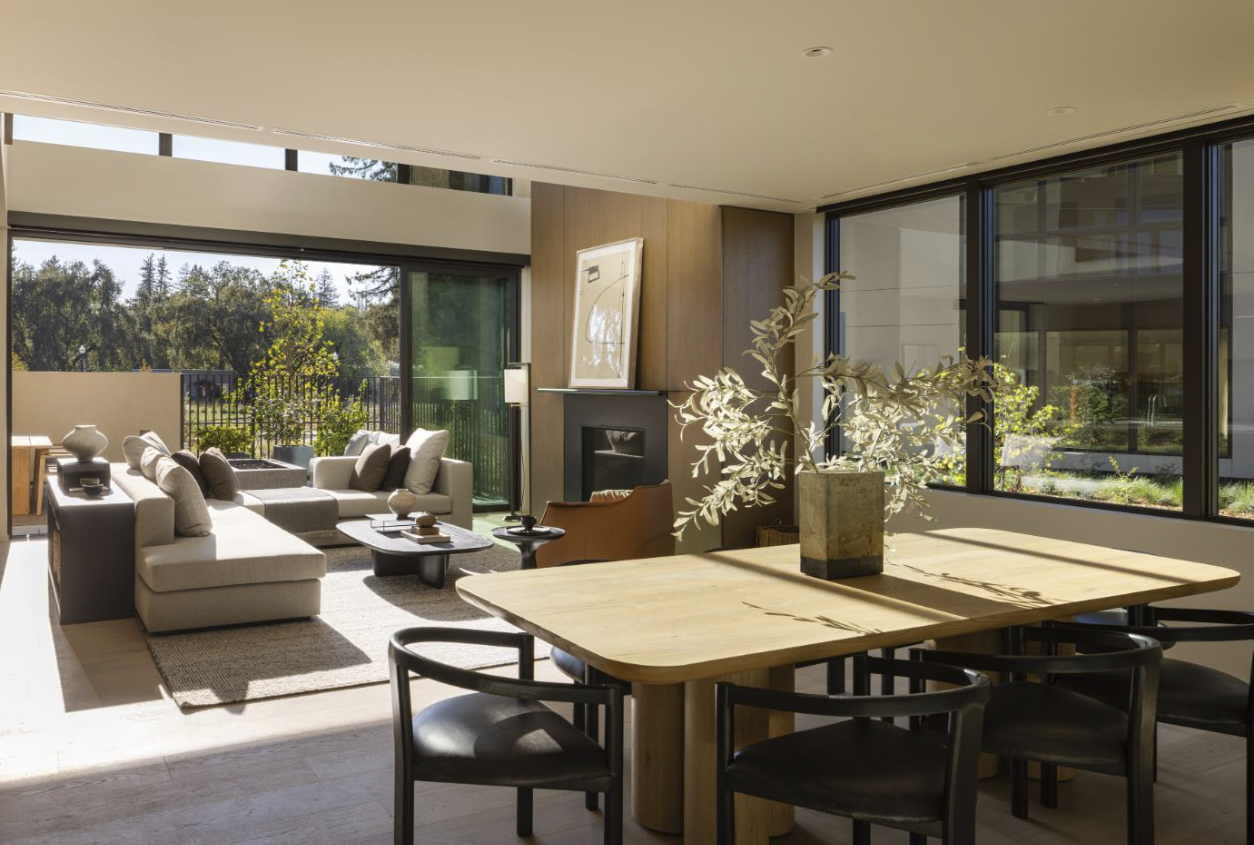
The clearer signal is on resale. One studio that sold new for $867,000 in 2024 is back on the market at $799,000, below what its owner paid, and it has not yet found a buyer. Another studio bought for $900,000 has been relisted at $999,000 and has now sat unsold for more than 450 days, an asking price the market has simply ignored. Neither has closed, so no one has taken a loss on paper yet, but both point to soft resale demand. The sharpest repricing is on the garden homes. The three that resold cleared between $6.2 million and $7.272 million, yet the three still available today are listed at $4,650,000, $4,750,000, and $4,850,000, roughly a million and a half below the cheapest of those resales and well over two million below the peak. Two of the three even come furnished, one with a Restoration Hardware package and one with a designer collection, and they still have not sold.
This is a Mill District story, not a Healdsburg one
Here is the distinction that matters. While those resale prices softened inside one development, the wider Healdsburg market did the opposite. The typical Healdsburg home sold for a median of $1.33 million in the second quarter of 2026, up 9 percent on the year, across 45 sales, with the average listing taking 43 days. The town's values rose. A handful of Mill District units slipped. Those two facts sit side by side, and confusing one for the other is a costly mistake.
It is also why I would be careful reading Mill District's per-square-foot figures across to your own home. People see $2,448 a foot on the penthouse, or the roughly $1,900 a foot a studio once fetched, and assume their Healdsburg house must be worth something similar. It is a completely different proposition. A resort-style condo and a traditional house are not the same product, and the loudest number from one will not value the other. If you want a real read on what your own Healdsburg home is worth, it has to be measured against genuine comparables.
Why a new resort development does this
In a phased project like Mill District, the developer keeps creating and releasing brand-new homes for years. An early buyer who wants to resell is competing head to head with the developer's newest inventory, often freshly finished and sometimes furnished. That competition caps what a resale can fetch until the developer has sold through. It also explains why average prices have gone essentially nowhere: price per foot across the building has been roughly flat from 2024 through 2026, so the early buyers who paid top numbers have not seen the easy appreciation the headlines imply.
The garden homes add a product wrinkle on top. They are two-story residences with no internal elevator, and for a development whose buyers skew older and want low-maintenance, lock-and-leave living, a home with stairs and no elevator was always going to be a hard sell. None of this means Mill District was a poor buy. Canopy, the Olson Kundig-designed first phase, sold about 70 percent of its 43 homes in the first year for a combined $90 million and is nearly sold out now. As that developer inventory runs dry, the pressure on resale prices should ease.
What is still available
For anyone shopping, the remaining developer inventory skews to the top of the range. One penthouse is left at $7,295,000, just under the record. Three garden homes remain between $4,650,000 and $4,850,000, two of them furnished. The smaller plans are nearly gone: a single one-bedroom-plus-den at $1,895,000, one two-bedroom-plus-den at $2,750,000, and another two-bedroom-plus-den under contract at $2,695,000. On top of that sit the two studio resales, at $799,000 and $999,000, from those early buyers trying to move on. You can see what is currently on the market on our listings page.
The lesson for off-plan buyers
Buying off-plan in a development like this can work very well. The mistake is selling early. My view is simple: when you buy into a phased resort development, you never want to be the one reselling while the developer is still selling. Hold until the project is built out and the developer stops competing with you, and the same scarcity and lifestyle that make these homes desirable start working in your favour. Sell into the middle of the build-out and you become the discount option sitting next to a shiny new release. That is the difference between a good off-plan purchase and a disappointing one, and it has far more to do with timing your exit than with the building itself.
If you own at Mill District or nearby and want an honest read on value, or you are weighing a purchase there, email me directly at david@bruingtonhargreaves.com.
About the Author
David Hargreaves is the co-founder of BruingtonHargreaves, one of Sonoma County's top-ranked real estate teams and part of W Real Estate. Originally from the UK and an Oxford University graduate, David built and ran a digital marketing agency serving Google, Facebook, and other major brands before becoming one of Sonoma County's top agents within three years of entering real estate.
Today he and business partner Jonathan Bruington have sold more than $232 million in Sonoma County homes over the past three years, earning recognition as a RealTrends No. 2 team in the county and the No. 1 team in Healdsburg. David specialises in helping Bay Area buyers and sellers with luxury properties and vacation rentals across Healdsburg, Windsor, Santa Rosa, and the Russian River communities.
He lives in Sonoma County with his wife Nancy and is happiest cycling the back roads, exploring local wineries, or behind a camera. Have a question about buying, selling, or building in Wine Country? Book a free call.