
Mortgage rates crossed 7% in September for the first time since January 2025, and Sonoma County buyers signed more contracts than in any month of the past 15. Freddie Mac's 30-year average reached 7.40% this week, yet 499 Sonoma County homes went pending in September, up 28% on a year earlier. Under flat-looking prices, the third-quarter data shows a firmer market than the headlines suggest, with big differences by price band and by town.
If you read the short version in our newsletter, here are the headline numbers again before we dig in. Compared with the third quarter of 2025, homes for sale fell 9.7% to 1,161, the median sold price rose 1.4% to $796,000, price per square foot rose 6.6% to $572, and homes sold for 96.0% of their original list price, up from 94.3%.
September broke the seasonal pattern
Fall is usually when Sonoma County slows down. Last year, pendings went from 390 in September to 320 in November and just 184 in January. This year, September pendings jumped 37% from August's 364 to 499, the highest month in our 15 months of data.
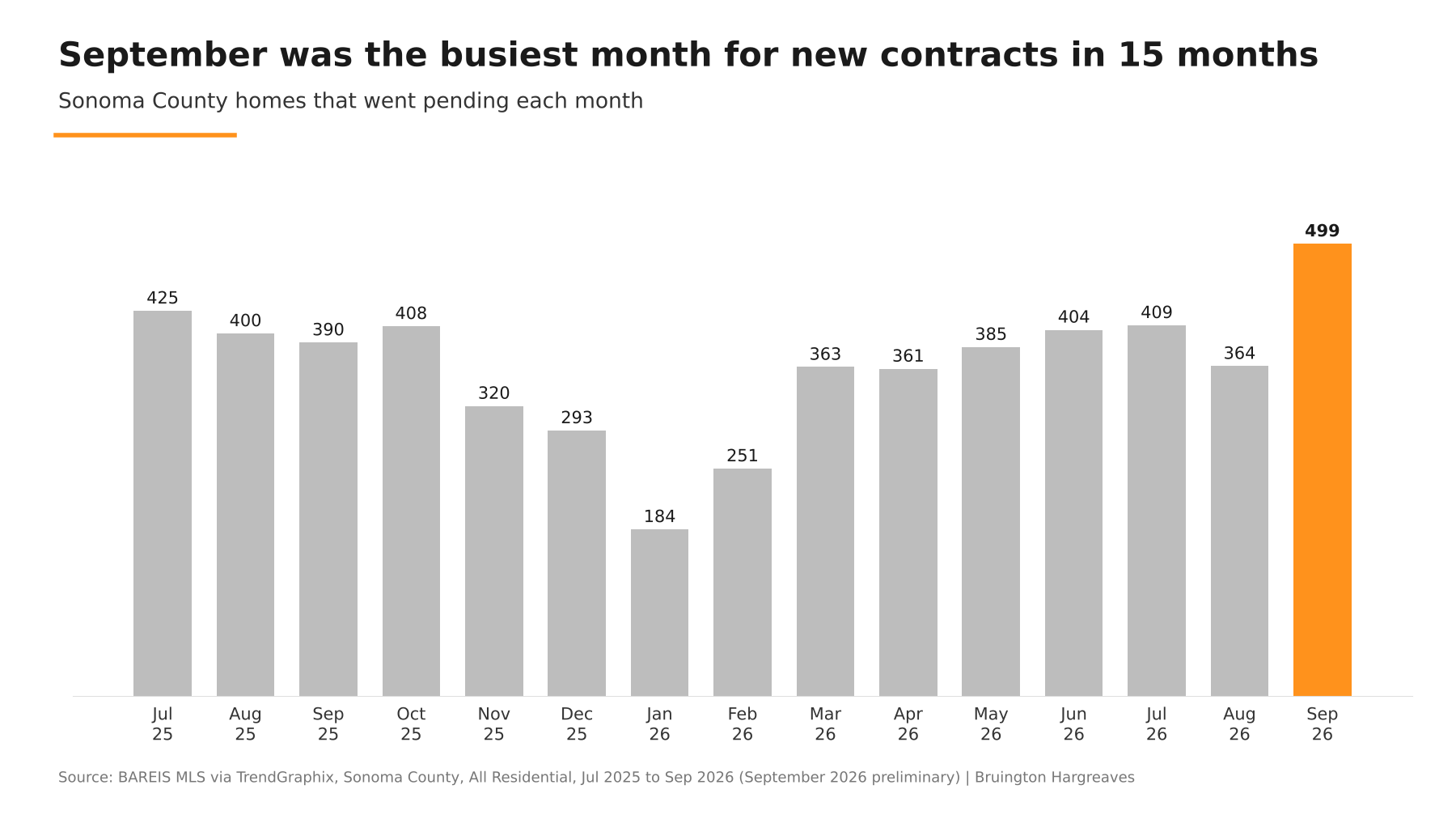
Closings tell a different story at first glance. They fell 6.6% to 1,133 for the quarter. But pendings rose 4.7% over the same period, and contracts usually close in 30 to 45 days. The slower closings look like timing, not weakness, and they point to a busier October and November than last year's 413 and 320 closings.
Three price bands, three different markets
Every price band moved toward sellers this year, but each for a different reason.
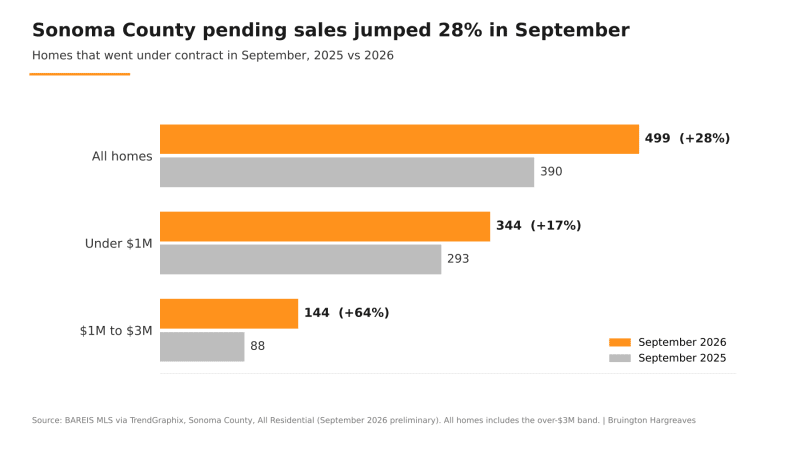
Under $1 million is still the engine of the county. It made up 71% of third-quarter sales, absorption held above 40% and homes sold for 97.3% of their original list price. Prices were flat: the median sold price rose 1% to $709,000, and the median list price fell 4% to $684,000, a sign that sellers are pricing to the market. September pendings rose 17%, from 293 to 344.
$1 million to $3 million had the most momentum. September pendings jumped 64%, from 88 to 144, and absorption that month hit 27.4%, up from 19.4%. Sellers kept 96.3% of their original list price, up from 93.7%, and the median sold price rose 3.8% to $1.42 million. This is where most Bay Area move-up and second-home buyers shop, so it matters most to our readers.
Over $3 million, supply is drying up. Homes for sale fell 22%, from 168 to 132, and new listings fell 21%, while sales rose from 31 to 34. Absorption of 8.4% still makes it a buyer's market, but it's the strongest third quarter in our data, and price per square foot rose 9% to $1,113. With only about 11 sales a month, ignore the median here: it swings with whichever homes happen to sell.
For a longer look at how each band behaves, see our breakdown of the market at three price points.
A two-speed county
Where you buy now matters more than when. Absorption ranged from 60% in Petaluma to 13% in Healdsburg, and only the wine-country luxury markets sat below the county's 32.6%.
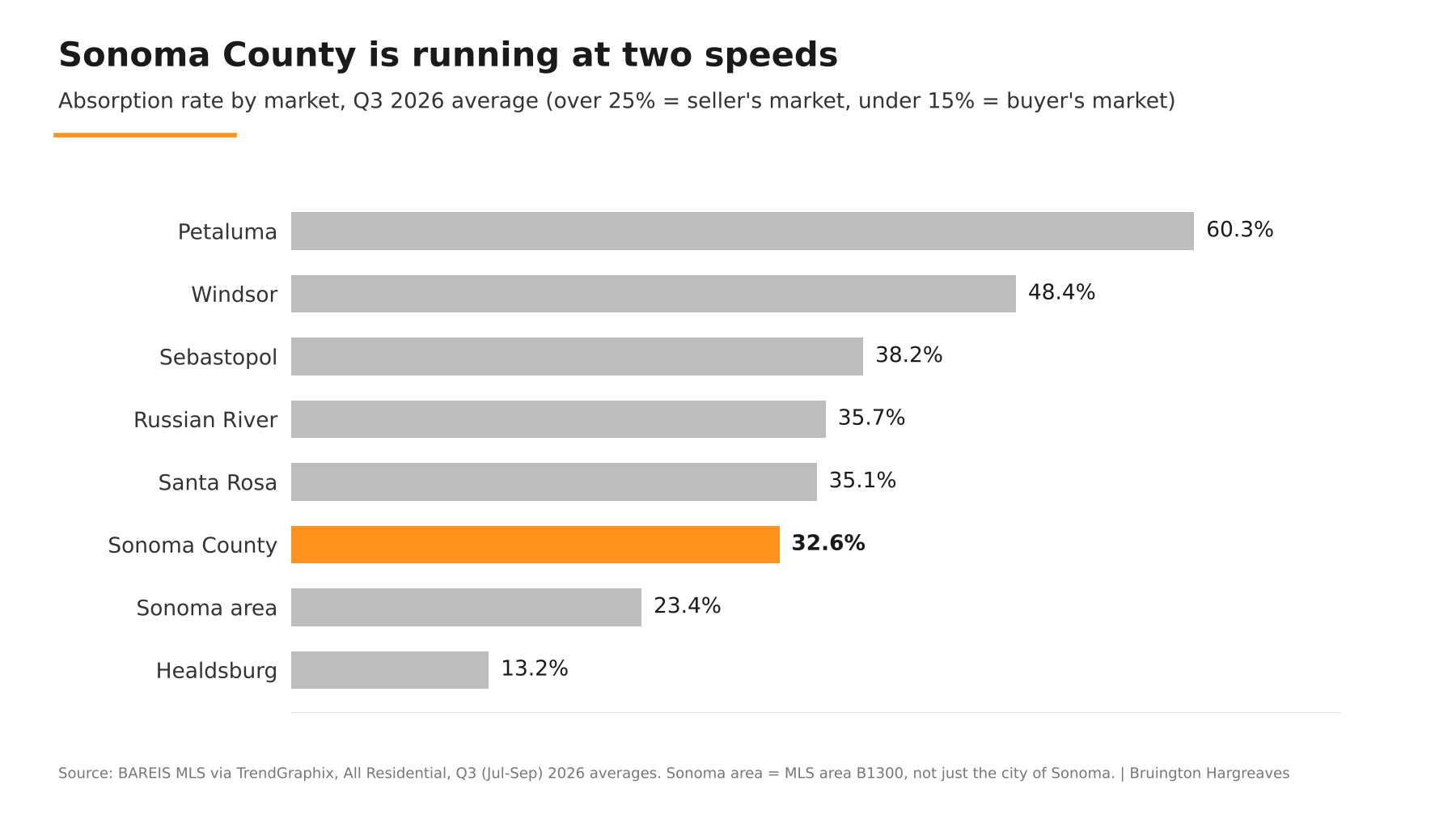
Petaluma is the tightest market in the county, with 26% fewer homes for sale than a year ago and 55 September pendings against 43.
Windsor is steady at 48% absorption and just 2.2 months of supply, though days on market rose from 51 to 63, the first sign that buyers are taking their time. Its under-$1 million median rose 5% to $811,000.
Sebastopol was the best $1 million to $3 million market: inventory in that band fell 29%, sales rose 19% and homes sold at 100% of their original list price.
The Russian River is recovering. Sales rose 7% to 94, absorption climbed to 36% and homes sold for 99% of their original list price, up from 94.7%. Its $573,000 median is the cheapest way into Sonoma County.
Santa Rosa has flat prices and healthy demand, with September pendings up 24% to 172. Its $1 million to $3 million median rose 12.6% to $1.43 million.
The Sonoma area (the wider MLS area, not just the city of Sonoma) is balanced at 23% absorption. Under $1 million, sales rose 24%, but sales between $1 million and $3 million fell 16%.
Healdsburg went the opposite way to the rest of the county, and it gets its own deep dive next week. If you're comparing towns, our ranking of the top-ranked Sonoma County cities is a good place to start.
Q3 vs Q2: a normal cool-down
Compared with the spring, the third quarter was softer. Absorption fell from 36.0% to 32.6% and days on market rose from 51 to 59. That's the usual summer-to-fall slowdown, which is why September's jump in pendings stands out.
Why October may look different
I wouldn’t read September as the start of a trend. Most of those contracts were signed before the latest rise in mortgage rates, and in the few weeks since, we’ve felt some of the air come out of the market. September’s contracts should still lift October and November closings, but I expect new contracts in October to look quite different, especially under $1 million, where buyers rely most on financing. For now, I’d treat September as a high point, not a new normal.
When buyers actually get leverage
If fall isn't the quiet season this year, last winter is the best guide to when it is. In January 2026, homes sold for 90% of their original list price, against 98% in May, and days on market stretched to 90.
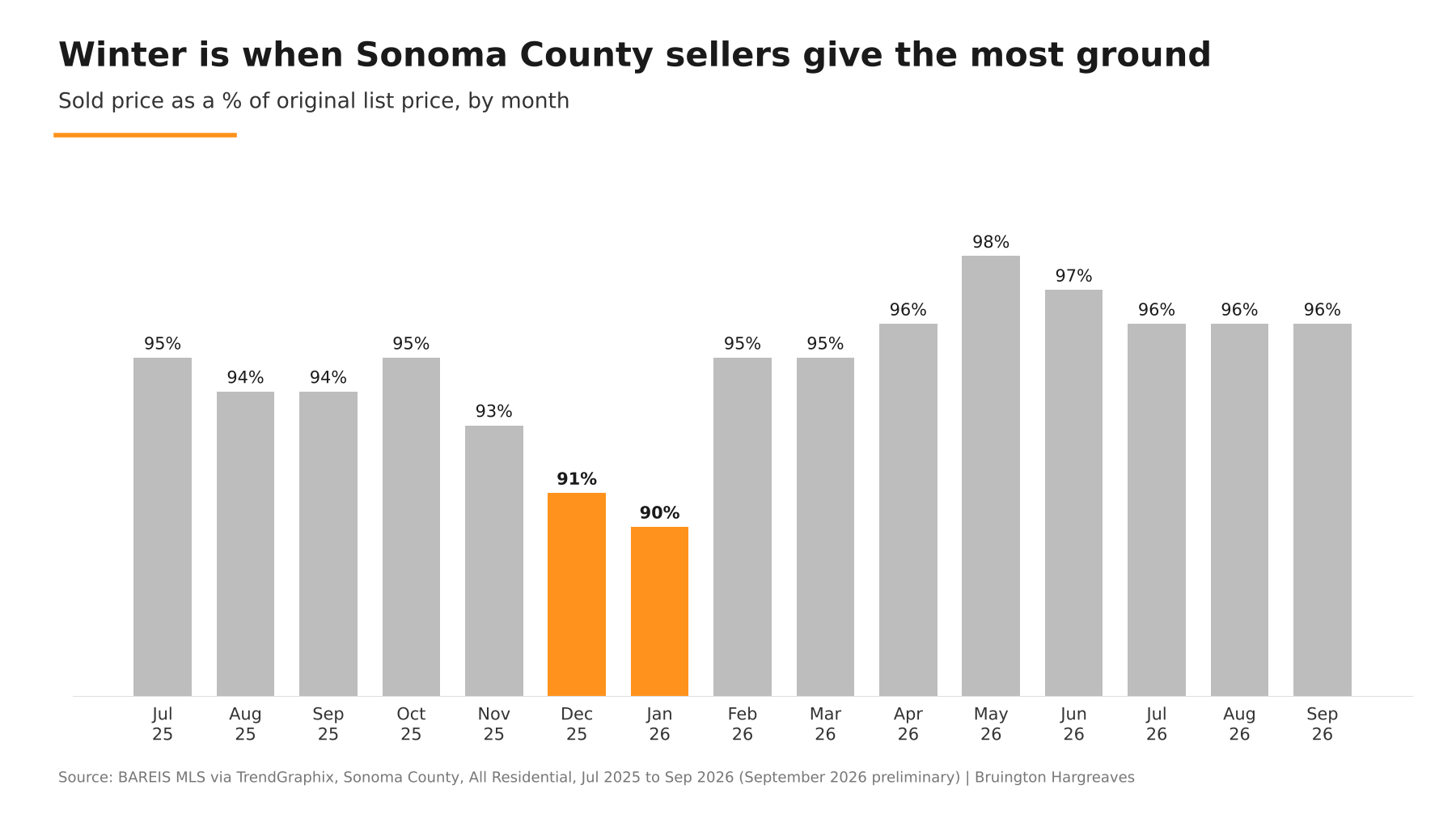
The trade-off is choice. Homes for sale fell from 1,268 in September 2025 to 630 in January, roughly half. You get more room to negotiate, but on a much shorter list.
If you need a specific home, town or price band, buy now while inventory is near 1,200 and before the holiday drop-off.
If you're flexible and price is everything, watch the homes still on the market in December. Those are the sellers most willing to deal.
If you're selling, the buyers are here now. Waiting for spring means competing with the 580 to 632 new listings that came to market each month last March and April.
One caveat: September's figures are preliminary, and some pendings will fall through before they close. I'll check October and November closings against these numbers and report back in December. In the meantime, here are the homes we have for sale right now.
Have questions about what this market means for your purchase or sale? Email me directly at david@bruingtonhargreaves.com.
About the Author
David Hargreaves is the co-founder of BruingtonHargreaves, one of Sonoma County's top-ranked real estate teams and part of W Real Estate. Originally from the UK and an Oxford University graduate, David built and ran a digital marketing agency serving Google, Facebook, and other major brands before becoming one of Sonoma County's top agents within three years of entering real estate.
Today he and business partner Jonathan Bruington have sold more than $250 million in Sonoma County homes over the past three years, earning recognition as a RealTrends No. 2 team in the county and the No. 1 team in Healdsburg. David specialises in helping Bay Area buyers and sellers with luxury properties and vacation rentals across Healdsburg, Windsor, Santa Rosa, and the Russian River communities.
He lives in Sonoma County with his wife Nancy and is happiest cycling the back roads, exploring local wineries, or behind a camera. Have a question about buying, selling, or building in Wine Country? Book a free call.