
The biggest mistake buyers make in Sonoma County isn't overpaying. It's buying the right house in the wrong spot. Daily life can change from one street to the next, even inside the same town, so the address matters as much as the house.
After nearly a decade selling homes here, these are the five things I tell every buyer to check before making an offer. If you're still deciding which Sonoma County town fits your lifestyle, start there, then work through this list.
1. Trusting the listing on schools and fire zones
Santa Rosa is the county's biggest city, and knowing a house is "in Santa Rosa" tells you very little. Two things have changed here recently, and both come down to the exact address.
Santa Rosa City Schools closed six campuses over two years, with the last closures this past June. Most high schools now serve grades 7 through 12, and thousands of students switched campuses. On top of that, about 10 public school districts serve the city and its edges, so one street can be in Santa Rosa City Schools and the next in Rincon Valley. A listing can name a school in good faith and still be using old boundaries. Run the address through the district's locator, then get the school assignment confirmed in writing for your child's grade and enrollment year before you remove a contingency.
Fire zones changed too. Santa Rosa has its own wildland-urban interface boundary, separate from the state's fire hazard maps. The city's map hadn't been updated since 2009; this year's update added roughly 3,000 parcels and took several hundred out. Inside that boundary, you must follow the city's defensible space rules, and when you sell you'll need a hazard disclosure and an inspection.
A fire map isn't an insurance quote. The state maps hazard by terrain, vegetation, and fire history, with no credit for a new roof or cleared brush. Coffey Park, which burned in 2017, is generally easier to insure today than hillside areas that never caught fire.
2. Ignoring the microclimate
The UC Master Gardener Program in Sonoma County describes three main microclimates, shaped by Pacific air, the hills, and cold air settling into low valleys. On a normal afternoon, Santa Rosa can be about 10 degrees warmer than Sebastopol, Graton, or Occidental, and two Sebastopol homes a couple of miles apart can feel completely different.
The "banana belt" is real, with warmer hillside pockets around Sebastopol. But there's no official boundary, so when a listing says banana belt, that's the seller's claim. Visit in the morning, afternoon, and around dinner. Check which rooms get sun, whether you'd sit on the patio in the evening, which way the land slopes, and where rainwater goes.
3. Guessing at the commute
Rohnert Park and Santa Rosa both have SMART stations. The train from Rohnert Park to Larkspur takes about an hour, and starting from Santa Rosa Downtown adds about eight minutes. If you're heading to San Francisco, you still need the ferry from Larkspur.

Leave Rohnert Park around 5:45 a.m. and you're off the ferry just before 8, before getting to the station or your office. SMART recommends at least 10 minutes between train and ferry if you're walking, and some scheduled connections are tighter. Driving has improved: the Narrows project is finished, giving three continuous lanes each way from Windsor to the Golden Gate Bridge. Rush hour is still rush hour, so test the trip on a weekday.
Rohnert Park's planned downtown is still on paper; the developer's plans reached the city council this fall. Today you get a comfortable residential city with easy driving, a university, and a train station, but no walkable downtown yet. Houses in both Rohnert Park and Santa Rosa sell in the low to mid $700,000s, below the county median of about $800,000, with Rohnert Park usually cheaper for condos and townhomes.
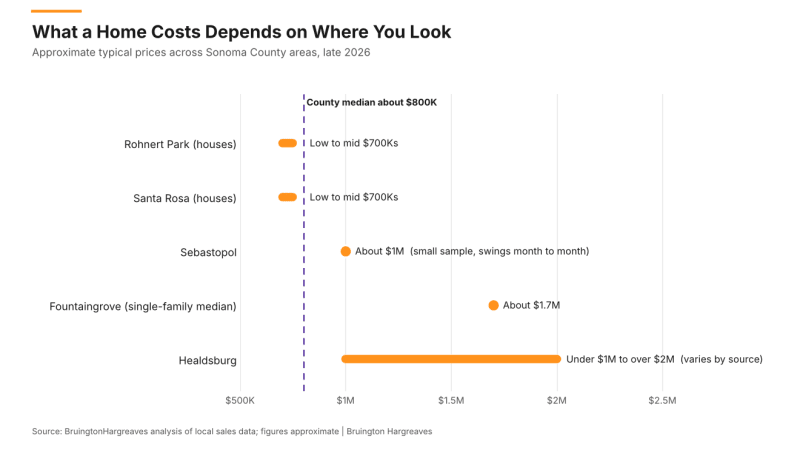
Watch small-town medians. Sebastopol sits around $1 million, but so few homes sell that one rural estate can push the median up by a few hundred thousand dollars for a month.
4. Buying walkability from photos
Healdsburg and Petaluma are the towns people fall for online. In Healdsburg, prices range from under $1 million to over $2 million depending on the source and month, because sites measure different things and only about 10 homes may sell in a slow month. The town limits new homes to an average of 30 a year, and in 2024 voters rejected loosening that rule in one area. That slows building, but it doesn't guarantee resale value. SMART is extending north, with service expected by the end of 2028, but the station site hasn't been chosen, so "walking distance to the future station" is a guess. If you're buying a home in Healdsburg, judge the house on what's there today.
Petaluma's historic downtown packs about 15 blocks of shops and restaurants along the river, with two train stations in town. Downtown street parking has time limits, exterior changes in historic districts usually need city review, and new rules near Petaluma Boulevard and the station allow taller buildings. In either town, walk your errand route from the front door on a weekday.
5. Underbudgeting luxury and views
In Fountaingrove, you can spend under $700,000 on a condo or over $4 million on a house, and the single-family median sits around $1.7 million. Homes can take two to three months to sell. Views come with hillside issues like access, drainage, and retaining walls. If a house is a post-2017 rebuild, ask what was built and when, whether it received final approval, what the roof, vents, and decks are made of, and which vegetation management zone it sits in.
Then price the insurance from day one. The California FAIR Plan covers fire and smoke but not liability, theft, or most water damage, so most owners need a second policy and pay two premiums. Its dwelling limit is around $3 million, so a costlier rebuild leaves a gap to fill. Shop around first, and don't assume you'll pay what the seller paid. (More on the California home insurance crisis.)
Most of these checks are free. Do them on the specific property, not just the town, before you remove your contingencies.
Trying to work out which part of Sonoma County fits your life? Email me directly at david@bruingtonhargreaves.com and I'll help you check the address before you make an offer.
About the Author
David Hargreaves is the co-founder of BruingtonHargreaves, one of Sonoma County's top-ranked real estate teams and part of W Real Estate. Originally from the UK and an Oxford University graduate, David built and ran a digital marketing agency serving Google, Facebook, and other major brands before becoming one of Sonoma County's top agents within three years of entering real estate.
Today he and business partner Jonathan Bruington have sold more than $250 million in Sonoma County homes over the past three years, earning recognition as a RealTrends No. 2 team in the county and the No. 1 team in Healdsburg. David specialises in helping Bay Area buyers and sellers with luxury properties and vacation rentals across Healdsburg, Windsor, Santa Rosa, and the Russian River communities.
He lives in Sonoma County with his wife Nancy and is happiest cycling the back roads, exploring local wineries, or behind a camera. Have a question about buying, selling, or building in Wine Country? Book a free call.