
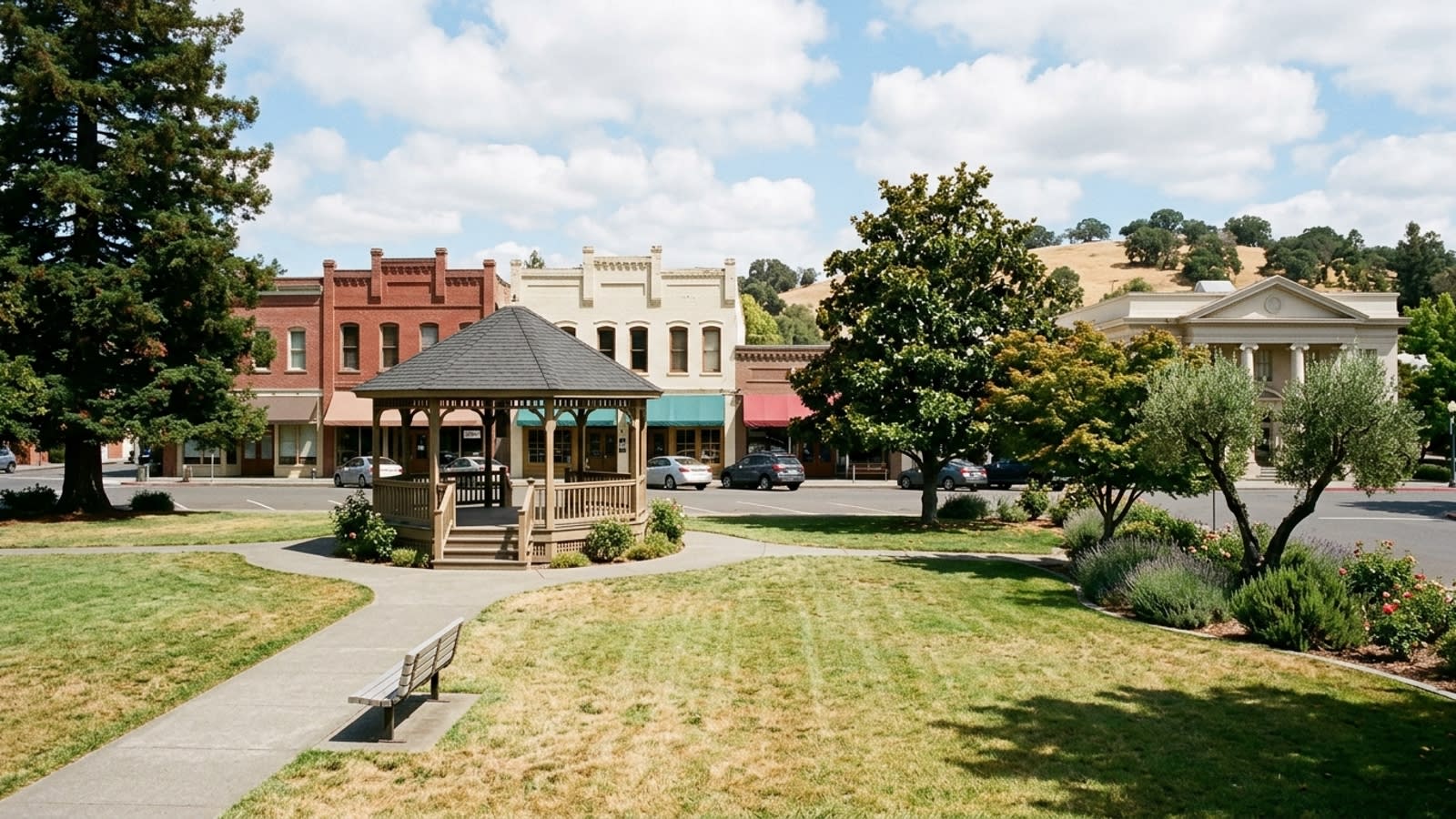
If you're looking at property in Sonoma County and weighing the pros and cons of living in Healdsburg, you've probably already noticed that the city feels different from its neighbors - more self-contained, more deliberate. That's not an accident. The city grew outward from a central plaza according to a plan its founders laid down in the 19th century, and that original structure is still visible today. The median sale price sits around $1,089,000, which tells you something about how the market values that continuity.
Local history helps you read the streets. The architectural styles shift as you move away from downtown, the preservation rules vary by district, and the lot patterns reflect different eras of expansion. None of that is obvious until you understand the timeline behind it.
A Quick Look at Local History
Healdsburg is an incorporated city inside Sonoma County - not a neighborhood, not an unincorporated community, but a municipality with its own government, its own zoning authority, and its own preservation guidelines. It sits within the Santa Rosa-Petaluma, CA Metropolitan Statistical Area, which gives it regional connectivity without sacrificing its distinct local identity.
The market right now has roughly 70 homes available, with properties spending an average of 67 days on the market before selling. You'll find homes that date back to the city's earliest decades alongside thoroughly updated newer construction. The range is real.
What shaped the inventory is a growth pattern that moved steadily outward from a 19th-century core. Early infrastructure set the template, and each subsequent decade added new residential fabric around it. That progression is still legible if you know where to look.
Defining the Area
Healdsburg is a recognized city, not a neighborhood or unincorporated town. That distinction matters practically: the city manages its own local services, its own zoning laws, and its own historic preservation guidelines.
For buyers interested in older properties, those preservation rules carry real weight. They govern what can and can't be changed on the exterior of homes in designated historic sections. Before you fall in love with a Victorian and start sketching renovation plans, you'll want to know which rules apply to that specific parcel.
Location and County Boundaries
Healdsburg falls entirely within Sonoma County, CA - no county line splits the city, which keeps property taxes and municipal services clean and straightforward. If you're buying near the city's outer edges, verify your parcel boundaries, but for most transactions the single-county jurisdiction simplifies things considerably.
The city functions as part of the Santa Rosa-Petaluma, CA Metropolitan Statistical Area. Early roads and transit routes were built to move agricultural goods to larger regional markets, and those same corridors now carry daily commuters. That geographic positioning is a big part of why the city developed into a regional hub rather than a quiet backwater.
The current housing supply sits at about 6.2 months, which points to a relatively balanced market - not the frenzied seller's conditions you see in some parts of the Bay Area, but not a buyer's paradise either.
Metro Connections and Regional Growth
The relationship between Healdsburg and the broader Santa Rosa-Petaluma metro shaped its economic trajectory from the beginning. Goods needed to move, so roads got built, and people followed the infrastructure. As the parent metro expanded over the decades, Healdsburg absorbed some of that regional growth while holding onto its original layout - the plaza is still the center, and the street grid still radiates from there.
The Story Behind the Name
The name Healdsburg traces directly to the family that laid out the original town grid. Early settlers throughout 19th-century California commonly named new settlements after the individuals who established the first commercial and residential structures, and this one was no different.
The suffix "-burg" is straightforward - it denotes a town or city, combined here with the founder's surname. The name has stayed unchanged since the city's early days, which is more than you can say for a lot of California communities that have rebranded or reorganized over the years.
What the Name Means Today
To current residents, the name signals a specific cultural and historical identity within Sonoma County. Local businesses, schools, and municipal departments all operate under it. The literal meaning is simply the founder's town, but the name now carries the weight of the region's signature industries and established reputation in the Northern California market - which is part of what buyers are purchasing when they choose this city over its neighbors.
Settlement and Timeline of Growth
The physical layout of Healdsburg evolved outward from a compact 19th-century core. Early maps show a tight grid focused on the central plaza and the commercial and public spaces that surrounded it. Residential neighborhoods grew around that center as the population expanded, and the architectural evidence of each era is still visible if you track construction dates moving outward from downtown.
By the late 1800s, distinct districts were already forming with their own housing types. As the local economy diversified, the city incorporated new tracts of land, and lot sizes and design sensibilities shifted with each addition.
Tracking the City's Expansion
Historical maps make the growth sequence concrete. The original town limits were tight, organized around immediate access to the central plaza. Later additions pushed outward with larger lots and different architectural vocabularies - mid-century modern designs show up in the peripheral neighborhoods in ways you simply won't find closer to the historic core.
For buyers, this timeline is a practical search tool. If late 19th-century architecture is what you're after, you stay near the city center. If you want newer construction or larger lots, you look at the outer developments.
Historic Districts and Landmarks
Two areas carry formal historic district designation: the Johnson Street Historic District and the Matheson Street Historic District. The Johnson Street district is known for its Queen Anne and Neoclassical homes dating to the late 1800s. Both districts require property owners to follow specific guidelines when making exterior changes - the goal is to preserve the visual character of the streetscape, not just individual buildings.
The anchor for all of it is Healdsburg Plaza. This 19th-century town square, centered around a gazebo, is still an active gathering space for residents and still sits at the center of the commercial district. It's a direct physical connection to the city's original town plan, and it's the reason the grid around it looks the way it does.
Local Museums and Preservation
Local history museums and historical societies keep extensive archives - photographs, documents, artifacts - that document the city's transition from a small 19th-century settlement to its current form. Buyers purchasing older homes consult these records regularly, using them to research a property's origins, understand the historical context of a neighborhood, and guide accurate restoration of original features. It's a resource worth knowing about before you close on anything with significant age.
Local Culture and Claims to Fame
Healdsburg built its identity on agriculture, and that foundation shapes everything that followed - the culinary scene, the local markets, the regional reputation that draws buyers here specifically rather than to neighboring towns. The area produces signature foods and ingredients that are central to local restaurants and celebrated throughout Sonoma County.
That reputation has real market implications. Homes here sell for about 96.5% of their list price, and buyers frequently cite proximity to high-quality dining and historical food markets when explaining why they chose this city. The combination of preserved architecture, strong local industries, and a recognized cultural identity keeps demand steady.
Signature Foods and Regional Identity
The local food culture connects directly to the surrounding Sonoma County agricultural landscape. Access to locally grown produce and regional specialties isn't incidental - it's woven into daily life here. For buyers weighing Healdsburg against other Northern California options, that access is often the deciding factor, not just an amenity.
Frequently Asked Questions
What county is Healdsburg, CA in?
Healdsburg is located entirely within Sonoma County. It does not cross into any neighboring counties.
Is Healdsburg a city, town, or neighborhood?
It's an incorporated city. It manages its own municipal services and zoning regulations within the Santa Rosa-Petaluma metro area.
When was Healdsburg, CA founded?
The area was settled and established in the 19th century. Its early development centered around the original town square.
How did Healdsburg get its name?
The city is named after its founding namesake and original settlers. The suffix "-burg" was added to the founder's surname to designate the new town.
What is Healdsburg, CA known for?
The city is known for its historic 19th-century plaza, preserved residential districts, and signature local foods. It also has a strong reputation tied to its surrounding agricultural industries in Sonoma County.
What are the main historic districts and museums in Healdsburg, CA?
The main historic areas are the Johnson Street Historic District and the Matheson Street Historic District. The city's historical center is Healdsburg Plaza, a 19th-century town square with a central gazebo.
How does Healdsburg compare to Sonoma?
Buyers evaluating the differences between Healdsburg and Sonoma often focus on the distinct local identity of each municipality. Healdsburg stands out for its 19th-century central plaza and the specific preservation guidelines that maintain its historic street grid. Both locations offer strong agricultural and culinary scenes within the broader county.