

A short-term rental in California needs its own insurance policy, because a standard homeowners policy can deny a claim the moment it learns the house was rented to guests. If you plan to buy a vacation rental in Sonoma County this year, insurance, financing and permits all need to line up in the next few weeks, because the tax benefit that makes the numbers so attractive only applies if the home is in service by December 31.
Here is what the timeline looks like, what you could save, and how to insure and finance the property properly.
Why the clock matters right now
Under current federal tax law, 100% bonus depreciation is back for property acquired after January 19, 2025. Pair that with a cost segregation study and the so-called short-term rental rules (average guest stays of seven days or less, and you materially participate in running the home), and the first-year paper loss can offset your W-2 or business income. We explain the full strategy in our Sonoma County Vacation Rental Rules 2026: Permits, Caps and Zoning blog.
On a $1,000,000 home with $750,000 of depreciable building value, a cost segregation study often reclassifies 25-35% of that basis into short-life assets. At 30%, that is $225,000 written off at once, plus regular depreciation on the rest: roughly $238,000 in year one, against about $19,000 on the standard 39-year schedule. In the 37% federal bracket, that could mean around $88,000 of federal tax saved in year one. California does not follow federal bonus depreciation, so the benefit is federal. Your CPA should run your own numbers.
The catch is that the home must be placed in service, meaning permitted and ready to rent, by the end of the calendar year. In Sonoma County that means a vacation rental permit, a TOT (Transient Occupancy Tax) number and a business license. Permits do not transfer on sale, so the new owner always applies from scratch. Allow about 45 days for the permit and about 30 days to find and buy the right home, and you can see the problem: as of today, there are 62 days left in 2026.
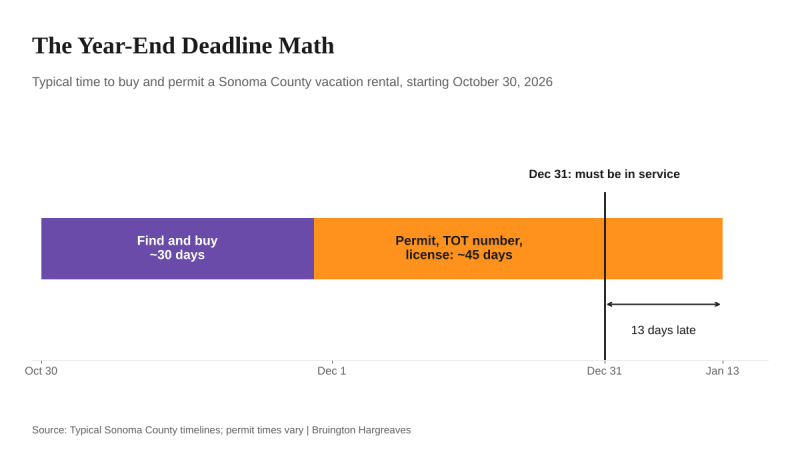
That is why we have two turnkey vacation rentals ready to buy and get into service now. Furnished, set up and in permit-eligible zoning, they cut weeks out of the process. You can see them on our current listings page, or email me for the income figures.
Why a vacation rental needs a different policy
Robert Pane of Rate Insurance, who insures STRs across Sonoma County, puts it simply: the risks change. More foot traffic means more theft and more water claims. Your liability also shifts from owner-occupied to tenant-occupied, which opens the door to claims a homeowners policy was never priced for, such as discrimination, illegal eviction, slander or libel.
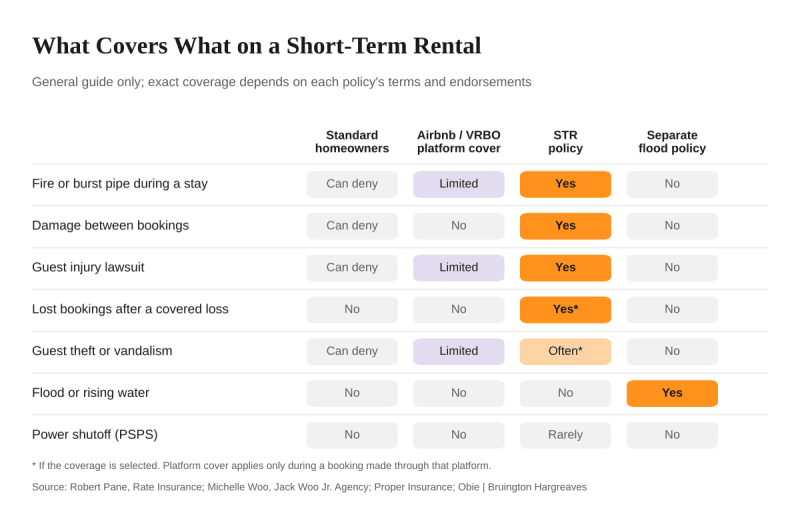
A vacation rental policy covers the same core items as a home policy (dwelling, contents and furnishings) plus liability for guest occupancy. Look for loss-of-rental-income cover too. After a covered loss, it should pay lost bookings until the home is habitable again, up to the policy limit.
Three gaps catch owners off guard. Flood is always a separate policy, which matters for Russian River homes in Guerneville, Monte Rio and Forestville. A burst pipe or leaking fridge should be covered, but rising water is not. Power shutoffs (PSPS events) are typically not a covered peril. And the most common claims are water damage, theft and vandalism: guests backing up toilets, overflowing tubs, or leaving a leak unreported. Keeping the home safe and up to local code is one of the best ways to avoid them.
Why Airbnb and VRBO cover is not enough
AirCover and VRBO's protection apply only during a booking made through that platform, and the platform tends to hold the upper hand in a dispute. They do not cover the dwelling between bookings, and the terms change often. If your underlying policy does not allow short-term rental use and something happens during a stay, that policy can deny the claim, and that happens a lot.
How much liability cover you need
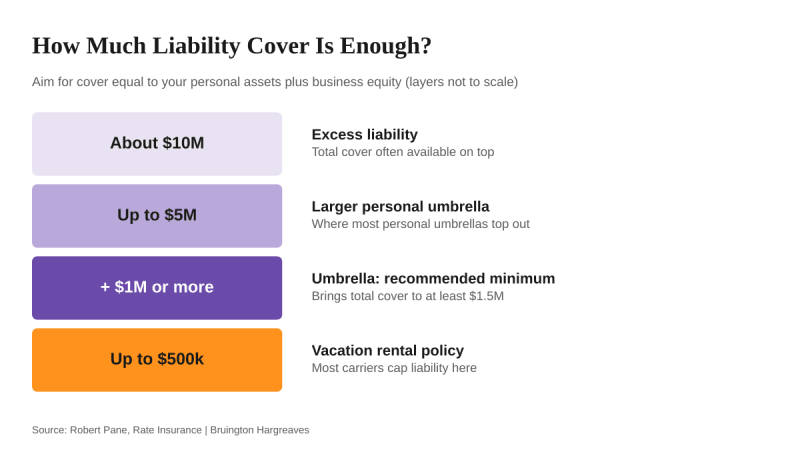
Most carriers cap vacation rental liability at $500,000. Add at least another $1 million through an umbrella or excess policy. A good target is your personal assets plus your business equity. Personal umbrellas usually top out at $5 million, though about $10 million in total is often possible.
Wildfire, the FAIR Plan and surplus lines carriers
In much of Sonoma County, the admitted carriers are not writing higher-risk homes, so most STR owners end up with a non-admitted, or surplus lines, carrier. These insurers are not licensed by California in the usual way and are not backed by the California Insurance Guarantee Association if they fail, so check that the carrier is A-rated. Premiums also carry a California surplus lines tax and stamping fee.
The upside is real. The FAIR Plan is best treated as a last resort, and many owners have swapped FAIR Plan plus wrap-around policies for surplus lines cover that is broader and, in most cases, cheaper. We cover the wider picture in our guide to the California home insurance crisis.
Where the FAIR Plan is still needed, a companion policy can fill the gaps. The Windsor-based Jack Woo Jr. Agency, a Farmers Insurance agency, offers short-term rental cover through Foremost, part of the Farmers Insurance Group of Companies. As agency manager Michelle Woo explains, depending on location and eligibility, a Foremost policy may be available without a FAIR Plan policy. Where it is not, an eligible home may qualify for a FAIR Plan policy paired with a Foremost companion (wrap-around) policy. The FAIR Plan covers specified causes of loss such as fire but provides no liability cover, so review the two policies together for limits, deductibles and exclusions.
What it costs and how to lower it
There is no reliable price range, because every home differs. STR use typically adds about $1,000 a year over a standard policy; the bigger effect is fewer carriers to choose from. Distance to a hydrant or fire station, the home's age, nearby brush and the rebuild cost all push premiums up. Defensible space and wildfire hardening are often required. Water shutoff valves, monitored fire and security systems and tankless water heaters can earn discounts.
How to finance a vacation rental
For financing, we turned to Stephen Barber, branch manager and SVP of mortgage lending at Rate. He starts with the old-school route: if your W-2 income covers both your current home and the new mortgage, a standard loan works, with debt-to-income ratios up to 43% (49.9% on some programs). If you already own a home, most lenders will count projected long-term rent, and a few niche lenders, Rate included, will count projected STR income.
If not, there are alternatives. Self-employed buyers and investors who show paper losses can qualify on 12 months of bank deposits. Buyers with large portfolios can qualify on assets, a method he jokingly calls "we like to lend to rich people": divide your assets by seven to set an annual income.
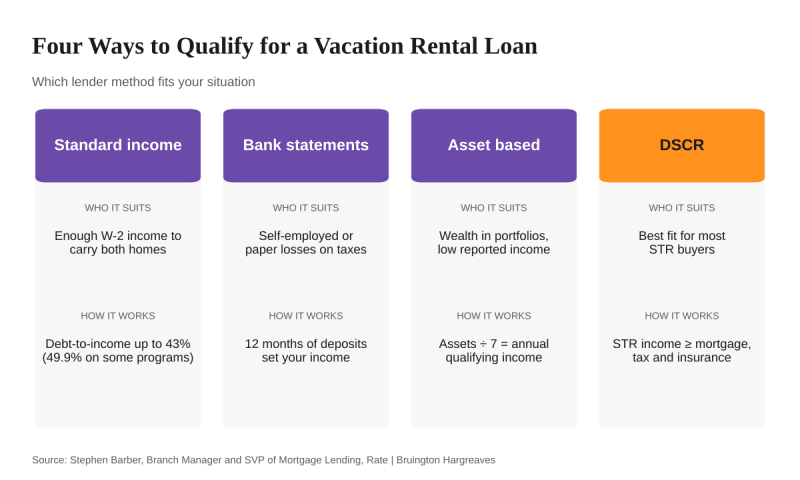
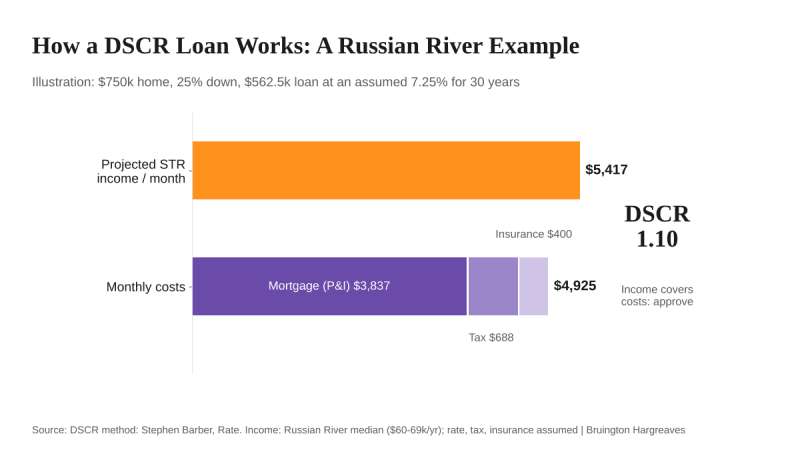
The best fit for most STR buyers is positive cash flow underwriting, known in the industry as a DSCR (debt service coverage ratio) loan. The lender compares projected monthly STR income with the monthly mortgage, property tax and insurance. If income equals or exceeds the costs, approval is straightforward. On a $750,000 Russian River home with 25% down, for example, about $65,000 a year in rental income (in line with the area's $60-69k median) covers a monthly mortgage, tax and insurance bill of roughly $4,900, for a ratio of about 1.10.
Income can come from an AirDNA report, an STR appraisal through NAN, a traditional appraiser working with a local vacation rental office, or 12 months of Airbnb or VRBO booking history. DSCR works best if you are not a first-time buyer, and pricing improves with 25% down. Some niche lenders now offer DSCR-based HELOCs too, letting you pull equity out of an STR without touching your first mortgage.
Before you write an offer, tell your insurance agent exactly how the home will be used, then review rebuild cost, contents, guest liability, rental income cover, pools or hot tubs, and how often you will use the home yourself. Getting quotes during escrow, not after, protects both your closing date and your year-end deadline. If you are still choosing an area, start with our vacation rental rules and our list of permit-eligible homes.
Want to see the two turnkey homes or check whether you can still make the 2026 deadline? Email me directly at david@bruingtonhargreaves.com.
Sources: Rate Insurance; Jack Woo Jr. Agency (Farmers Insurance); Rate; Proper Insurance; Obie.
About the Author
David Hargreaves is the co-founder of BruingtonHargreaves, one of Sonoma County's top-ranked real estate teams and part of W Real Estate. Originally from the UK and an Oxford University graduate, David built and ran a digital marketing agency serving Google, Facebook, and other major brands before becoming one of Sonoma County's top agents within three years of entering real estate.
Today he and business partner Jonathan Bruington have sold more than [ADD SALES VOLUME] in Sonoma County homes over the past three years, earning recognition as a RealTrends No. 2 team in the county and the No. 1 team in Healdsburg. David specialises in helping Bay Area buyers and sellers with luxury properties and vacation rentals across Healdsburg, Windsor, Santa Rosa, and the Russian River communities.
He lives in Sonoma County with his wife Nancy and is happiest cycling the back roads, exploring local wineries, or behind a camera. Have a question about buying, selling, or building in Wine Country? Book a free call.
Jack Woo Jr. Agency disclosure: This information is a general overview, not an insurance quote, binder or guarantee of coverage. Products and coverages may not be available in all areas and are subject to underwriting eligibility. Coverage depends on the policies and endorsements issued, including their terms, exclusions, limits and deductibles. Optional coverages may require additional premium. The California FAIR Plan is separate from Farmers and Foremost. Each insurer is responsible for its own policies and obligations.