
Sonoma County home prices aren't moving in one direction, which is why Redfin says up and Zillow says down. Nothing crashed in 2026 and nothing took off. Instead, the market is pricing each home on what it costs to own every month, what you're allowed to do with the property, and how much risk comes with the address. Here are the seven forces behind that shift.
The countywide picture is steady. In a typical month this spring, about a third of the homes for sale went under contract, and normal homes closed close to their original asking price. Homes still took around seven weeks to sell, so this isn't a frenzy. Town by town, though, the differences are sharp: Petaluma was close to sold out, while Healdsburg was the coolest market in the county, with homes taking close to three months to sell.
1. Insurance is a hidden price-setter
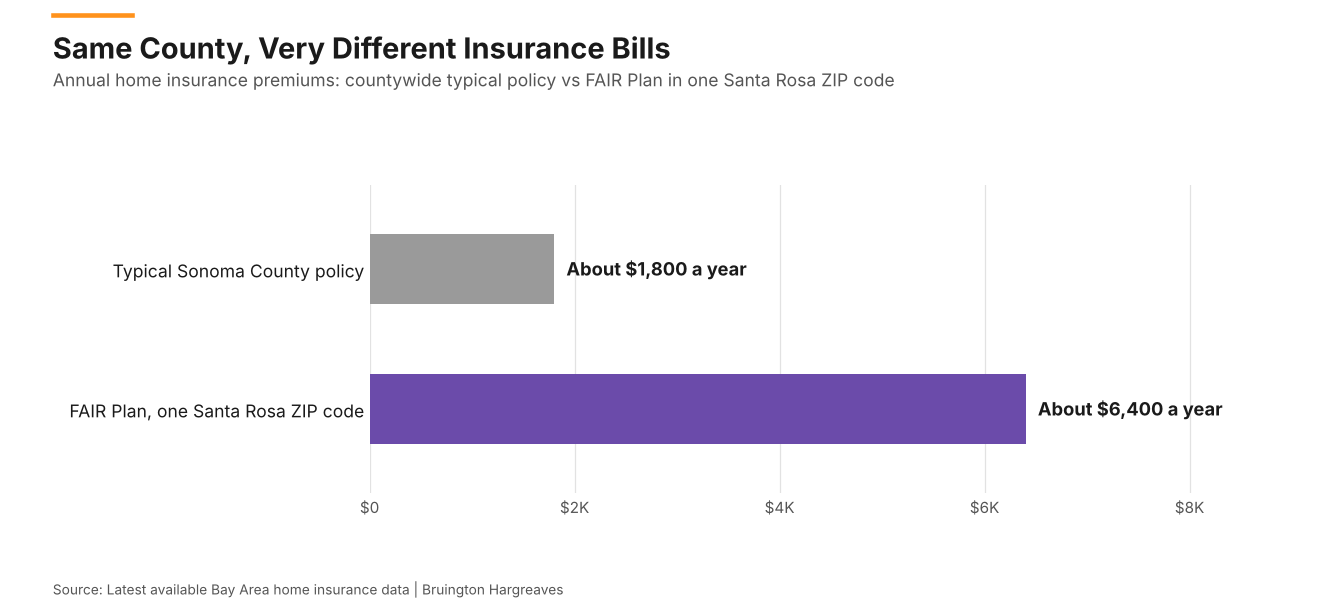
Over the last decade, Sonoma County saw the steepest rise in home insurance costs in the Bay Area, up nearly 40%. The typical policy runs around $1,800 a year, but in one Santa Rosa ZIP code, homeowners on the FAIR Plan, California's insurer of last resort, pay around $6,400.
In Rio Nido, near Guerneville, more than a quarter of policies weren't renewed in 2023, the highest rate in the Bay Area, and Jenner made the Bay Area's top 10 for homes moving onto the FAIR Plan. Statewide, FAIR Plan growth has slowed this year, which is encouraging. If you're buying in the hills, along the river, or in a higher-risk area, get a quote before you write the offer. (More on the California home insurance crisis.)
2. The price-band split
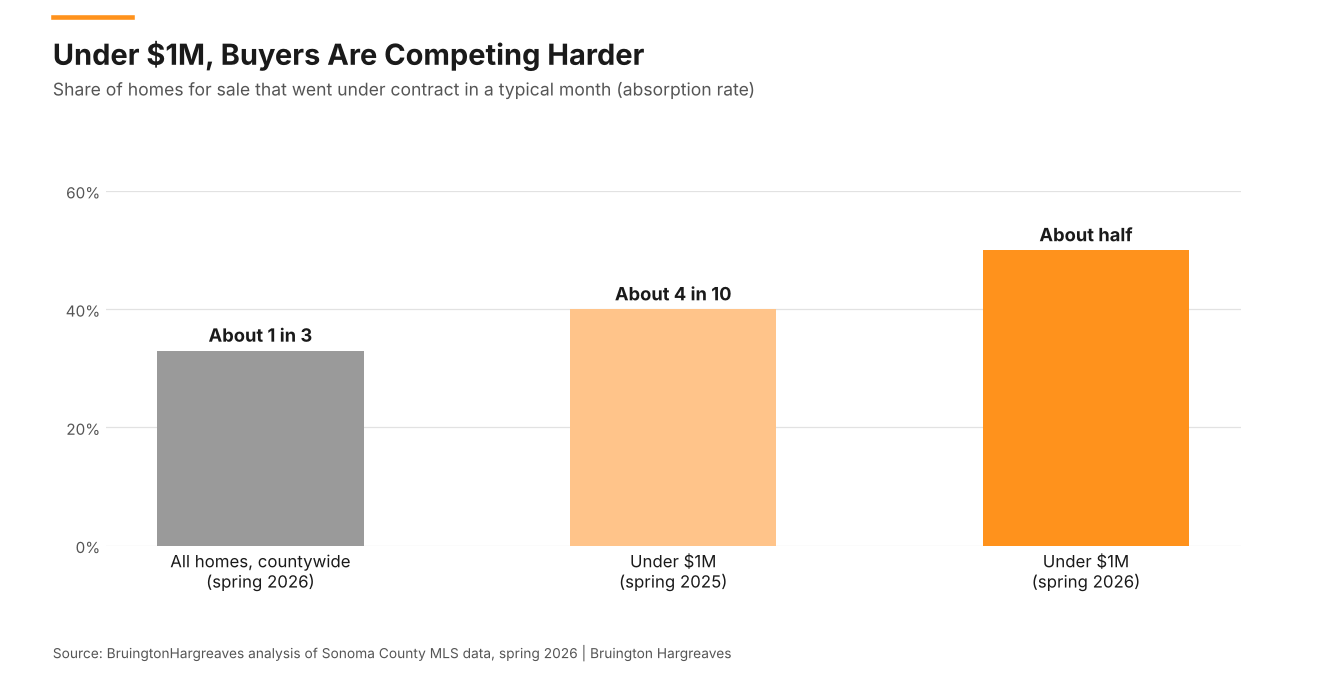
Under $1 million, about half the homes for sale went under contract each month this spring, up from about four in 10 a year earlier. In Santa Rosa and Windsor it was more than half, and in Petaluma, homes under $1 million went under contract faster than new ones came on. Even so, prices stayed in the low $700,000s; buyers are near the limit of their budgets.
From $1 million to $3 million, prices sit around $1.4 million and have edged higher, but homes take about a week longer to sell than last year. Earlier this year, homes between $2 million and $3 million averaged more than four months on the market and closed at about 90% of their original price. Above $3 million, spring sales rose by more than half and the pace roughly doubled. I break this down further in Sonoma County Housing Market: 3 Price Points, 3 Stories.
3. Wine's contraction is changing farmland
Sonoma County's wine industry is in its fifth straight year of decline. The harvest has fallen by nearly a third from its peak, and last year roughly three in 10 grapes grown here never found a buyer. Growers pulled thousands of acres in a single year, Jackson Family Wines closed its Carneros Hills winery, and Arista in Healdsburg is ending winemaking.
This is pressure on one industry, not a countywide recession; total employment is still edging up, led by health care and hospitality. But it changes how farmland is valued. A turnkey vineyard can now be harder to sell if the next owner doesn't want the vines, so look at what the land can support next, not only what's planted today.
4. Vacation rental eligibility is a price feature
In unincorporated Sonoma County, new vacation rentals are no longer allowed in low-density residential zones, Fitch Mountain has a cap, and new permits are limited to one per person. Inside Healdsburg city limits, they're only allowed in the commercial district with a special use permit. A permit doesn't transfer automatically when a home sells, so the buyer must qualify under the current vacation rental rules.
Across the broader Healdsburg area, only about 28 eligible homes came on the market last year. And while about six in 10 Healdsburg purchases in 2024 were second homes or investments, that includes weekend homes the owners use themselves, and a large share of those buyers were Healdsburg locals.
5. Bay Area wealth is landing unevenly
San Francisco's median house price hit a record this spring at a little over $2 million, fueled partly by AI salaries and stock wealth. For the price of one typical San Francisco house, you can buy more than two typical homes in Sonoma County. I can't prove from sales data alone that this money is driving our luxury rebound, but the pattern fits. It shows up in certain towns and price ranges, not everywhere, so strength at the top doesn't mean every part of the county is rising.
6. Flood maps are being redrawn
FEMA updated the Russian River flood maps in 2024 for the first time in more than 30 years, and some zones grew around Guerneville, Monte Rio, and Rio Nido. Move into a flood zone and your lender may require flood insurance, with extra rules when you build. The county has a tool to compare old and new boundaries parcel by parcel.
Map changes can help, too. Near Santa Rosa and Rohnert Park, a county study of Todd Creek changed the designation on nearly a third of the parcels it reviewed, and more than half of those moved out of a flood zone.
7. ADU rules are adding value to the right lots
Since January 8, most single-family lots in unincorporated Sonoma County can have two ADUs plus a junior ADU, attached, detached, or converted, with no parking requirement. The county has also moved to remove an old overlay that restricted ADUs on nearly 4,000 parcels. City rules apply inside places like Santa Rosa and Healdsburg.
A large rural lot may gain room for a guest house or a home for family, while a small lot may gain little. And the land still has to support it: you'll need to show the septic system can handle a new unit, and in water-scarce areas the well may need to pass a dry-season test.
Before you buy or sell, check three things on the address: the insurance quote, the flood zone, and what the lot is allowed to do. Whichever one differs from your neighbors' is probably what's pricing the home.
Seeing something unusual on a home you own or want to buy? Email me the address at david@bruingtonhargreaves.com, and I'll help you work out which of these forces matters most for that property.
About the Author
David Hargreaves is the co-founder of BruingtonHargreaves, one of Sonoma County's top-ranked real estate teams and part of W Real Estate. Originally from the UK and an Oxford University graduate, David built and ran a digital marketing agency serving Google, Facebook, and other major brands before becoming one of Sonoma County's top agents within three years of entering real estate.
Today he and business partner Jonathan Bruington have sold more than $250 million in Sonoma County homes over the past three years, earning recognition as a RealTrends No. 2 team in the county and the No. 1 team in Healdsburg. David specialises in helping Bay Area buyers and sellers with luxury properties and vacation rentals across Healdsburg, Windsor, Santa Rosa, and the Russian River communities.
He lives in Sonoma County with his wife Nancy and is happiest cycling the back roads, exploring local wineries, or behind a camera. Have a question about buying, selling, or building in Wine Country? Book a free call.