
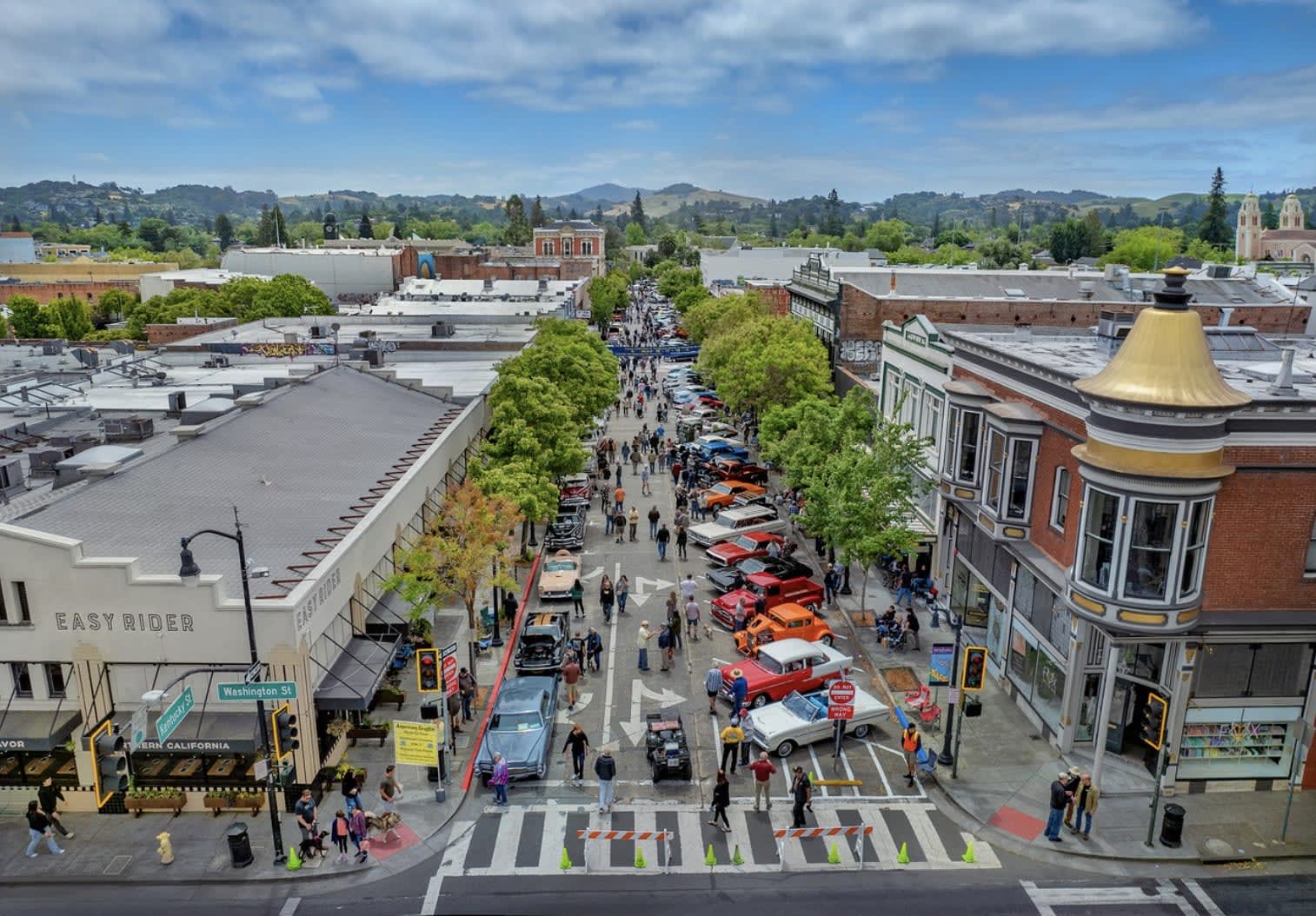
Sonoma County's population has been shrinking, yet the towns where people most want to live are pulling in new residents, new money, and new investment. On paper the county looks like it's losing ground. Underneath, demand is concentrating in a handful of towns, major projects are reshaping whole neighborhoods, and some of the strictest building rules in the region are keeping supply tight. Here are the five forces I'm watching that could put Sonoma County in a very different place over the next five years.
Five forces shaping Sonoma County real estate through 2031
1. Migration is concentrating in the best towns
Forget the price charts for a second. The simplest question about where a market is headed is this: are people showing up, or packing up?
For years the story was the California exodus, and Sonoma County lost people along with the rest of the state. That was real. But the out-of-state exodus has slowed sharply since the pandemic peak, and the county's population has flattened out instead of falling.
Here's the part hardly anyone is talking about. In the latest count, only two places in the entire county added residents: Santa Rosa and Healdsburg. Not five. Not seven. Two. Everywhere else, including the rural areas, lost people.
Where Sonoma County added residents in the latest count
Source: Sonoma County Features analysis of state population estimates
Demand isn't spread evenly. It's concentrating in towns with walkable downtowns, a strong sense of lifestyle, and the things people actually want nearby. From years of working with these buyers, I can tell you they're mostly Bay Area remote workers and downsizers: people who can live anywhere and are choosing the plaza, the tasting rooms, and a slower pace. San Francisco is about an hour south, so they keep the network without the commute.
That matters for your money. When high-earning buyers keep choosing the same towns, they put a floor under values. Even when the market softens, a deep pool of buyers is ready to step in. You can see that floor in Healdsburg and Santa Rosa; in the towns losing people, the buyer pool is much thinner. If you want to own where resale demand is strongest, own where the money is moving. For clients chasing the luxury Bay Area buyer pool, that usually means buying a home in Healdsburg.
2. Money is going into the ground
One rule has held true my whole career: follow the money into the ground, and appreciation shows up a few years behind it. That money is flowing into exactly the towns you'd want.
| Town | Project | Scale | Why it matters |
|---|---|---|---|
| Healdsburg | Healdsburg Avenue rebuild | About $11 million | Bike lanes, safer crossings, links North Village to downtown |
| Healdsburg | North Village | 30 acres | Enso Village, the Appellation hotel, shops, Foss Creek trail |
| Windsor | New-build communities and SMART station | Train arrived May 2025 | New homes around the Town Green; still strong value |
| Santa Rosa | Northwest housing project | Nearly 800 homes | One of the city's largest approvals in over a decade |
Sources: City of Healdsburg, Carlile Macy, The Press Democrat, BruingtonHargreaves
Healdsburg is the strongest case. The city is putting around $11 million into rebuilding Healdsburg Avenue, the northern spine of town, with continuous bike lanes, safer crossings, and better walkability designed to stitch the north end back into downtown. Healdsburg North Village is the centerpiece: a 30-acre former lumber mill becoming a destination, with Enso Village, a Zen-inspired senior community, plus the Appellation hotel, a retail promenade with a market and cafés, and a trail down to Foss Creek. When a whole corner of town gets built from scratch, everything around it benefits.
Windsor is about new homes. A wave of new-build communities is going up around the Town Green, and the SMART train reached Windsor's new downtown station at the end of May 2025. I don't think the train is the big driver people make it out to be, but the building around it is real.
In Santa Rosa, the county's commercial heart, nearly 800 homes have been approved in the northwest part of the city, one of the biggest projects in over a decade, on top of new homes reshaping downtown.
Buying near this kind of investment before it's finished and priced in is one of the more reliable long-game plays, and Windsor still offers strong value today. The trade-off is patience: you're betting on completion, so be comfortable holding while the work gets done. If you want these updates as they happen, our newsletter at news.bruingtonhargreaves.com sends market moves and new developments before they reach a video.
3. The economy runs on more than wine
Drive the back roads and you'll see bare dirt where vines used to run. The wine business is going through it: too much grape supply, softer demand, and a couple thousand acres of vineyard pulled in a single recent year. When wine slows, hospitality feels it too.
But that land isn't sitting empty. A new generation of farmers is scrambling for it; one grower described landing a few acres as feeling like winning the lottery. One Dry Creek winery pulled a block of vines and planted about 3,000 heirloom sunflowers, and now people come just to drink a glass among the flowers.
| Sector | Major Sonoma County employers and examples |
|---|---|
| Healthcare | Kaiser Permanente, Providence St. Joseph Health |
| Education | Santa Rosa Junior College |
| Tech and manufacturing | Keysight Technologies |
| Hospitality | Graton Resort and Casino |
| Wine | Jackson Family Wines |
| Food and craft | Small makers at The Barlow in Sebastopol; new diversified farms |
A diversified job base, anchored in Santa Rosa. Source: BruingtonHargreaves
That mix is protection. When a local economy leans on one industry, a downturn there can crater home values with it. Sonoma County doesn't have that problem: wine can have a rough stretch while healthcare, education, and tech keep people employed and keep demand under housing. That's what you want beneath a long-term hold, and it's why Santa Rosa's job base supports values across the county.
4. Inventory has tightened, and leverage moved upmarket
About a year ago, inventory opened up and buyers had more negotiating power than at any time since before the pandemic. That window has changed. The county has tightened back up: homes often sell within a month, and a well-priced home frequently closes at or slightly above asking. Waiting around and lowballing everything no longer works.
The bigger mistake is treating Sonoma County as one market. Entry-level homes and Santa Rosa move fastest. But the top of the market in a town like Healdsburg still gives buyers room: premium homes sit longer, the gap between asking and sold price is wider, and you can negotiate on price and terms. The opportunity didn't disappear; it narrowed and moved upmarket.
What your money buys: typical home prices by town
Approximate ranges; exact figures vary by source
Sources: Redfin, Realtor.com, BruingtonHargreaves. Bars show approximate relative price levels.
Santa Rosa generally runs from the mid-$600s into the mid-$700s. Windsor tends to sit in the low-to-mid $800s, with new builds pushing higher. Healdsburg comfortably clears $1.3 million, with luxury homes well beyond that, and Sebastopol runs north of $1 million. Countywide, the middle of the market sits from the high $700s to the high $800s, and prices have held steady rather than swinging.
| Segment | Pace | Buyer leverage |
|---|---|---|
| Entry-level homes and Santa Rosa | Fastest | Low: expect competition |
| Well-priced homes countywide | Often under a month | Limited: at or near asking |
| Premium homes in Healdsburg | Slower | Highest: room on price and terms |
Source: BruingtonHargreaves
5. Strict zoning protects long-term value
What makes Healdsburg different from almost anywhere else? The town legally limits how many new market-rate homes it will build. Voters passed its growth management rule in 2000, and it has held ever since: roughly 30 new market-rate homes in an average year, and no more than 90 in any three years.
Healdsburg's growth cap at a glance
Source: City of Healdsburg Residential Growth Management program
Thirty homes a year, in a town this in demand, for more than 20 years. The math is simple. Demand keeps showing up, especially from Bay Area buyers, while the supply of new homes barely moves. Cap the new while demand climbs, and existing homes become more valuable. That's about the most durable force you can have working for you on a long hold.
The trade-off is that the same cap makes it hard to build. The fastest routes around the queue are the exemptions, such as adding an accessory dwelling unit or rebuilding on an existing lot. If your top goal is preserving wealth over the next decade rather than chasing a short-term play, this is the case for Healdsburg: you're buying into a market that has legally promised to stay scarce.
Put the five together and they point the same way. Demand is concentrating in the best towns, real money is going into the ground, the economy is reinventing itself, the market has split into distinct pockets, and a legal cap keeps new supply scarce. If you're still choosing a town, my video ranking every Sonoma County town from worst to best pairs well with our guide to the best cities in Sonoma County.
Not sure which of these forces matters most for your situation? Email me directly at david@bruingtonhargreaves.com, tell me whether you're buying, selling, or investing, and I'll give you a straight read on where you stand.
About the Author
David Hargreaves is the co-founder of BruingtonHargreaves, one of Sonoma County's top-ranked real estate teams and part of W Real Estate. Originally from the UK and an Oxford University graduate, David built and ran a digital marketing agency serving Google, Facebook, and other major brands before becoming one of Sonoma County's top agents within three years of entering real estate.
Today he and business partner Jonathan Bruington have sold more than $250 million in Sonoma County homes over the past three years, earning recognition as a RealTrends No. 2 team in the county and the No. 1 team in Healdsburg. David specialises in helping Bay Area buyers and sellers with luxury properties and vacation rentals across Healdsburg, Windsor, Santa Rosa, and the Russian River communities.
He lives in Sonoma County with his wife Nancy and is happiest cycling the back roads, exploring local wineries, or behind a camera. Have a question about buying, selling, or building in Wine Country? Book a free call.