
The places I would think twice about retiring in Sonoma County are the Russian River towns (flood risk), the Santa Rosa hills (fire insurance), Cloverdale (heat and distance to care), and the coast at Bodega Bay and Sea Ranch (isolation). Sebastopol and the City of Sonoma make the list for a softer reason: traffic and tourist crowds. None of these are bad places. They are wrong for a retiree who has not priced what sits behind the view.
I have lived in Healdsburg for nearly a decade and watched retirees fall for a view, then spend three years fighting an insurance company over it. Here is what to check, area by area.
Six areas at a glance
| Area | Main issue | Works well for | Check before you offer |
|---|---|---|---|
| Guerneville, Monte Rio, Forestville | FEMA flood zones (A and AE), winter road closures | Confident drivers who priced flood insurance first | Flood zone status and flood insurance quote |
| Fountaingrove and the Santa Rosa hills | Very High Fire Hazard Severity Zone, costly insurance | Buyers with room in the budget for FAIR Plan cover | Fire zone map and a homeowners quote |
| Oakmont (Santa Rosa) | Mixed fire ratings street by street | Most retirees, if the address checks out | The exact parcel's hazard rating |
| Cloverdale | Summer heat in the 90s, long drive to Santa Rosa hospitals | Early retirees who drive happily and rarely need specialists | Drive time to your own doctors |
| Bodega Bay and Sea Ranch | Fog, 30-60 minutes to groceries, far from hospitals | Ocean people with family nearby | Emergency response time and a health care plan |
| Sebastopol and the City of Sonoma | Traffic bottleneck and weekend tourist crowds | People who enjoy the buzz | A Saturday visit in August |
The Russian River flood trap
Guerneville, Monte Rio and Forestville give you river cabins, redwoods and Armstrong Redwoods a few minutes away. But many of those homes sit in mapped FEMA flood zones (A and AE), and FEMA and the county have spent the past year redrawing flood risk along the Russian River and the Santa Rosa creeks. More homes now sit inside a line they were not inside when the last owner bought.
| What a mapped flood zone means | Why it matters in retirement |
|---|---|
| Flood insurance is required with a federally backed mortgage | A permanent bill that can rise while a fixed income does not |
| Repairs must meet today's floodplain rules | Rebuilding often means lifting the house, a project few retirees want to run |
| River roads close when the river floods, most winters | Usually only for a few days, but that is hard to plan around with a medical appointment that week |
The river works for people who still drive comfortably and checked the insurance before they bought. If the premium fits, there is nothing else like it.
The fire hazard reality in Santa Rosa
Fountaingrove and the eastern hills offer newer homes and quick access to Kaiser and Sutter, exactly what retirees look for. But those streets sit in Very High Fire Hazard Severity Zones on CAL FIRE's maps, and the Tubbs Fire burned through Fountaingrove in 2017. That label brings:
- 100 feet of cleared defensible space around the house, maintained every year
- Wildfire building codes (ember-resistant materials and vent rules) for new builds and major remodels
- A disclosure to the next buyer when you sell
- Pricier insurance: many buyers end up on the FAIR Plan with a second policy on top, which usually costs more than a standard policy
At 65, plenty of people clear brush themselves. At 78, you either pay a crew or fall out of compliance.
Oakmont deserves a careful answer, because retirees ask about it by name more than anywhere else. It is well run and well loved, and I would never wave anyone off it as a whole. But CAL FIRE's newest local maps put different parts of the village in different hazard ratings, some moderate, some higher. Two homes on the same side of the village can price coverage very differently, and the HOA keeps a Firewise program and brush clearing going for that reason. Check the exact address, and read our guide to the California home insurance crisis before you shop for cover.
The Cloverdale affordability trap
Cloverdale has a charming downtown, Lake Sonoma nearby, and homes that often sell in the high $500s to mid $600s, among the lowest prices in the county. A spring visit sells it well. Summer is a different story: inland and far from the coastal fog, it climbs into the 90s and stays warm into the evening, which pushes up cooling bills and changes when you garden or walk.
Distance is the bigger issue. The main hospitals and specialists are in Santa Rosa, and a course of treatment two or three times a week wears on you fast. SMART stops at Windsor today, the Healdsburg extension is under construction, and Cloverdale is years out, so you drive everywhere. The restaurant and social scene is growing but thinner than further south.
For an early retiree who drives happily, rarely needs a specialist, and wants the savings to fund travel and health care, Cloverdale is a smart play. The trap is buying the price and forgetting to price the driving.
Coastal isolation: Bodega Bay and Sea Ranch
The Sonoma Coast has 50 miles of headlands, sea stacks and beaches. Bodega Bay is a working fishing village with great seafood, and Sea Ranch is a private community with strict design rules, custom homes and a golf course. For most retirees buying sight unseen, three things get in the way:
| Factor | Bodega Bay | Sea Ranch |
|---|---|---|
| Weather | Marine layer that can sit for days | Same, plus more remote |
| Groceries and pharmacy | 30 minutes at best, up to an hour | About an hour further up the coast before you head inland |
| Hospitals | Kaiser, Providence St. Joseph and Sutter are all inland around Santa Rosa and Petaluma | Falls in a far-north coastal service area, a long way from a full hospital |
| Public transit | Almost none | Almost none |
The coast suits ocean people who will use it constantly, have family nearby, and have a clear health care plan. Everyone else can live inland in Healdsburg or Sebastopol and stand on the same bluff within an hour.
Traffic and tourist crowds: Sebastopol and Sonoma
Sebastopol is lovely, with The Barlow, galleries and farms, but Highway 12 and Highway 116 meet downtown. The one-way Main Street layout dates to the 1970s, when both highways were routed onto it, and the city is still debating a return to two-way traffic. Crossing town at the wrong hour takes 10 to 15 minutes, so appointments and errands get planned around Main Street.
The City of Sonoma has the tourist version. Sonoma Plaza, the largest plaza in California, draws weekend crowds circling for parking, and a 20-minute grocery run can double. Streets northeast of the Plaza keep the walkability without the crush. On Highway 101, traffic generally eases north of Santa Rosa. My advice: drive the town on a Saturday in August, not a Wednesday in February.
What the Wine Country lifestyle really costs
The mortgage is rarely the problem. Living costs in Sonoma County run about 45% above the national average, higher in premium towns like Sonoma, and trades, gardeners and services all price against a tourist economy.
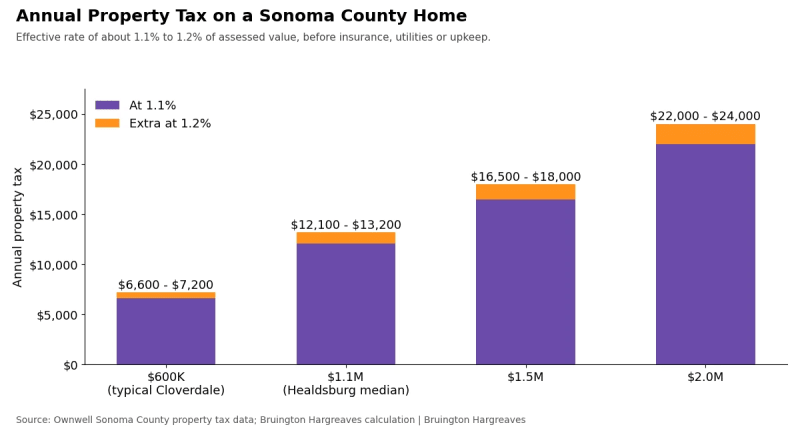
Property tax is the line people underestimate. Sonoma County's effective rate runs about 1.1% to 1.2% of assessed value:
| Home price | Annual property tax (1.1%-1.2%) | Per month |
|---|---|---|
| $600,000 (typical Cloverdale) | $6,600 - $7,200 | $550 - $600 |
| $1,100,000 (Healdsburg median) | $12,100 - $13,200 | $1,008 - $1,100 |
| $1,500,000 | $16,500 - $18,000 | $1,375 - $1,500 |
| $2,000,000 | $22,000 - $24,000 | $1,833 - $2,000 |
That is before insurance, utilities or upkeep, which is why cash buyers still find the monthly number higher than planned.
Four checks before you make an offer
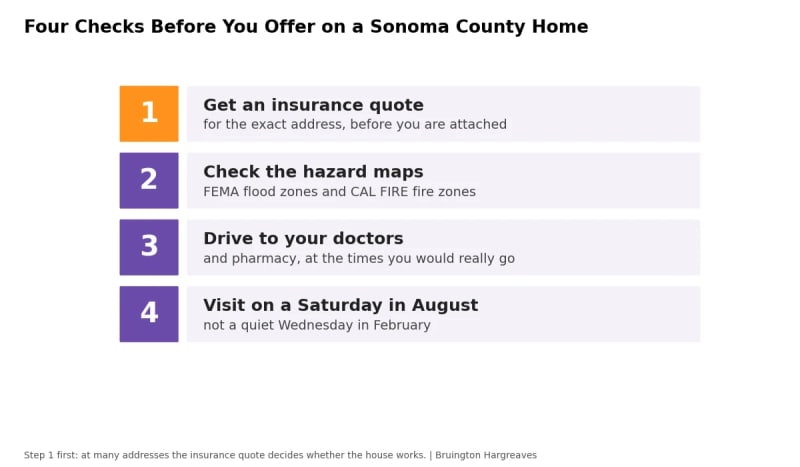
The insurance quote comes first because at many addresses here, it decides whether the house works at all. It takes one phone call to a broker, before you are emotionally committed. For the towns that do suit most retirees, see our guide to retiring in Sonoma County and what retiring to Healdsburg looks like.
Have a town or address on your shortlist? Email it to me at david@bruingtonhargreaves.com and I will tell you which hazard zone it falls in and what that tends to mean for coverage.
About the Author
David Hargreaves is the co-founder of BruingtonHargreaves, one of Sonoma County's top-ranked real estate teams and part of W Real Estate. Originally from the UK and an Oxford University graduate, David built and ran a digital marketing agency serving Google, Facebook, and other major brands before becoming one of Sonoma County's top agents within three years of entering real estate.
Today he and business partner Jonathan Bruington have sold more than $250 million in Sonoma County homes over the past three years, earning recognition as a RealTrends No. 2 team in the county and the No. 1 team in Healdsburg. David specialises in helping Bay Area buyers and sellers with luxury properties and vacation rentals across Healdsburg, Windsor, Santa Rosa, and the Russian River communities.
He lives in Sonoma County with his wife Nancy and is happiest cycling the back roads, exploring local wineries, or behind a camera. Have a question about buying, selling, or building in Wine Country? Book a free call.