
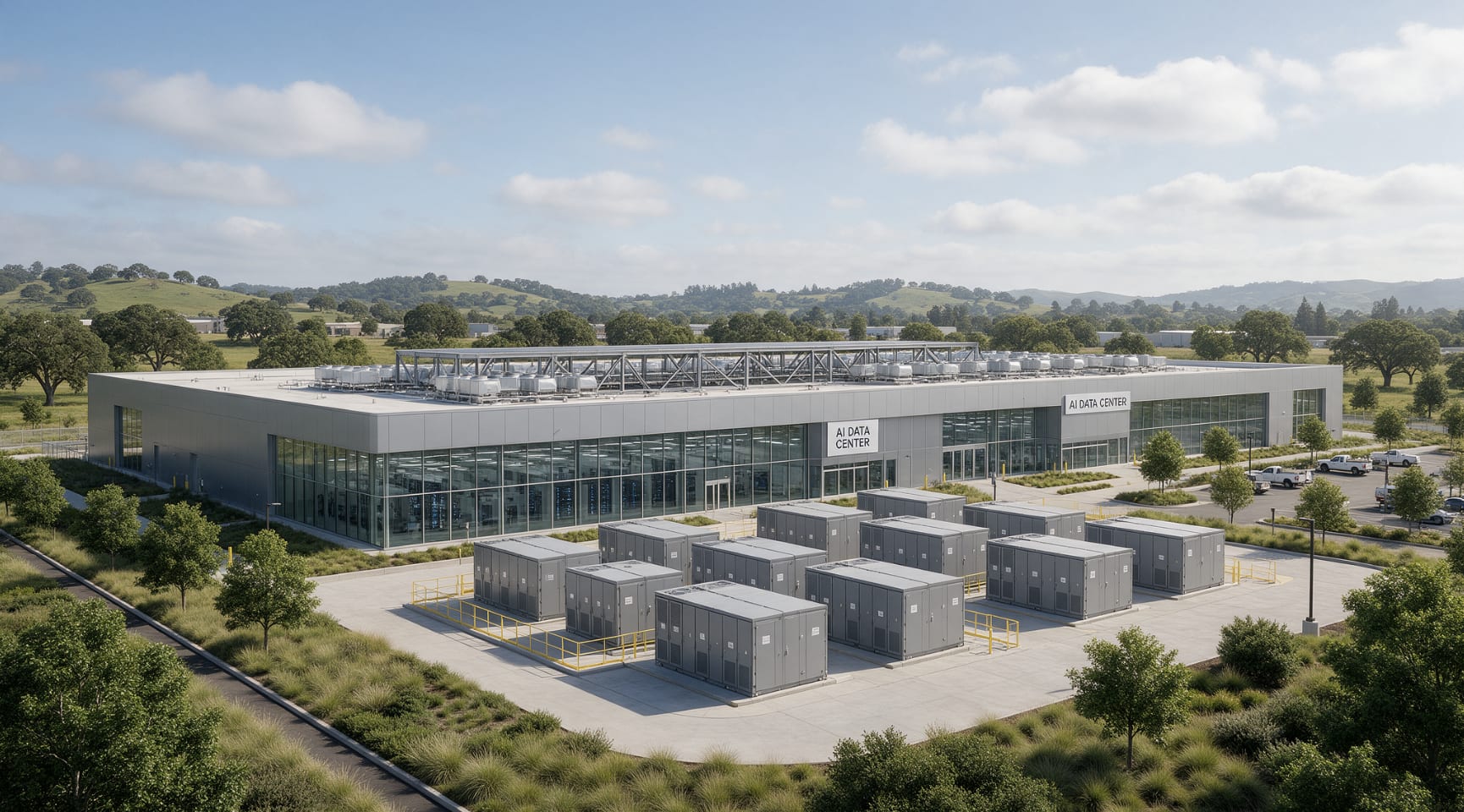
Sonoma County has no permanent data center ban. Data centers are not allowed in unincorporated Sonoma County today only because the zoning code never lists them as an allowed use, and a routine code amendment could change that without a public vote. For anyone who owns rural land or a home near it, that difference matters.
I have spent nearly a decade in this market, and I follow zoning decisions closely because they shape property values more than most people realize.
How the current protection works
Permit Sonoma's own FAQ says data centers are not allowed anywhere in unincorporated Sonoma County, and that is true today. The reason is technical. The county uses a permissive zoning code: if a use is not on the list, planners cannot approve it. The code was written decades before AI infrastructure existed, so no one ever added data centers.
That protects a lot of land. Most of the county is unincorporated: the rural and agricultural areas outside the nine cities, which is exactly the kind of large acreage a data center developer wants.
The catch is that the county has been rewriting its code since about 2021 through the General Plan Sonoma process, with Board of Supervisors workshops expected to run through 2026 and beyond. Every update to the zoning tables is a chance to add a new use.
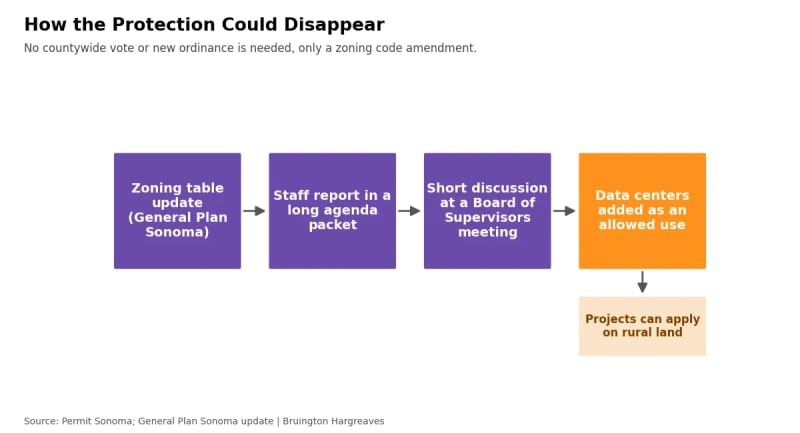
No countywide vote or new ordinance is needed. That is why "Sonoma banned data centers" is the wrong way to describe it.
What a real ban looks like: Monterey Park
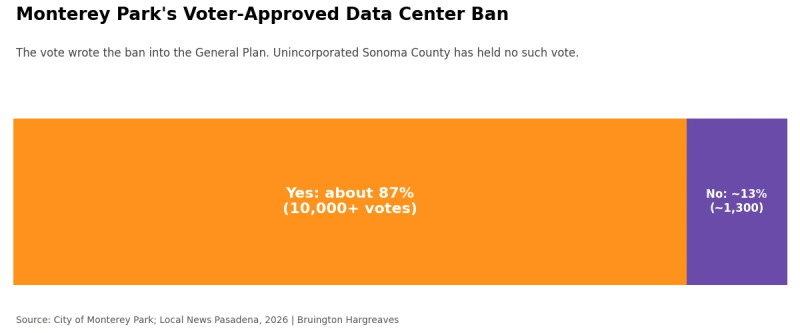
Monterey Park, in the San Gabriel Valley, took the opposite route. After months of meetings and a temporary pause, it put a permanent data center ban on the ballot. Voters approved it with almost 87%: more than 10,000 yes votes against about 1,300 no. The vote changed the city's General Plan, so allowing data centers again would take another public vote.
| Monterey Park | Unincorporated Sonoma County | |
|---|---|---|
| How data centers are kept out | Voter-approved ballot measure | Not listed in the zoning code |
| Vote result | About 87% yes (10,000+ yes, about 1,300 no) | No vote held |
| Written into | The city's General Plan | The current zoning tables only |
| What it takes to reverse | Another public vote | A code amendment by the Board of Supervisors |
| Status today | Settled | Code under active review |
Developer interest rarely starts with a press release. It starts with planning-level conversations and pre-application meetings, and by the time a formal proposal goes public, those talks may have run for months.
Data centers already in the North Bay
The region already has data centers; they are just much smaller than the AI campuses going up elsewhere.
| Facility | Location | Size and role |
|---|---|---|
| Sonoma Mountain Datacenter | Rohnert Park | 35,000+ sq ft, 9+ megawatts, room to grow past 200,000 sq ft |
| Innova Solutions | Santa Rosa | Hosting and colocation for local and regional businesses |
| Hyperscale AI campuses (for comparison) | Elsewhere in the US | Hundreds of acres, power use on the scale of a small city |
Both local sites sit inside incorporated cities, which set their own zoning, separate from the county code. Sonoma County is a hard place to build an AI campus:
| Existing industrial buildings | Typical sale price |
|---|---|
| Sonoma County | Low to mid $200s per sq ft |
| Central Valley, where many large projects go | About $80s to $90s per sq ft |
| Silicon Valley | Higher than Sonoma County |
Add power constraints and wildfire-driven insurance costs, and a massive AI campus gets much harder to justify here.
Regional data centers are a more realistic fit. Sonoma County sits close to Bay Area businesses, has fiber running roughly along Highway 101, and costs less than sites nearer San Francisco. Those smaller facilities, and whether they keep growing, are what I would watch.
Why residents push back
| Concern | Why it matters in Sonoma County |
|---|---|
| Water | Large data centers use huge amounts for cooling, in a county with repeated droughts and a groundwater agency already planning long-term supply in the Petaluma Valley basin |
| Power | A large site can use as much electricity as a small city; PG&E says its data center demand pipeline could reach about 10 gigawatts over the next decade, mostly around the Bay Area and Silicon Valley |
| Noise | Industrial cooling runs around the clock and carries far in quiet rural valleys |
| Tourism and landscape | Visitors spend about $2.4 billion a year here, drawn by vineyards, open land and small towns |
The pushback is national, too. A recent Gallup poll found about 7 in 10 Americans oppose a new AI data center in their own community, and one study found more than $130 billion of US data center projects delayed or blocked by local opposition. Even after a zoning change, a project here would still face environmental review, water permits and public hearings, and Sonoma County has a long record of organizing on land use, from vineyard development to Sonoma County rental rules.
What it could mean for property values
If the rules changed, the likeliest spots for a project would be near Penngrove or Petaluma. Here is where those markets stand today:
| Market | Recent home prices | Trend |
|---|---|---|
| Sonoma County (median) | Low to mid $800s | About flat year over year |
| Petaluma | High $800s to just under $900K | Softened slightly |
| Rohnert Park | High $600s to low $700s | Cooled more than the county |
A zoning change cuts two ways. For the owner of an eligible parcel, it is a "zoning play": land that can host a data center is worth more before anything gets built. For the neighbors, it can mean construction, trucks, noise and an industrial site that was not there when they bought.
The jobs math matters too:
| Vineyards and wine | A data center | |
|---|---|---|
| Jobs | 54,000+ across Sonoma County's wine industry | Large crew during construction |
| After construction | Ongoing | A much smaller operating staff |
| Land use | Agricultural, supports tourism | Industrial |
If you own rural acreage, our vineyard buying guide shows how agricultural land is valued here today.
Three ways the rules could change
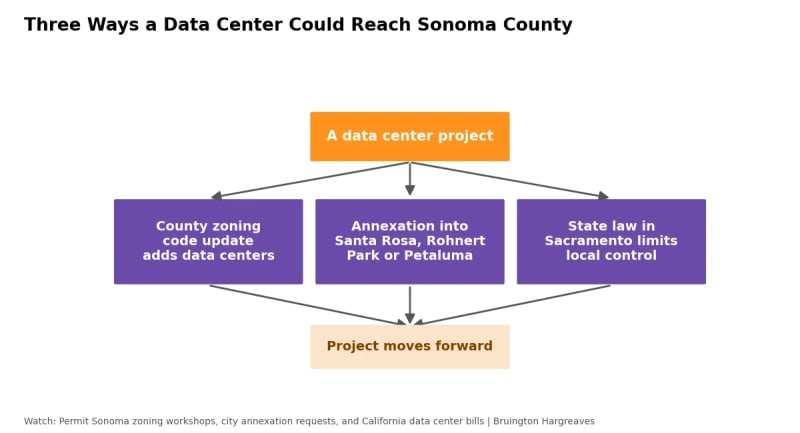
- The Permit Sonoma zoning code update: public workshops, drafts and General Plan meetings are scheduled over the coming year. This is where a change is most likely.
- Annexation: Santa Rosa, Rohnert Park and Petaluma set their own zoning, so a developer turned away by the county could try to bring land into a city instead.
- Sacramento: proposals already cover special utility rates for data centers and how they move through environmental review. A bigger state role could leave local governments with less say.
Board of Supervisors meetings, zoning workshops and General Plan updates are where residents can comment while changes are still on the table. Monterey Park got a permanent ban because residents engaged before the rules changed. Sonoma County is still writing its rules.
Zoning rules differ between the county and each city, so it pays to know which set covers your address; our ranking of the best cities in Sonoma County is a good place to compare them.
Own property in Sonoma County and want to know what your zoning allows, or how these updates could affect it? Email me directly at david@bruingtonhargreaves.com.
About the Author
David Hargreaves is the co-founder of BruingtonHargreaves, one of Sonoma County's top-ranked real estate teams and part of W Real Estate. Originally from the UK and an Oxford University graduate, David built and ran a digital marketing agency serving Google, Facebook, and other major brands before becoming one of Sonoma County's top agents within three years of entering real estate.
Today he and business partner Jonathan Bruington have sold more than $250 million in Sonoma County homes over the past three years, earning recognition as a RealTrends No. 2 team in the county and the No. 1 team in Healdsburg. David specialises in helping Bay Area buyers and sellers with luxury properties and vacation rentals across Healdsburg, Windsor, Santa Rosa, and the Russian River communities.
He lives in Sonoma County with his wife Nancy and is happiest cycling the back roads, exploring local wineries, or behind a camera. Have a question about buying, selling, or building in Wine Country? Book a free call.