Sonoma County Vacation Rental Rules 2026: Permits, Caps and Zoning
Yes, you can still operate a whole-house vacation rental in Sonoma County in 2026, but almost only in the unincorporated county and only on the right parcel. The home has to be a detached single-family house in an eligible zone (RR, AR, LEA, DA or RRD inland, or anywhere in the coastal zone). It also has to sit outside an exclusion zone and outside a full cap zone, and it needs a zoning permit, a TOT certificate and an annual license. Every city except Petaluma and Sebastopol is effectively closed to new whole-house rentals. A permit never transfers when a home sells, so every buyer starts from scratch under today's rules.
There is no moratorium in 2026. The last one ran from May 10, 2022 to May 9, 2023, and applications have been open since.
This guide covers every rule that decides whether a property qualifies, how the rules have changed since 2016, and what to check before you buy. We run every property that comes on the market through these checks, and we put the ones that qualify on a private website for our clients.
The Rules at a Glance
In the unincorporated county you need four things to operate legally, in this order: a certified property manager, a zoning permit, a TOT certificate and an annual license. They apply inland and on the coast alike.
What
What it does
Cost from July 1, 2026
How often
Certified property manager
An individual who has passed the county exam and answers complaints within 1 hour by day, 30 minutes at night
$153 certification
Once per manager
Transient Vacation Rental (TVR) zoning permit
Confirms the parcel is eligible and sets the bedroom count and occupancy
Vacation rental: renting a whole home for 30 days or less.
Hosted rental: renting one bedroom while the owner lives in the home. It's a separate, simpler permit and is allowed in many places where whole-house rentals aren't.
Exclusion zone: an area where no new vacation rental permits are issued at all.
Cap zone: an area where vacation rentals are limited to 5% of single-family homes. A 5% cap allows one vacation rental for every 20 homes, rounded down.
TOT: Transient Occupancy Tax, 12% of rent in the unincorporated county. Operators taking more than $350,000 a year in rent also pay a 2% tourism assessment.
Is This Property Eligible? The 10-Step Check
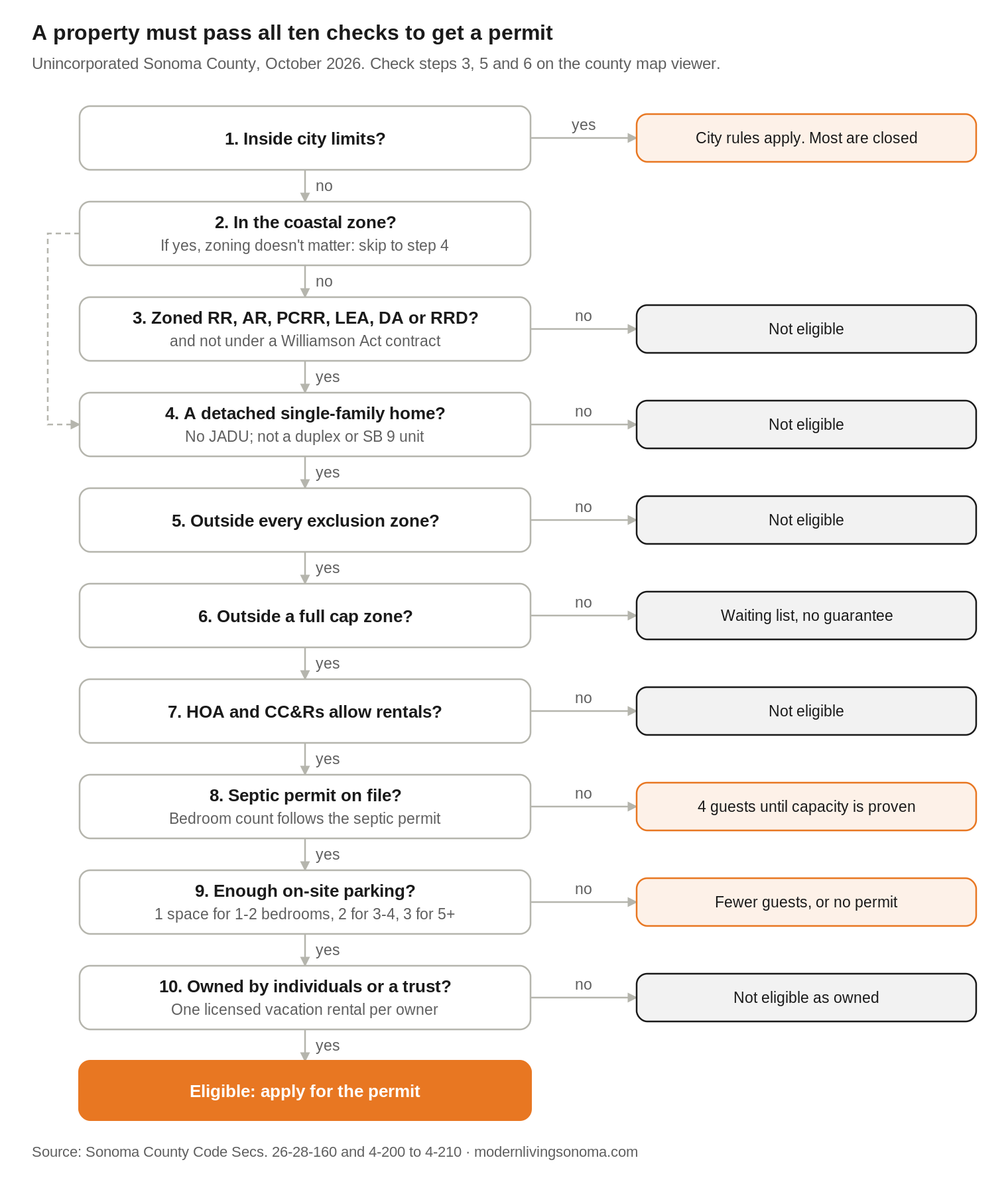
A property qualifies only if it passes every step below. Most failures happen at steps 1, 3 and 6. You can check steps 3, 5 and 6 yourself on the county's vacation rental map viewer: enter the address or APN to see the zoning, any cap or exclusion zone, and every active permit nearby. The general county zoning lookup shows the base zoning too.
The 10-step eligibility check for unincorporated Sonoma County, October 2026
Is it inside city limits? If so, the city's rules apply, not the county's, and most cities are closed to new whole-house rentals (see the city-by-city section below). A street can separate city from county, so check the boundary, not the mailing address.
Is it in the coastal zone? Coastal homes can be vacation rented whatever the underlying zoning, so skip step 3, but new operators now need a permit and license like everyone else. The permit has the same septic, parking and bedroom rules as inland. Coastal rentals that legally operated and paid TOT between October 26, 2018 and October 26, 2023 need only the license until the property sells.
Is the zoning eligible? In the unincorporated county:
Eligible: RR (Rural Residential), AR (Agricultural Residential), PCRR, LEA (Land Extensive Agriculture), DA (Diverse Agriculture) and RRD (Resources and Rural Development). Existing single-family homes in C2, LC and K zones also qualify.
Not eligible: R1 (since August 2, 2022), R2, R3, PC and LIA (Land Intensive Agriculture).
Not eligible: any land under a Williamson Act contract, whatever the zoning.
Is it a detached single-family home? Duplexes, triplexes, multi-family homes and SB 9 lot-split or duplex units don't qualify. Two homes on one lot can turn out to be zoned as a duplex, which rules the property out. A home with a permitted Junior ADU (JADU, under 500 sq ft inside the house) can't be licensed. A detached ADU doesn't disqualify the main house, but the ADU itself can never be part of the rental.
Is it in an exclusion zone? If yes, no new permit is possible. Existing permits there continue only until the home sells.
Is it in a cap zone, and is the cap full? Every cap zone is at or over its 5% limit, which puts new applicants on a waiting list with no guarantee of a permit.
Is there an HOA or CC&Rs? Most HOAs prohibit vacation rentals. Some areas have CC&Rs but no HOA to enforce them; we know of one in Bennett Valley where a couple of vacation rentals operate. Read the documents either way.
What does the septic permit allow? The permitted bedroom count follows the septic permit on file, not the listing. A home sold as four bedrooms with a three-bedroom septic permit gets a three-bedroom rental permit. If the county has no record of the system's size and capacity, occupancy is capped at four guests until you prove capacity.
Is there parking? You need 1 space for 1-2 bedrooms, 2 for 3-4 bedrooms and 3 for 5 or more. All must be on-site except one, which can be on-street. With no on-site parking, occupancy is capped at four, and with no parking within 500 feet there's no permit.
Can you own it the way you plan to? New licensees must be individuals; a trust can hold the property through its trustee, but an LLC or corporation can't. Each owner can have an interest in only one licensed vacation rental at a time.
If a property passes all ten, it can get a permit. The remaining risk is a rule change before you apply, so it pays to apply soon after closing.
City by City: Where the Cities Stand
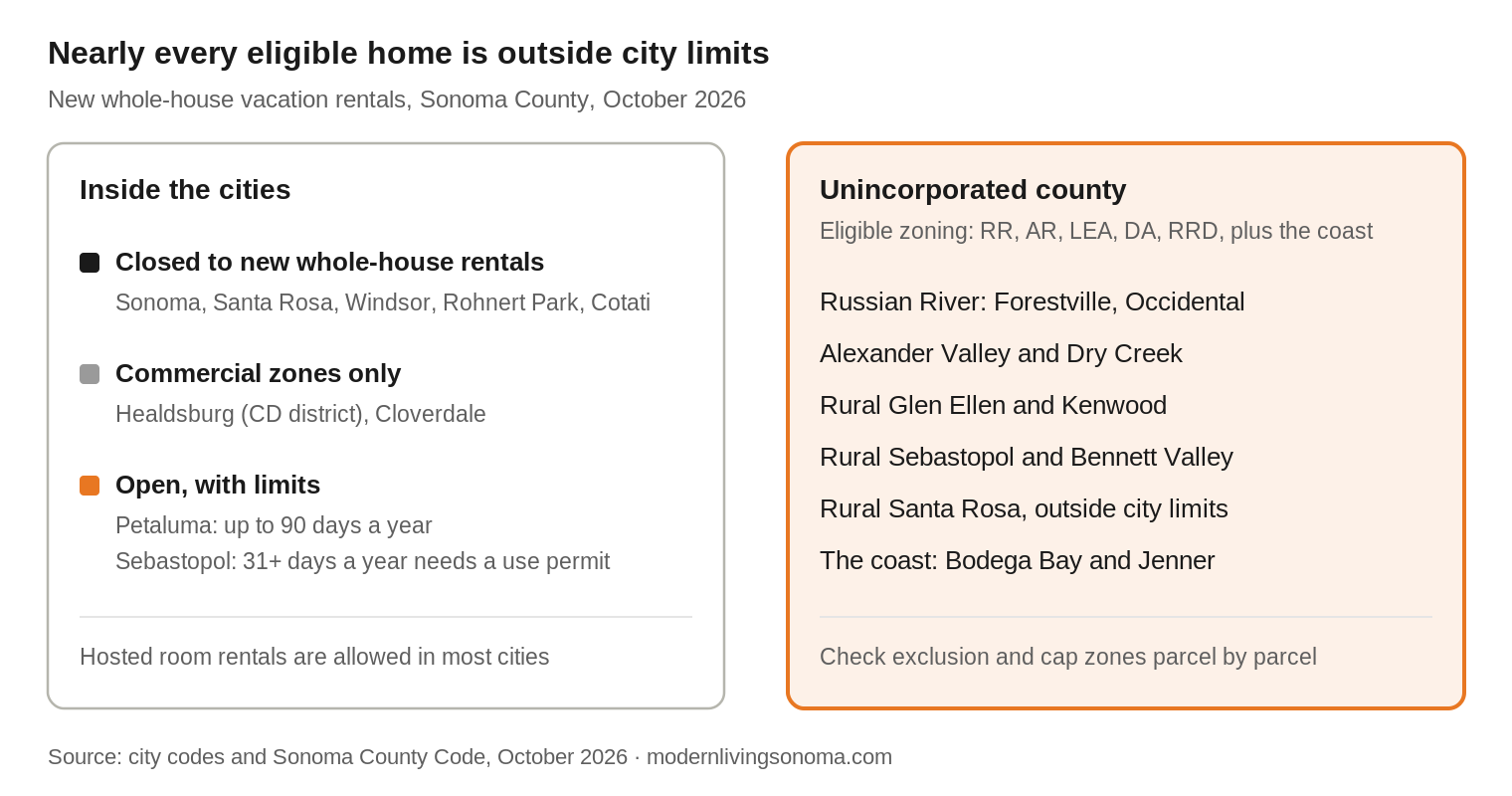
Nine cities run their own rules, and only Petaluma and Sebastopol still issue new whole-house permits on ordinary homes. That's why nearly all eligible homes sit in the unincorporated county: the Russian River corridor, Alexander Valley, Dry Creek, Glen Ellen, the coast and the rural pockets just outside the cities.
City and county vacation rental rules, October 2026
City
New whole-house (non-hosted) rentals
Hosted rentals
Source
Healdsburg
Only in the CD commercial district, with a conditional use permit. Not allowed in any residential or mixed-use zone.
Not a defined use in the city code; check with the city
City permits don't survive a sale either. Santa Rosa voids a permit on sale, and Windsor's license "does not run with the land."
The city closures pushed demand just outside city limits, which is why the county later capped areas such as Chiquita Road and Norton Road near Healdsburg and Palmer Avenue south of Sonoma. In Healdsburg the line between city and county is often a single street, so the best opportunities are usually just across it.
Cap Zones and Exclusion Zones, Area by Area
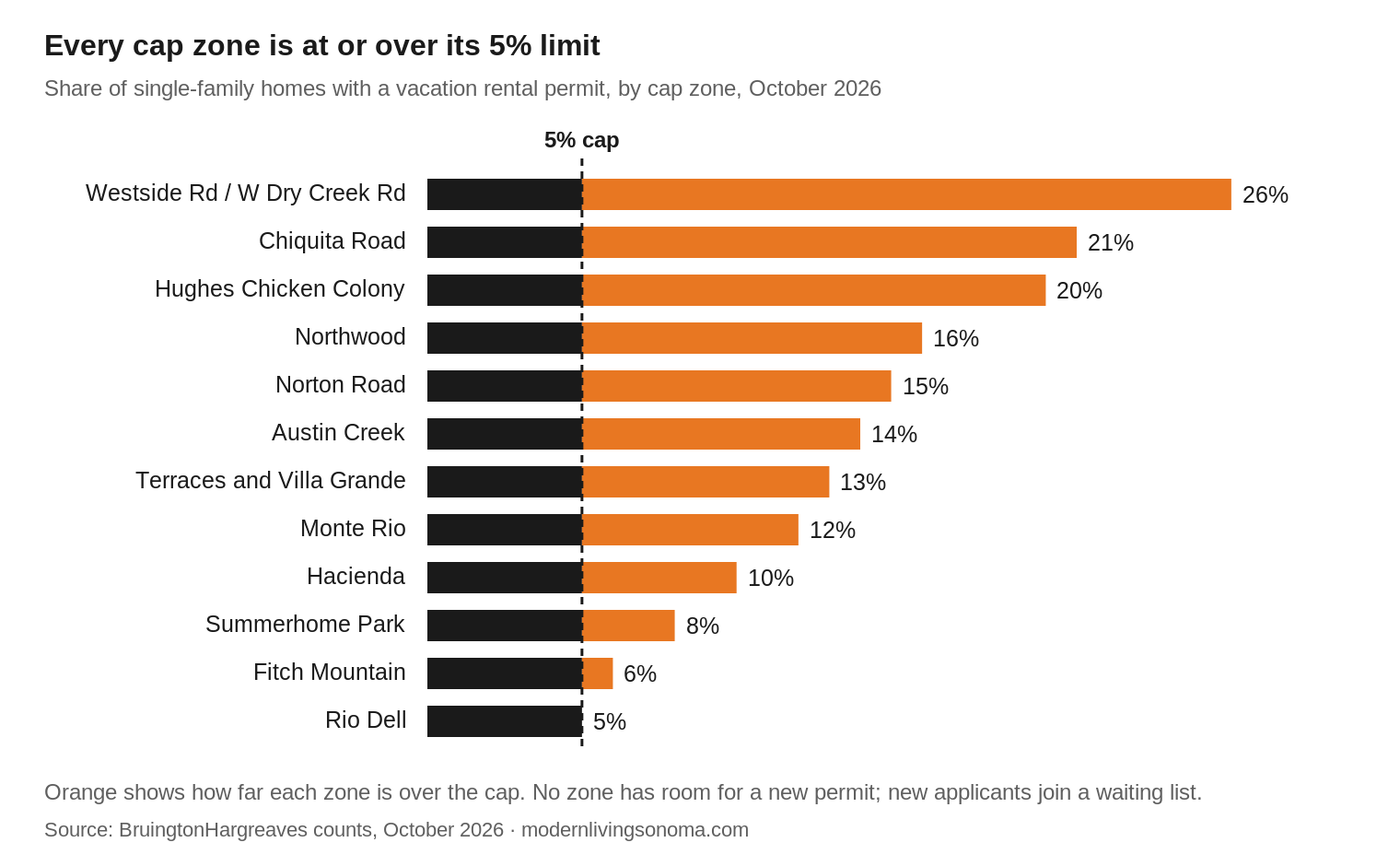
There are 12 cap zones and more than 25 exclusion areas, and all 12 are now at or over their 5% limit, so no cap zone has room for a new permit. Every cap zone has the same 5% cap, whatever its current density; the figures below show how far over the cap each zone is, not a different limit. We track every zone ourselves. Exclusion and cap rules aren't retroactive: a home that already had a permit keeps it until it sells. Concentrations move as homes sell, so check the county map viewer for any specific parcel.
The 12 Cap Zones (5% Limit)
BruingtonHargreaves counts, October 2026, all 12 county cap zones
Cap zone
Where
Status
Our count, October 2026
County figure, April 2024
Westside Road / West Dry Creek Road
20 parcels near Healdsburg, added July 16, 2024
Over cap, waiting list
26%
Not yet a cap zone
Chiquita Road
West of Highway 101, near Healdsburg
Over cap, waiting list
21%
17%
Hughes Chicken Colony
Southwest of Highway 12 and Ramal Road, Sonoma Valley
Over cap, waiting list
20%
17%
Northwood
Russian River, near Monte Rio
Over cap, waiting list
16%
15%
Norton Road
North of Dry Creek Road, near Healdsburg
Over cap, waiting list
15%
15%
Austin Creek
Between Highway 116 and Cazadero
Over cap, waiting list
14%
14%
Terraces and Villa Grande
Downriver from Monte Rio
Over cap, waiting list
13%
13%
Monte Rio
Russian River
Over cap, waiting list
12%
13%
Hacienda
Forestville
Over cap, waiting list
10%
8%
Summerhome Park
Forestville
Over cap, waiting list
8%
8%
Fitch Mountain
Between the Russian River and Healdsburg's eastern city limit
In a cap zone, new applicants join a waiting list with no guarantee of a permit. A zone at 15% has to lose two-thirds of its rentals before a new one is allowed, and that only happens as permitted homes sell and lose their permits. Buying in a cap zone in the hope a slot opens up is closer to gambling than investing. Buying next to one can work well, because the cap limits your competition.
The Exclusion Zones (No New Permits)
The original exclusion zone (the X combining district) was adopted in 2016. It covers:
Sonoma Valley: Boyes Hot Springs, Fetters Hot Springs, El Verano and Agua Caliente, plus the private communities of Diamond A, Foothill Ranch, Agua Caliente Knolls, Sobre Vista, Palomino Lakes and the Vineyards subdivision
The Nut Tree/Apple Tree neighborhood (Lovall Valley), Winter Creek Road and Slattery Road
Glen Ellen and Kenwood: certain neighborhoods close to the downtown areas and on the south side of Warm Springs Road and Highway 12, a combination of R1 and RR-zoned properties
Glen Ellen and Kenwood are not off limits. The exclusion zones cover the residential pockets in and around each village, but the rural parcels around them on agricultural and resource zoning can still qualify. Those parcels include some of the highest-earning vacation rentals in the county: Glen Ellen has the county's highest median vacation rental income, and 27 eligible homes sold in Glen Ellen and 18 in Kenwood in 2025. The trick is knowing exactly where each exclusion boundary runs, parcel by parcel.
Fitch Mountain was in the original exclusion zone; in 2023 it became a 5% cap zone instead.
Added April 24, 2023:
Around Sonoma: Falcon Lane-Theodor Lane, and Palmer Avenue/Harrington Drive south of the city, where concentration jumped after the city banned rentals
Glen Ellen and Kenwood: Gates Road and Waldruhe Heights (private roads that don't meet county fire-safe standards), central Glen Ellen, and Kenwood northwest of Greene Street
Russian River: Armstrong Woods Road, Drake Road (13.4% concentration at the time), Guernewood Park/Monte Rosa (14.2%) and Neeley Road (19.2%), all with limited evacuation routes prone to flooding or landslides
Added July 16, 2024: the Carriger Road area in Sonoma and the Trinity Oaks subdivision in Glen Ellen, 388 parcels in all (Ord. 6494).
Hosted rentals are still allowed inside exclusion zones. Neighborhoods can also petition the county to add themselves to the exclusion zone, so a quiet area today isn't guaranteed to stay open.
The Operating Rules Once You Have a Permit
Most of these rules don't affect whether you can buy, but they decide how much you can earn and how easily you can lose the license. They come from the license ordinance, Chapter 4, Article VIII of the county code.
Occupancy and bedrooms:
Up to 2 guests per bedroom plus 2 more per property, to a maximum of 12. Children under 3 don't count. A three-bedroom permit can be advertised as "3 bedrooms, sleeps 8."
Only permitted bedrooms count. Since 2022 you can't add a "sleeping area" in a guest house, secondary structure or unpermitted space to raise the count.
The septic permit and parking set hard ceilings (steps 8 and 9 above).
One tenant group at a time.
Noise, light and safety:
Quiet hours are 9pm to 7am, with daytime and nighttime decibel limits. Outdoor amplified sound and loud impulsive sounds such as drumming are banned at all times.
A lighting plan is required: fixtures shielded, no more than 1,000 lumens and 3,000K each. No floodlights, uplights or security lights that aren't on a motion sensor.
No fireworks and no outdoor burning of solid fuels.
Defensible space must be maintained under the county's vegetation rules. You need a Knox box or gate code for emergency access, a NOAA weather radio, and a landline or broadband VoIP phone.
Guests must get written evacuation instructions and the CalFire checklist, and must leave when a voluntary evacuation order is issued.
The property manager:
Must be an individual who has passed the county certification exam. A management company can't be the certified manager, but it can employ one.
Must contact guests within 1 hour of a complaint between 7am and 9pm, and within 30 minutes between 9pm and 7am, and report each complaint to the county within 24 hours.
There's no longer any rule that the manager live within 30 miles.
Posting, advertising and neighbors:
The license, operating standards and land use permit must be posted within 6 feet of the front door and included in the rental agreement.
Every listing must show the license number, maximum occupancy, maximum vehicles, quiet hours, the no-amplified-sound rule and the TOT certificate number.
Neighbors within 300 feet are mailed a notice each time the license is issued or renewed.
Tax:
TOT is 12% of rent. Operators with more than $350,000 in rent in the prior year also pay a 2% tourism assessment.
Airbnb and Vrbo collect TOT under agreements with the county, but you stay liable for anything they don't collect.
Ownership:
Licensees must be individuals; a trust can hold a rental through its trustee. LLCs and corporations can't hold new licenses.
Each owner can have an interest in only one licensed vacation rental at a time.
Both rules exempt rentals that were legally operating, or had an application accepted, before mid-June 2023.
Enforcement:
Running a rental without a permit or license carries a fine of 10 times the application fee; other violations run up to $1,500, $3,000 and $5,000. A wider 3x-10x range was introduced in April 2024.
If a license is revoked, no new license can be issued on that parcel for up to 5 years.
You can't renew while a code violation is open on the property.
Appeals against a suspension or revocation must be made in writing within 10 days.
Buying or Selling: The Permit Does Not Transfer
A vacation rental permit ends the day a home changes hands. The county code says a permit "automatically expires upon sale or transfer of the parcel," and the new owner has to apply from scratch under the rules in force that day (Sec. 26-28-160). Santa Rosa and Windsor work the same way. So "the sellers run it as an Airbnb" tells you nothing about whether you can.
This matters most for homes that were grandfathered in. A rental permitted before R1 was banned in 2022, or before its neighborhood became an exclusion or cap zone, keeps operating only until it sells. The buyer can't get a new permit, so the income goes with the seller. Coastal rentals operating before October 26, 2023 are the same: they're exempt from the permit only until the property transfers.
The one exception is a commercial bed and breakfast license. Unlike a vacation rental permit, it transfers with the property when it sells, which makes a licensed B&B one of the few ways to buy a short-term rental business that keeps operating.
What buyers should check before removing contingencies:
Run the 10-step check above on the exact parcel, not the neighborhood.
Confirm the septic permit is on file and how many bedrooms it covers. If there's no record, budget for the county's process to prove capacity: plan on a couple of thousand dollars and up to six months.
Count the permitted bedrooms and the on-site parking spaces against what you plan to advertise.
Look for a JADU, a duplex classification or an unpermitted bedroom.
Read the HOA rules or CC&Rs.
Check road access, evacuation routes and insurance cost. Recent exclusion zones went to areas with substandard private roads and limited escape routes, and the county has said it will keep looking at them.
Keep checking through escrow. In 2020, 15925 Morningside Drive in Guerneville went into escrow after three days on the market as a turnkey vacation rental; a week later a new cap meant it could no longer be permitted.
Don't rely on the listing description or the listing agent. One of our clients nearly bought a home in Santa Rosa city limits that the listing agent said would make an excellent vacation rental; it could never have been permitted.
For sellers, eligibility is a selling point worth documenting. Show buyers the zoning, the septic permit, the parking and, if you've been operating, your income and occupancy records. An eligible home draws both vacation rental investors and second-home buyers who want to offset costs, which widens the pool and supports the price. If your permit is grandfathered and a buyer can't get a new one, price for that rather than for the income.
How the Rules Changed, 2016 to 2026
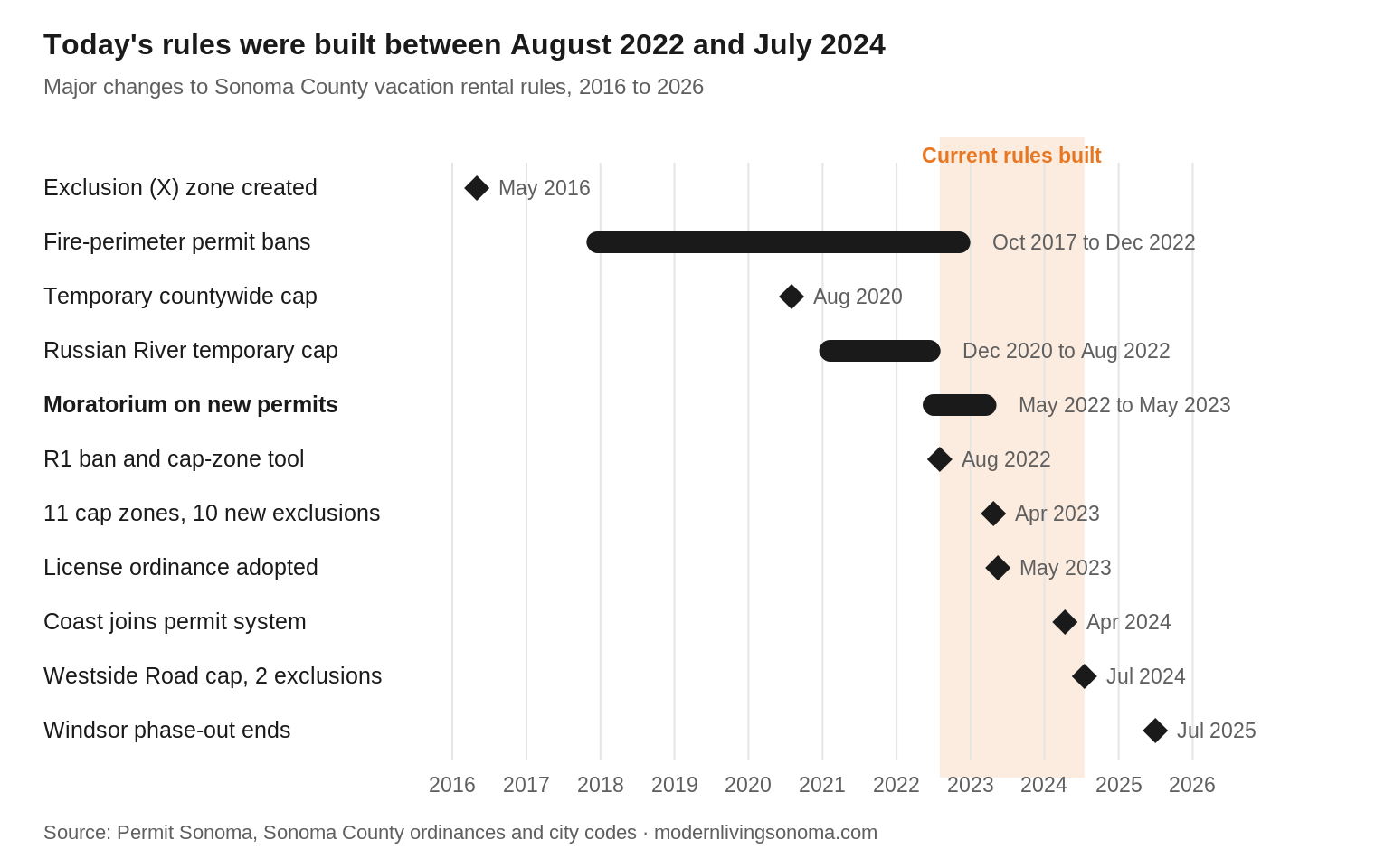
The current system was built between August 2022 and July 2024, and nothing major has changed since. If you read an older article (including some of ours) that mentions a moratorium, a 30-mile manager rule, 10% caps or R1 eligibility, this is where those rules went.
Major changes to Sonoma County vacation rental rules, 2016 to 2026
Date
What changed
July 1, 2026
New county fees: permit about $980, license about $712 a year
July 2025
Windsor's existing non-hosted rentals in residential zones had to close
April 11, 2025
Deadline for grandfathered coastal rentals to get a license
July 16, 2024
Westside Road/West Dry Creek Road near Healdsburg becomes a 5% cap zone; Carriger Road (Sonoma) and Trinity Oaks (Glen Ellen) become exclusion zones
June 15, 2024
Deadline for existing inland rentals to get a license
April 11, 2024
Coastal Commission certifies the county's coastal vacation rental rules, bringing the coast into the permit and license system
September 26, 2023
County adopts its coastal vacation rental ordinance
July 25, 2023
Santa Rosa caps non-hosted permits at 182 and stops taking new applications
June 2023
Windsor bans non-hosted rentals in residential zones, with a two-year phase-out
Mid-June 2023
License ordinance takes effect; new licensees must be individuals, one license per owner
May 16, 2023
County adopts the vacation rental license ordinance
May 9, 2023
Moratorium ends; applications reopen under the new rules
April 24, 2023
County adopts 11 cap zones at 5% and 10 new exclusion zones; Fitch Mountain switches from exclusion to cap
December 2022
The last fire-perimeter bans on new permits (2019 Kincade, 2020 LNU and Glass fires) expire
August 2, 2022
County bans new permits in R1, creates the cap-zone tool, moves quiet hours to 9pm, ends "sleeping areas" and sets the license framework. It also agrees to process applications it had frozen from mid-March to May 10
May 10, 2022
County stops accepting applications: a 45-day moratorium, extended in June to May 9, 2023. About 200 applications were pending, 90 of them in District 5
March 2022
County delays its decision. Its 2021 count was 2,459 vacation rentals, 1.8% of housing stock, and a county study found no link between vacation rentals and house prices
December 4, 2021
Santa Rosa requires permits and introduces its 1,000-foot rule
December 15, 2020
Temporary cap on the lower Russian River (over 1,000 parcels) and a small Sonoma Valley area, to August 6, 2022
August 2020
County imposes a temporary countywide cap of about 1,943 permits
January 2019
LIA parcels can host rentals; LIA whole-house rentals then operating could seek a use permit to continue
December 2017
City of Sonoma removes vacation rentals as a conditional use
October 24, 2017
Urgency ban on new permits inside the 2017 fire perimeters, later extended to the 2019 and 2020 fires
May 2016
County creates the vacation rental exclusion (X) zone across parts of Sonoma Valley, Glen Ellen, Kenwood and Fitch Mountain
Is there a vacation rental moratorium in Sonoma County?
No. The county's moratorium ran from May 10, 2022 to May 9, 2023. Applications have been open since, subject to the zoning, cap and exclusion rules.
Does a vacation rental permit transfer when I buy a house?
No. The permit expires automatically on sale, and you apply for a new one under the rules in force at the time. A home that operates today may not qualify for you. The one exception is a commercial bed and breakfast license, which does transfer with the property.
Can I Airbnb my house in Healdsburg, Santa Rosa, Sonoma or Windsor?
Not as a whole-house rental on an ordinary home. Healdsburg allows them only in its CD commercial district, Santa Rosa accepts no new non-hosted applications, and the City of Sonoma and Windsor's residential zones are closed. Santa Rosa and Windsor do allow hosted rentals, and just outside each city there are eligible county parcels.
Where can I still buy a vacation rental in Sonoma County?
Mostly in the unincorporated county on RR, AR, LEA, DA or RRD zoning: parts of the Russian River corridor such as Forestville and Occidental, Alexander Valley, Dry Creek, rural Glen Ellen and Kenwood outside the exclusion zones, rural Sebastopol, Bennett Valley and rural Santa Rosa, and the coast. See our guide to buying a vacation rental in Sonoma County.
How much does a permit cost, and how long does it take?
From July 1, 2026 the zoning permit is about $980 and the license about $712 a year, plus $153 to certify a property manager. In our experience the permit takes 30 to 45 days with a complete application, and the TOT certificate about a week; the license comes after both.
Can I rent out an ADU as a vacation rental?
No. An ADU or JADU can never be the vacation rental, and a home with a permitted JADU can't be licensed at all. A legal guest house can be part of the main home's rental. An ADU can be rented for more than 30 days, which isn't a vacation rental.
Do I need a permit for rentals of more than 30 days?
No vacation rental permit is needed, because a vacation rental is defined as a stay of 30 days or less. Normal landlord rules apply instead.
What's the difference between a vacation rental and a hosted rental?
A vacation rental is the whole home. A hosted rental is one bedroom rented while you live there. Hosted rentals need a simpler permit (about $226) and are allowed in R1 zones and exclusion zones where whole-house rentals aren't.
Can an LLC own a vacation rental?
Not a new one. New licensees must be individuals or a trust acting through its trustee, and each owner can hold an interest in only one licensed vacation rental. Rentals operating before mid-June 2023 are exempt.
How many guests can I have?
Two per permitted bedroom plus two, up to 12. Septic capacity and parking can lower that, and with no septic record or no on-site parking the limit is four.
Do coastal homes need a permit?
Yes, since the Coastal Commission certified the county's rules on April 11, 2024. Coastal zoning isn't restricted, but septic, parking and bedroom rules apply. Rentals operating legally between October 2018 and October 2023 need only a license until they sell.
What happens if I buy in a cap zone?
You join a waiting list. With every cap zone at or over 5%, a slot may not open for years, so treat a cap zone home as ineligible unless the county map shows room under the cap.
Do I need a property manager?
Yes. Every vacation rental needs a county-certified individual who can respond to complaints within an hour by day and 30 minutes at night. It can be you, if you pass the exam and can meet the response times.
Financing: the box you tick on the loan application (second home versus investment or DSCR) has to match how you'll use the property. Mortgage colleague CJ Kerls covers it in this deep dive.
A "vacation rental eligible" home in Sonoma County is one that legally qualifies for a short-term rental permit on the day you buy it. Permits do not transfer on residential properties. Here is exactly what eligibility means in 2026 and how to identify it.
None of Sonoma County's cities are currently open to new vacation rental permits on regular single-family homes. Healdsburg, Sonoma, and Windsor have bans; Santa Rosa is maxed out on distance rules. Eligibility lives in the unincorporated county, with two narrow city…
Yes, you can vacation rent in Healdsburg — but it has never been harder. Here is the breakdown of cap zones, city-limits zoning, and the eligible inventory still on the market in 2026
Sonoma County's vacation rental market is shifting in 2026 as new permit caps take effect and demand stays strong. Here's what investors need to know about where to buy, what the numbers look like, and which properties are coming to market this spring.
In 2025, just 714 Sonoma County properties — roughly 9% of all residential sales — qualified for vacation rental permits. This data-driven guide breaks down where those properties are, what they cost, and which four markets deliver the best returns. Using the MLS…
Do you spend time searching Zillow or Redfin trying to find vacation rental properties and then wonder if they would qualify?
You no longer need to.
We have done all the hard work to sort through every property that comes on the market and determine if it would qualify.
If you want to get access to this website then get in touch by completing this form.
We promise not to spam you but we will reach out to you via email to find out what it is you a looking for and also provide useful videos and blogs that will help with your search.
We provide access to the website for free as long as you are working with us find and then buy your vacation rental.
The Complete Guide to Sonoma County Vacation Rentals
Picture yourself sitting on a sun-drenched deck overlooking rolling vineyards, a glass of local wine in hand, knowing that not only are you enjoying your own piece of wine country paradise, but your investment is working for you even when you're not there. This isn't just a dream – it's a reality for savvy investors who have discovered the unique opportunity that Sonoma County vacation rentals present.
The allure of Sonoma County is undeniable. From the world-class wineries of Healdsburg to the towering redwoods along the Russian River, from the historic charm of Sonoma Plaza to the artistic enclave of Sebastopol, this region captures the hearts of visitors from around the world. It's this magnetic appeal that makes Sonoma County not just a beautiful place to own property, but a compelling investment opportunity.