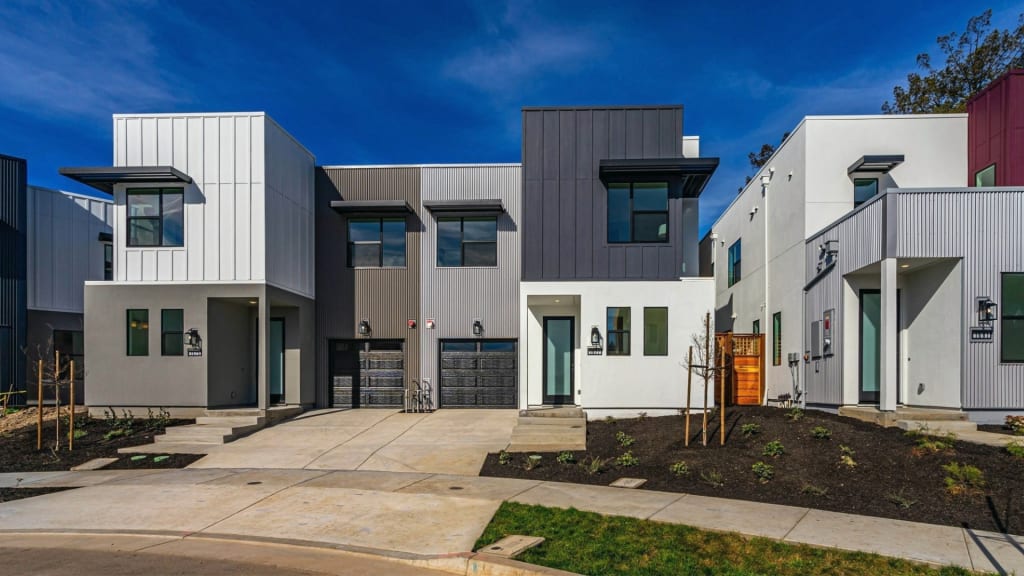
As wildfires burn across France, Spain, and parts of the US this summer, every Sonoma County homeowner is right to ask the same question: is my home ready? Two things decide whether a house survives a wildfire, and both are in your control. The first is home hardening, retrofitting the house with fire-resistant materials. The second is defensible space, the buffer you clear between the house and everything that can burn around it. CAL FIRE's Wildfire Action Plan lays out how to do both, and here is the short version for our fire-prone corner of Wine Country.
Why homes ignite
Homes catch fire in a wildfire in three ways: flying embers, direct flame, and radiant heat. Embers are the biggest threat. Wind can carry them up to a mile ahead of a fire, and they slip into vents, gutters, and gaps in the roof long before any flame reaches the property. That is why preparation is less about the wall of fire you see on the news and more about the small, unglamorous details around your house.
Harden your home
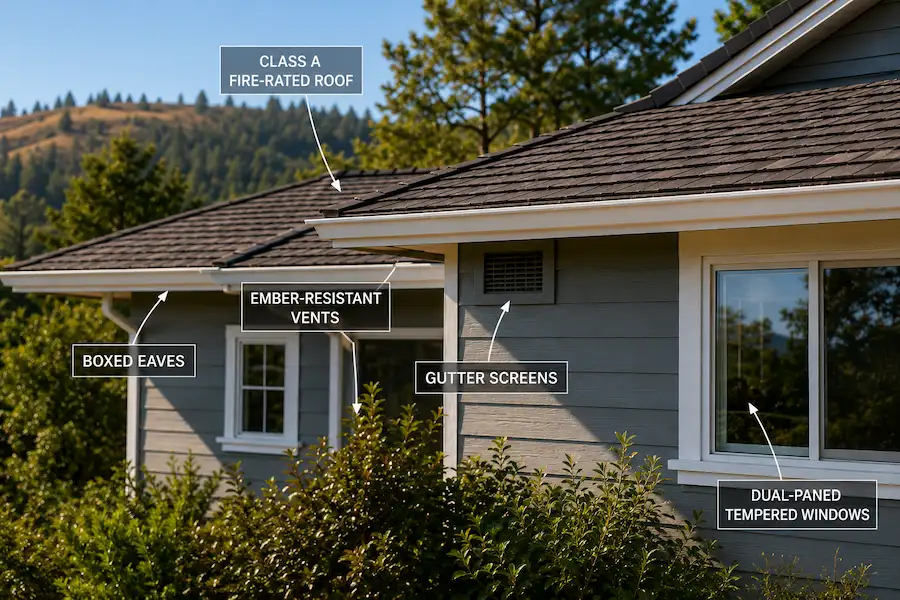
Hardening means replacing the parts of your home that catch embers with materials that do not. CAL FIRE recommends starting with:
- Roof: replace wood shake or shingle with a Class A fire-rated roof, and clear debris from valleys and gutters.
- Vents: cover openings with 1/16 to 1/8 inch metal mesh, or switch to ember-resistant vents.
- Eaves, gutters, and decks: box in open eaves, screen gutters, and keep anything combustible out from under the deck.
- Windows: dual-paned windows with at least one tempered pane resist heat far better than single-paned glass.
Most of these are weekend jobs or line items in a remodel, not major expense. They are also increasingly what home insurers want to see, a subject we cover in our guide to the California home insurance crisis.
Create defensible space in three zones
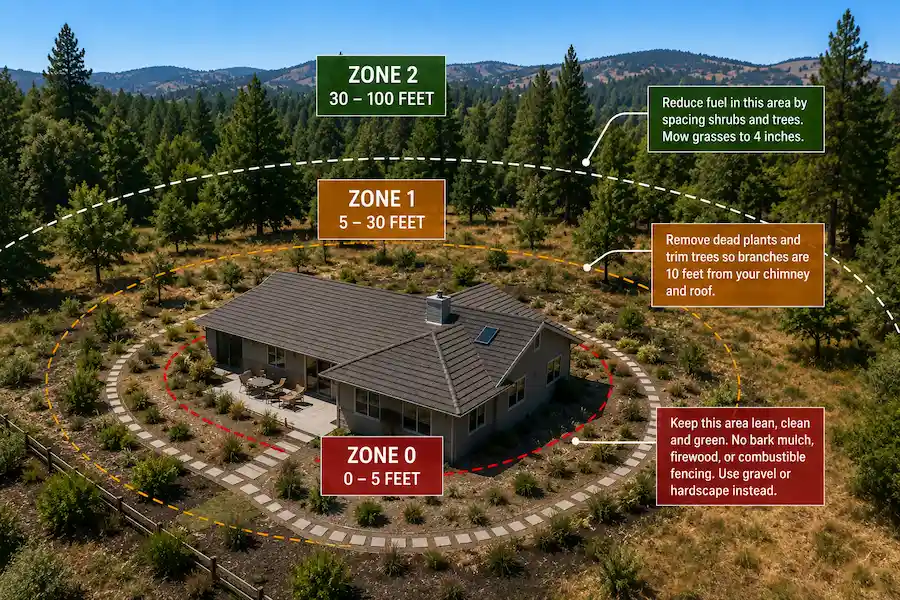
Defensible space is the 100-foot buffer California law (Public Resources Code 4291) requires around your home. CAL FIRE breaks it into three zones:
- Zone 0, the first 5 feet: the most important and the most overlooked. Keep it lean. No bark mulch, no firewood, no combustible fencing touching the house. Use gravel or hardscape instead.
- Zone 1, 5 to 30 feet: remove dead plants, keep branches 10 feet from the chimney, and trim trees so they do not touch.
- Zone 2, 30 to 100 feet: mow grasses to four inches, space out shrubs, and clear wood piles down to bare soil.
Assembly Bill 3074 added the Zone 0 requirement in 2020, and many Sonoma County fire districts enforce rules stricter than the state minimum, so check locally.
How to book a defensible space inspection
If you want your property assessed, Permit Sonoma's Fire Prevention Division and your local fire district run thousands of defensible space inspections across the county each year, mostly in late spring and summer. You can reach them at (707) 565-2361 or FirePrevention@sonomacounty.gov.
Selling a home in a Fire Hazard Severity Zone is a common reason to request one. California does not force a defensible space inspection at the point of sale, but a passing report is useful to have in hand, and you can request one through CAL FIRE's online Real Estate Defensible Space Inspection Request Form, not a downloadable app. In parts of northern Sonoma County the local district handles it instead: the Northern Sonoma County Fire Protection District takes requests at (707) 857-4373.
What this means if you are buying or selling
If you are selling a home built before 2010 in a high or very high Fire Hazard Severity Zone, state law (Civil Code 1102.6f) does not require you to pass an inspection to close. It requires you to disclose. You give the buyer a Fire Hardening and Defensible Space Disclosure and flag the known weak points: vents wider than 1/8 inch, a wood shake roof, combustible plants within 5 feet of the house, single-pane windows, missing roof flashing, and gutters without noncombustible covers. If a passing defensible space report exists, you attach it. If not, you say so.
Bringing the property into compliance is negotiable, and that is the part worth understanding before you list or write an offer. The standard disclosure form gives both sides two paths: the seller obtains a passing report before close, or the buyer agrees to obtain one within a year of close of escrow. Who does the work, and who pays for it, is a deal term like the roof or the septic, not a fixed rule.
For buyers, that puts defensible space on your due-diligence list. Read the disclosure closely, walk the first 5 feet around the house, and price in any clearing or hardening you will inherit. For sellers, a little work up front, a current inspection and a clean Zone 0, takes an easy lever away from the buyer and helps the home show as move-in ready. Some Sonoma County fire districts enforce stricter rules than the state minimum, so confirm what applies to your specific parcel. If you are getting a Healdsburg home ready to list, this is worth sorting out early.
A new app is coming for homeowners
Booking an inspection and waiting on a mailed report has always been the clunky part. That is about to change. A new app is on the way that will let homeowners request a defensible space inspection and view their results digitally, in one place, rather than chasing a form and waiting for paper. We will share the details here the moment it goes live, so anyone planning to buy, sell, or simply protect a home in Sonoma County can put it to use.
None of this guarantees a house survives a wildfire. But a hardened home with real defensible space gives itself, and the firefighters defending it, the best possible chance. If you are new to Wine Country and unsure where to start, our guide to moving to Sonoma County covers what to expect from life in a fire-adapted landscape.
Have questions about protecting, buying, or selling a home in a fire-prone part of Sonoma County? Email me directly at david@bruingtonhargreaves.com.
About the Author
David Hargreaves is the co-founder of BruingtonHargreaves, one of Sonoma County's top-ranked real estate teams and part of W Real Estate. Originally from the UK and an Oxford University graduate, David built and ran a digital marketing agency serving Google, Facebook, and other major brands before becoming one of Sonoma County's top agents within three years of entering real estate.
Today he and business partner Jonathan Bruington have sold more than $250 million in Sonoma County homes over the past three years, earning recognition as a RealTrends No. 2 team in the county and the No. 1 team in Healdsburg. David specialises in helping Bay Area buyers and sellers with luxury properties and vacation rentals across Healdsburg, Windsor, Santa Rosa, and the Russian River communities.
He lives in Sonoma County with his wife Nancy and is happiest cycling the back roads, exploring local wineries, or behind a camera. Have a question about buying, selling, or building in Wine Country? Book a free call.