
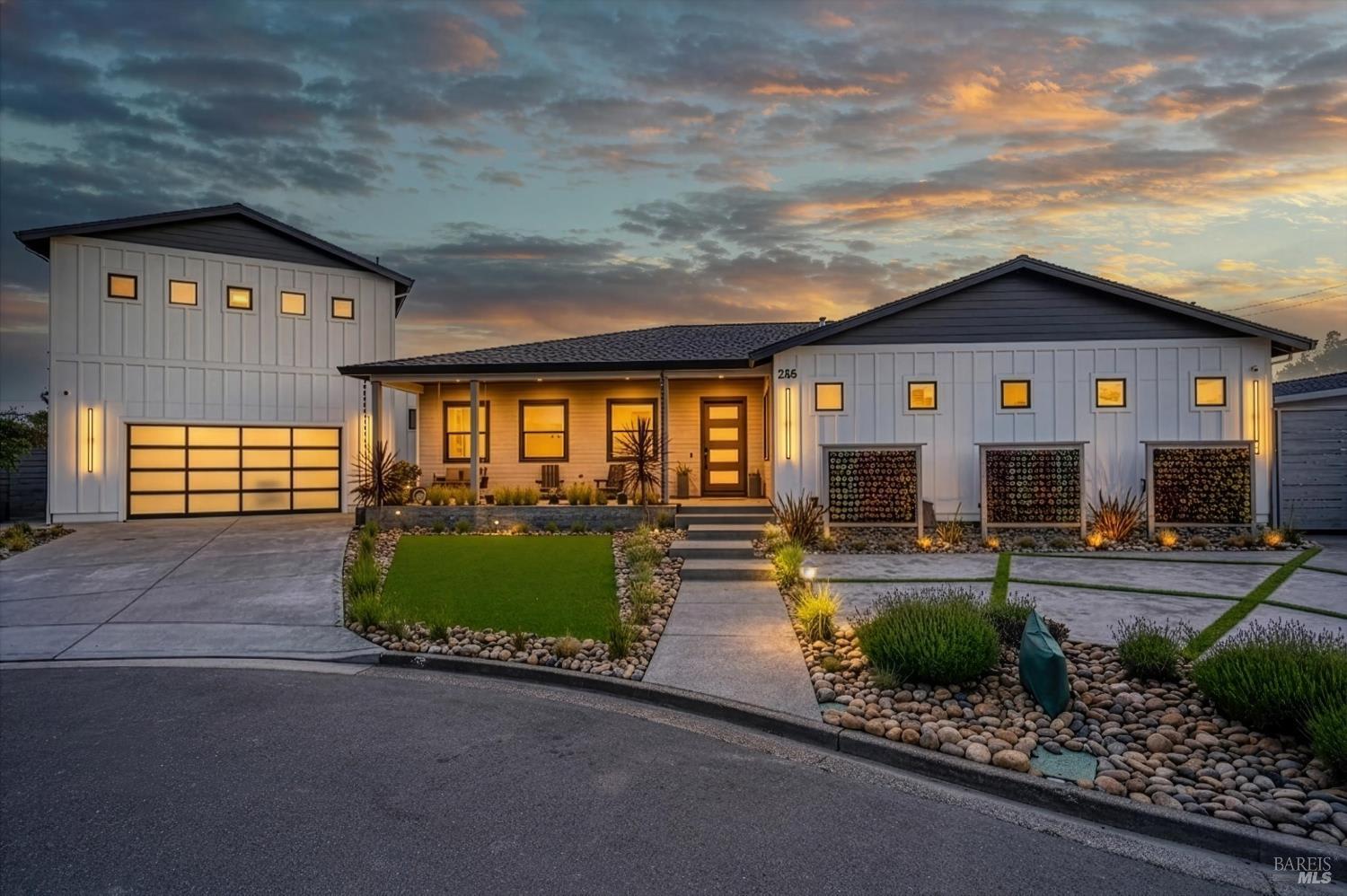
Wealthy owners are putting Sonoma County luxury homes on the market faster than buyers can absorb them. New listings over $3 million jumped 56% in the first half of 2026, yet only 143 homes above that price sold across the entire county in 15 months. The money hasn't left Wine Country, though. It's moving toward homes that are simpler and cheaper to own, led by walkable Healdsburg and the vineyard valleys just outside it.
The numbers behind the slowdown
I pulled every Sonoma County MLS sale over $3 million from June 2025 through August 2026. This is local Sonoma County data, not a national average, and it tells a clear story:
- New $3M+ listings rose from 112 in the second half of 2025 to 175 in the first half of 2026. April 2026 alone brought 49, the busiest month in the dataset and more than double the June 2025 pace.
- Sales stayed thin. Only 2 homes over $3 million sold in February 2026, and just 5 sold in each of January and August, against 76 to 141 active listings in those same months.
- Average days on market went from 49 in June 2025 to 241 in December 2025, about eight months to sell. It eased this spring, then climbed back to 108-111 days by July and August.
- At the low point in December 2025 and January 2026, sellers closed at 78% of their original list price. On a home first listed at $4 million, that's an $880,000 discount.
- Months of inventory peaked at 41 in February 2026, an extreme oversupply reading.
Yet the median sale price held at roughly $4 million the whole way through. Luxury values haven't collapsed. What changed is volume and speed: more wealthy owners want out than there are buyers willing to pay peak prices for what they're selling.
Why carrying costs are pushing owners out
Buy the same bottle of wine in Sebastopol and in Napa, and Napa usually comes out cheaper. Over the decades, Sonoma County voters have approved eight countywide special taxes that together add roughly two percentage points at the register, which puts the sales tax floor across the county at about 9.25%. Healdsburg, Sonoma, Santa Rosa, and Petaluma layer their own measures on top.
That money pays for things locals value: open space, the SMART train, libraries, regional parks, fire and emergency response, mental health services, and child care. But several of these taxes have no end date. Voters extended the SMART tax in June for another three decades, and the parks tax is up for an open-ended renewal on the November 3 ballot.
Property tax adds another layer. Once local bonds are added to the base rate, most of the county runs about 1.15% of the purchase price. Buy a $4 million estate and you'll pay around $46,000 a year. Thanks to Prop 13, a neighbor who bought decades ago may pay a fraction of that on a similar home; UC researchers found the gap between neighbors can reach 10 or even 20 times.
Insurance hits estate owners hardest. Most properties in the county carry some level of wildfire risk, and many standard carriers have pulled back from the highest-risk areas. That pushes owners onto the California FAIR Plan, the state's insurer of last resort, where rates are rising roughly 30% on average starting this October. I cover the options in more detail in our guide to the California home insurance crisis.
Nobody sells a Wine Country estate over one tax bill. But stack these costs on top of California income tax and the upkeep of a large property, and the research shows where it leads. The California Policy Lab at UC Berkeley found that people leaving the state increasingly come from affluent neighborhoods. When Sonoma County residents move, they're about 25% more likely than movers from other Bay Area counties to leave California entirely. Texas draws the most former Californians by raw numbers, Nevada leads relative to its population, and Arizona rounds out the top three.
Buyers want a gate, not a shared wall
Put two homes side by side at the same luxury price. One shares a wall and looks onto a common courtyard; the other sits behind its own gate on a few private acres. Right now, the gate gets the showings.
National market reports show single-family homes holding steady while townhomes and condos move noticeably slower. Locally, even private single-family estates in Sonoma Valley commonly take 60 to 120 days to sell. If you're selling an attached home at a luxury price, you're competing for an even smaller pool of buyers and should plan to wait longer.
Two luxury markets, not one
I track luxury in two tiers: $1 million to $3 million, and over $3 million. Over the same 15 months, they behaved like different markets entirely.
- Monthly absorption: 24.8% of active listings sold each month in the $1M-$3M tier, versus 7.1% above $3 million.
- Months of inventory: 4.1 months in the $1M-$3M tier (a balanced market) versus 16.6 months above $3 million.
- Days on market: 72 days on average for $1M-$3M versus 113 days for $3M+. In the most recent three months, the gap held at 63 days versus 97.
- Sale price vs original list: 94% for $1M-$3M (worst month 88%) versus 90% for $3M+ (worst month 78%).
- Sale price vs final list: 98% for $1M-$3M versus 94% for $3M+.
- New listings growth, second half of 2025 to first half of 2026: up 18% for $1M-$3M (752 to 890) versus up 56% for $3M+ (112 to 175).
- Closed sales: about 1,435 in the $1M-$3M tier (roughly 96 a month, from 400-480 active listings) versus 143 above $3 million (roughly 10 a month, from 130-180 active listings).
So even with far less competition, homes above $3 million sell at a fraction of the pace of the tier below. The top tier carries roughly four times the unsold supply relative to its sales rate. I've seen the same split across the whole market, which I broke down in three price points, three very different stories.
Where the wealthy are still buying
The ultra-wealthy haven't gone anywhere. In late August, The Summit, a ranch of more than 1,000 acres on Sonoma Mountain with private lakes, barns, and a 10-bedroom main house, sold for $38.5 million. That's a new Sonoma County record, beating a high of around $30 million set more than 15 years ago, and it sold just under asking.
But look at the other side of that deal. The seller, a tech entrepreneur, bought the land a little over a decade ago for about $12 million and reportedly put more than $30 million into it. The biggest sale in county history is also a wealthy owner exiting, and arguably not at a profit.
Below the trophy-ranch level, wealthy buyers are consolidating into walkable towns, and the clearest example is downtown Healdsburg. I've lived here for more than a decade. The tree-shaded plaza is lined with tasting rooms, galleries, and boutiques, and SingleThread, which holds three Michelin stars, is a short walk away. Just off the plaza sit the streets I call the Golden Streets, lined with restored Victorians and Craftsman bungalows on generous lots. Park the car on Friday and you may not touch it again until Monday.
Homes close to the plaza start in the low-to-mid $1 million range, with standout properties climbing well into the $2 millions. An in-town home on a smaller lot is generally easier to insure and cheaper to maintain, and as a second home you can lock it and leave without worrying about a well, septic, or defensible space. The SMART extension to Healdsburg is now under construction, with service targeted for late 2028.
Healdsburg still moves at its own pace, though. My data from this spring showed homes here averaging about 80 days on market, one of the slower, more luxury-heavy towns in the county. Well-priced homes sell; overpriced ones sit. For a street-by-street look, see my guide to where the wealthy live in Sonoma County.
How to sell a luxury home in a slower market
Buyers above $3 million are judging your price, your paperwork, and your patience as closely as the house. This is the playbook I'd follow.
Don't react to one scary number. Luxury stats swing hard because so few homes sell. One quarter in 2025 showed a double-digit year-over-year drop in the high-end median, mostly because of which homes happened to sell that quarter.
Price to hyper-local comps. A neighbor's sale from two years ago tells you little about today's buyer. You need fresh MLS data for your micro-area, acreage range, and property type. A couple of acres near the plaza and a large vineyard property 10 minutes out are two different markets, even in the same ZIP code.
Plan a runway. Budget for 60 to 120 days, and longer if the home is niche or needs work. A plan of staged price adjustments beats one big cut after months of sitting.
Go find your buyer. Bay Area buyers remain the core of demand for Wine Country estates. Above $3 million, local foot traffic won't cut it; your marketing has to reach Bay Area buyer circles and agent networks directly.
Do the homework early. Have septic and well records, water rights, defensible space work, and wildfire mitigation documents ready before you list. Get an insurance quote on your own home before buyers do, because many luxury buyers hear "FAIR Plan" for the first time once they're already in escrow.
Make it turnkey, or price it as if it isn't. Modern systems, guest space, outdoor kitchens, EV charging, and solar or backup power all help. Dated or complicated homes are the ones that linger.
How buyers can use the shift
Above $3 million, you're shopping in the slowest, most negotiable part of the Sonoma County market. Sellers there have averaged about 90% of their original asking price, and some dipped near 78% last winter. Below $3 million, homes still move and sellers hold firmer.
Start with data for your price band and your pocket of the county, not the countywide figures you see online, which blend starter homes with vineyard estates.
If you want privacy without the density of a townhome or tight subdivision, look hard at Dry Creek Valley. It runs northwest from Healdsburg toward Lake Sonoma, a narrow ribbon of vineyards known for old-vine Zinfandel, and from much of the valley you're 10 to 15 minutes from dinner on the plaza. The trade-off is rural, fire-country living: insurance, wells, septic, and vegetation management come with the territory. Prices vary hugely with acreage and planted vines, so email me and I'll send you examples at different price points.
Finally, cash is leverage. Freddie Mac's 30-year rate crossed 7% in late September for the first time since early 2025, a real headwind for jumbo-loan buyers. A seller whose listing has sat through an entire season cares about certainty, and a clean offer with no financing contingency can beat a slightly higher number with strings attached. Turnkey estates in great locations still draw competition, so use the data to separate homes that sat for good reason from those still waiting for the right buyer.
Thinking about listing a $3 million-plus home, or making an offer while luxury sellers are still negotiating? Email me directly at david@bruingtonhargreaves.com and I'll put together a pricing snapshot for your pocket of the county.
About the Author
David Hargreaves is the co-founder of BruingtonHargreaves, one of Sonoma County's top-ranked real estate teams and part of W Real Estate. Originally from the UK and an Oxford University graduate, David built and ran a digital marketing agency serving Google, Facebook, and other major brands before becoming one of Sonoma County's top agents within three years of entering real estate.
Today he and business partner Jonathan Bruington have sold more than $250 million in Sonoma County homes over the past three years, earning recognition as a RealTrends No. 2 team in the county and the No. 1 team in Healdsburg. David specialises in helping Bay Area buyers and sellers with luxury properties and vacation rentals across Healdsburg, Windsor, Santa Rosa, and the Russian River communities.
He lives in Sonoma County with his wife Nancy and is happiest cycling the back roads, exploring local wineries, or behind a camera. Have a question about buying, selling, or building in Wine Country? Book a free call.